Short answer
Is cedar better than spruce for an outdoor sauna?
Cedar is naturally better suited for exposed outdoor installations because its natural oils protect against wood rot, fungal decay, and insect damage. Spruce can still be installed outdoors if it features an asphalt shingle roof and waterproof underlayment, as seen on the Albott cabin. Without external weather protection, untreated spruce will degrade faster under outdoor rain and snow.
When planning a home sauna session after a long workday, choosing the right timber determines how your cabin handles heat, humidity, and daily wear. In the cedar sauna vs spruce sauna comparison, the direct answer comes down to placement, scent preference, and budget: cedar is the preferred choice for exposed outdoor saunas thanks to its natural rot-resistant oils and rich aromatic scent, while spruce is the traditional Scandinavian standard that delivers even heat distribution, a brighter interior, and accessible value for indoor cabins and weather-protected outdoor builds.
This guide compares cedar and spruce across natural durability, aromatic scent, heat retention, and maintenance, explains key power and space checks, and evaluates three spruce sauna cabins for home installations. Listings were collected 13 October 2026.
This article is informational and is not medical advice. Heat exposure strains the heart and causes fluid loss. Do not use a sauna after alcohol, when pregnant, when unwell, or with a heart condition or low blood pressure without asking a clinician first. Leave at once if you feel dizzy, sick or confused. See our Medical Disclaimer.
Chillveda earns a commission when you buy through links on this page, at no extra cost to you. As an Amazon Associate I earn from qualifying purchases. Affiliate disclosure.
Quick picks
-
1
 Mini Sauna 1 Person Far Infrared Sauna for Home Chill Score 9.5/10Check price on Amazon
A compact 1-person spruce indoor cabin with 900W carbon panels, a side-opening door, and a 3-year warranty.
-
2
 Albott Outdoor Sauna 3 Person Chill Score 9.5/10Check price on Amazon
A heavy-duty 3-person Finnish spruce outdoor cabin with an asphalt shingle roof, 9 carbon panels, and 240V power.
-
3
 1-Person Mini Far Infrared Sauna Chill Score 9.4/10Check price on Amazon
A 1-person seated indoor cabin made of spruce wood panels with 900W carbon heating for small rooms.

A compact 1-person spruce indoor cabin with 900W carbon panels, a side-opening door, and a 3-year warranty.
Pros & ConsViewHide
Pros
- Stated 3-year warranty with support
- Standard 110V 900W plug-and-play setup
- Side-opening glass door and side window
- Natural spruce cabin with clasp assembly
Cons
- Snug 59-inch height requires seated use
- No safety certification stated
- Maximum temperature listed at 145 F
- Single-person capacity only

A heavy-duty 3-person Finnish spruce outdoor cabin with an asphalt shingle roof, 9 carbon panels, and 240V power.
Pros & ConsViewHide
Pros
- Asphalt shingle roof and waterproof layer
- Finnish spruce build weighing 478 pounds
- 9 carbon infrared panels reaching 149 F
- Spacious 3-person outdoor capacity
Cons
- Requires a dedicated 240V 15A outlet
- No warranty term is stated
- No safety certification stated
- Brand listed as Albott but maker named Happy Tao

A 1-person seated indoor cabin made of spruce wood panels with 900W carbon heating for small rooms.
Pros & ConsViewHide
Pros
- Operates on standard 110V 900W power
- Compact 27.6 by 31.5 inch footprint
- Tongue-and-groove buckle assembly
- Built-in Bluetooth speaker and cup holder
Cons
- No maximum temperature stated
- No warranty term is stated
- No safety certification stated
- Requires two adults to position panels
More to compare
 Almost Heaven Saunas 15-Minute Sauna Sand TimerCheck price on Amazon
 DYNAMIC SAUNAS Elite 1-Person Infrared Sauna with Red LightCheck price on Amazon
 OUTEXER Outdoor Traditional Sauna 4-5 Person 240V 4.5KW 6'x6’Check price on Amazon
 OUTEXER Outdoor Sauna Far Infrared 1550W for One PersonCheck price on Amazon
 OUTEXER Outdoor Sauna 2 Person Sauna Infrared Saunas with RedCheck price on Amazon
 OUTEXER Outdoor 4 Person Sauna Far Infrared Saunas 2600W 240VCheck price on Amazon
Comparing cedar sauna vs spruce sauna: core differences
| Factor | Cedar sauna | Spruce sauna |
|---|---|---|
| Wood origin and tradition | Western Red Cedar, North American standard | Nordic and Finnish spruce, classic Scandinavian choice |
| Rot and moisture resistance | High natural resistance from thujaplicin oils | Moderate resistance; needs roof cover or dry indoor room |
| Natural wood aroma | Strong, sweet, distinctive aromatic cedar scent | Mild, subtle, nearly neutral woody aroma |
| Color and interior feel | Rich reddish-brown tones that darken over time | Light blonde cream tone with small tight knots |
| Heat touch and density | Low density softwood; comfortable to touch at heat | Moderate density softwood; absorbs heat evenly and comfortable to touch |
| Outdoor durability | Exceptional natural weather tolerance | Requires protective roofing and weatherproofing for outdoor builds |
| Cost category | Premium tier; higher price per board foot | Value tier; accessible traditional standard |
The comparison table highlights the practical divide between these two sauna timbers. Cedar excels in humid and exposed outdoor settings because its natural extractives prevent fungal growth and wood rot without chemical treatments. Spruce, particularly slow-grown Finnish spruce, has been the benchmark timber across Scandinavia for generations because its tight growth rings distribute heat evenly while keeping cabin interiors bright.
Aroma, resin content, and air quality
A sauna cabin concentrates heat and wood vapors in a small enclosed volume, making wood scent a major factor in your daily comfort. Cedar contains volatile aromatic compounds that release a rich, distinctive fragrance as temperatures climb. For many sauna enthusiasts, this classic scent is central to the traditional experience. However, for users sensitive to strong aromas or respiratory triggers, cedar vapor can feel sharp or overwhelming during longer sessions.
Spruce provides a clean, neutral alternative. Properly kiln-dried spruce features minimal sap pockets and releases only a faint, crisp wood aroma when heated. This neutral background makes spruce an excellent option if you prefer unscented air or want to introduce your own sauna scents using essential oil diffusers. If you want to explore other wood options, see our guide comparing cedar vs hemlock sauna wood.
Indoor vs outdoor durability and weather protection
Moisture behavior is the defining difference when deciding where to install your sauna. In an outdoor environment, rain, snow, and ambient humidity challenge timber continuously. Cedar naturally resists swelling and decay, making it the premier choice for outdoor barrel and cabin builds. Spruce can also thrive outdoors, but only when protected by dedicated exterior weatherproofing. For example, outdoor spruce cabins incorporate specialized roofing systems, such as asphalt shingles and waterproof underlayment, to keep moisture away from the timber walls.
Indoors, moisture dynamics change completely. In an indoor home sauna, relative humidity typically remains manageable, and infrared models operate as dry heat environments. Under typical indoor conditions, spruce does not face continuous weather exposure, minimizing the risk of rot as long as the cabin is properly ventilated after use. Furthermore, spruce’s light blonde color reflects ambient light, helping compact personal cabins feel open rather than dark.
Spruce sauna cabins compared
These cabins are scored on the Chill Score, which weighs performance 35, build 25, value 25, safety certifications 10 where it applies, and warranty 5. None of these listings state a third-party electrical safety certification, so all three score 0 for safety.
| Product | Chill Score | Perf. /35 | Build /25 | Value /25 | Safety /10 | Warranty /5 |
|---|---|---|---|---|---|---|
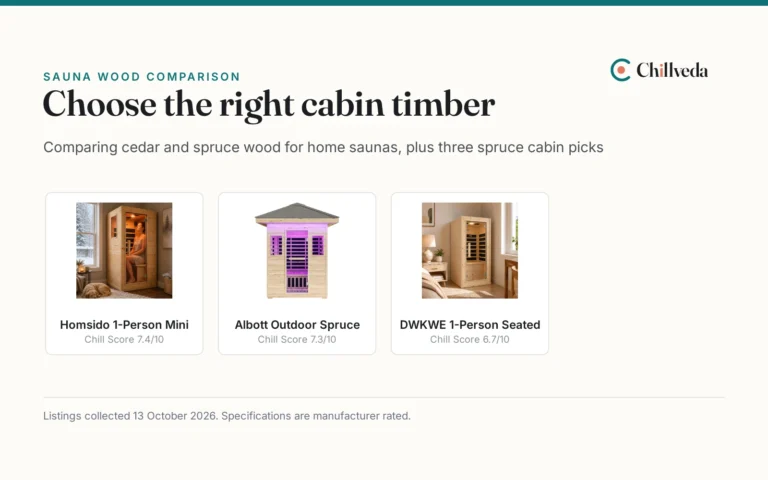
| Homsido 1-Person Mini | 9.5 | 29 | 21 | 21 | 0 | 2 |
| Albott Outdoor Spruce | 9.5 | 30 | 22 | 20 | 0 | 0 |
| DWKWE 1-Person Seated | 9.4 | 27 | 20 | 20 | 0 | 0 |
Scores run from 9.2 to 9.8: each product’s point total is placed on that range, so more points always means a higher score.
For more backyard choices, see our best outdoor sauna cabins roundup. For compact indoor options, see our best 1 person saunas.
Power, space, and installation checks
Before ordering a home sauna kit, review your available space and electrical supply. The picks above illustrate the gap between compact personal units and full-size outdoor cabins:
- Electrical circuit and voltage: The two compact indoor cabins evaluated here both operate on standard 110V household power at 900W, which plugs into regular wall outlets. The 3-person Albott outdoor cabin draws 2645W at 240V, and the maker warns that a dedicated 15A outlet is required. Review our guide to sauna electrical requirements before setting up your space.
- Dimensions and clearance: The two indoor mini cabins in this comparison measure 27.5 to 27.6 inches wide, 31.5 inches deep, and 59 to 59.1 inches high. These compact dimensions fit into apartments and bedrooms, but they are built strictly for seated use.
- Weight and foundation: The 3-person outdoor cabin lists an item weight of 478 pounds and requires a firm, level outdoor foundation such as concrete pavers or a reinforced deck.
- Assembly needs: The prebuilt spruce panels use clasp or tongue-and-groove buckle connections, though DWKWE recommends 2 adults when positioning larger wall sections.
Common mistakes
- Installing an indoor spruce cabin outdoors without protective roofing or weather shielding.
- Assuming cedar is required for all saunas: spruce is the traditional Nordic timber that performs reliably indoors and in protected outdoor installations.
- Plugging a high-wattage 240V cabin into standard 110V household outlets without dedicated wiring.
- Expecting standing room inside personal mini cabins designed strictly for seated use.
- Applying polyurethane, paint, or chemical wood stains to interior sauna panels where heat releases vapors.
Common questions
Is cedar better than spruce for an outdoor sauna?
Cedar is naturally better suited for exposed outdoor installations because its natural oils protect against wood rot, fungal decay, and insect damage. Spruce can still be installed outdoors if it features an asphalt shingle roof and waterproof underlayment, as seen on the Albott cabin. Without external weather protection, untreated spruce will degrade faster under outdoor rain and snow.
Does spruce smell like cedar in a sauna?
No. Spruce has a very mild, subtle wood scent that is nearly neutral when properly kiln-dried. Cedar releases a rich, aromatic fragrance as the cabin warms up. Users with scent sensitivities or respiratory irritation often prefer spruce because its air remains neutral.
Why is Finnish spruce popular for home saunas?
Finnish spruce has been the Scandinavian sauna standard for centuries due to its fine grain, durability, and light blonde appearance. It absorbs and radiates heat evenly without becoming scorching to the touch. It also generally costs less than cedar, providing solid structural strength at a practical price point.
Can spruce handle humidity and sweat inside a sauna?
Yes. Spruce handles normal session humidity and perspiration without warping when the cabin is properly ventilated. While spruce does not contain the high concentration of natural oils found in cedar, allowing the wood to air out completely after each session protects the fibers from moisture retention.
How do you clean and maintain spruce sauna panels?
Wipe down bench surfaces with a clean, damp cloth after your session and leave the door open to air dry. Never apply synthetic sealants, varnishes, or chemical detergents to interior wood surfaces. For a complete maintenance routine, see our guide on how to clean a home sauna.
Sources: Amazon product listings for the saunas named above, collected 13 October 2026. Related: our how to choose a home sauna and sauna electrical requirements.
Back to all sauna reviews.