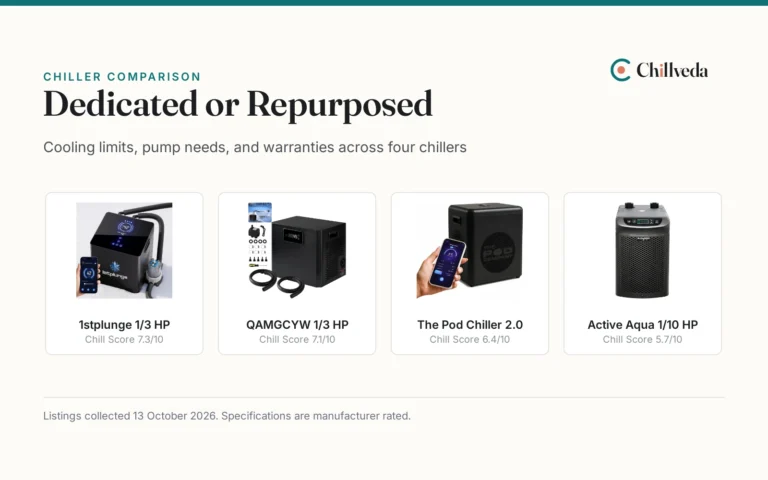
Stepping out to your garage, basement, or patio for an early morning recovery session means having water waiting at the exact temperature you set. When weighing a cold plunge chiller vs aquarium chiller, the direct answer comes down to cooling capacity, water volume, and filtration: dedicated cold plunge chillers in these listings are built to handle 76 to 79 gallons down to 37 to 42 F using dedicated filtration systems (either built-in or external), whereas a compact aquarium chiller (like a 1/10 HP unit) is rated for 10 to 40 gallons and is designed for aquatic tanks rather than large human plunge tubs.
This guide examines stated cooling limits, electrical draw, pump and filter requirements, and four chillers found on Amazon to help you choose the right cooling setup for your tub. Listings were collected 13 October 2026.
This article is informational and is not medical advice. Cold water immersion triggers cold shock and afterdrop, and strains the cardiovascular system. Never plunge alone, do not stay in past numbness, and consult a physician before cold water immersion if you have cardiovascular conditions or high blood pressure. See our Medical Disclaimer.
Chillveda earns a commission when you buy through links on this page, at no extra cost to you. As an Amazon Associate I earn from qualifying purchases. Affiliate disclosure.
Quick picks
-
1
 Ice Bath Chiller, 1/3HP WiFi Chiller for Cold Chill Score 9.5/10Check price on Amazon
A dedicated 1/3 HP cold plunge chiller cooling down to 42 F for tubs up to 79 gallons, equipped with WiFi app control and a top-mounted touchscreen.
-
2
 𝑼𝒑𝒈𝒓𝒂𝒅𝒆 1/3 HP Ice Bath Water Chiller Chill Score 9.5/10Check price on Amazon
A 1/3 HP water chiller rated down to 42 F for plunge tubs up to 76 gallons, featuring a titanium evaporator and a stated 2-year warranty.
-
3
 The Pod Chiller 2.0 for Cold Plunge Tubs Chill Score 9.4/10Check price on Amazon
A dedicated cold plunge chiller cooling down to 37 F with an integrated 20-micron filtration system and standard 120V plug.
-
4
 Active Aqua Water Chiller with Boost, 0.10 HP Chill Score 9.2/10Check price on Amazon
A compact 1/10 HP chiller delivering 1,020 BTU per hour with a titanium evaporator, designed for small reservoirs from 10 to 40 gallons.

A dedicated 1/3 HP cold plunge chiller cooling down to 42 F for tubs up to 79 gallons, equipped with WiFi app control and a top-mounted touchscreen.
Pros & ConsViewHide
Pros
- Cools down to 42 F for cold plunge tubs up to 79 gallons
- Top-mounted HD touchscreen plus WiFi app control
- Quiet operation rated at approximately 40 dB
- 1-year warranty stated by the manufacturer
Cons
- Requires separate external pump and filter placement
- Listed at 600 watts power draw
- No safety certifications like UL or ETL stated
- Only cools to 42 F rather than sub-40 F

A 1/3 HP water chiller rated down to 42 F for plunge tubs up to 76 gallons, featuring a titanium evaporator and a stated 2-year warranty.
Pros & ConsViewHide
Pros
- 2-year manufacturer warranty stated
- Titanium evaporator with pure copper condenser
- Rated to cool tubs up to 76 gallons down to 42 F
- Includes remote control and large LED display
Cons
- Contradiction on pump type between built-in and submersible
- Large housing measuring 26 by 16 by 16 inches
- Spec table lists 300 liters while text states 76 gallons
- No UL or ETL electrical safety certification stated

A dedicated cold plunge chiller cooling down to 37 F with an integrated 20-micron filtration system and standard 120V plug.
Pros & ConsViewHide
Pros
- Cools down to 37 F from stated maker specs
- Dual 20-micron filtration system with two included filters
- Rated circulation rate of 145 GPH
- Plugs into a standard 120V electrical outlet
Cons
- No warranty term is stated
- Compressor horsepower and wattage are not stated
- Contradiction between WiFi title and Bluetooth bullet
- No safety certifications like UL or ETL stated

A compact 1/10 HP chiller delivering 1,020 BTU per hour with a titanium evaporator, designed for small reservoirs from 10 to 40 gallons.
Pros & ConsViewHide
Pros
- Anti-corrosive pure titanium evaporator for fresh or salt water
- Rated cooling capacity of 1,020 BTU per hour at 190 watts
- Digital control system with boost function and remote
- Flow rate capacity rated from 400 to 1060 GPH
Cons
- Only 1/10 HP and rated for small 10 to 40 gallon setups
- Requires a separate water pump that is not included
- Contradictions across capacity and placeholder 1 inch dimensions
- No warranty term is stated
More to compare
 The Pod Company Standard Water ChillerCheck price on Amazon
 Active Aqua Water Chiller with BoostCheck price on Amazon
 Inflatable Cold Plunge TubCheck price on Amazon
 Cold Plunge Tub with Water ChillerCheck price on Amazon
 AQUASMITH Aquarium Chiller FanCheck price on Amazon
 79 Gal Aquarium ChillerCheck price on Amazon
Cold plunge chiller vs aquarium chiller: key differences
| Chiller type | Example model | Stated power | Cooling floor | Water volume |
|---|---|---|---|---|
| Dedicated cold plunge | 1stplunge 1/3 HP | 600 watts, 110V | Down to 42 F | Up to 79 gallons |
| Dedicated cold plunge | QAMGCYW 1/3 HP | 1/3 HP | 42 to 50 F | Up to 76 gallons |
| Dedicated cold plunge | The Pod Chiller 2.0 | 120V outlet | Down to 37 F | 145 GPH circulation |
| Repurposed aquarium | Active Aqua 1/10 HP | 190 watts | Not stated | 10 to 40 gallons |
The table highlights the divide between equipment built specifically for cold therapy and units designed for hydroponics or fish tanks. Dedicated plunge chillers in our comparison state cooling floors between 37 F and 42 F for plunge tubs holding up to 76 or 79 gallons. Among the dedicated units, 1stplunge and QAMGCYW specify 1/3 HP compressors cooling down to 42 F, while The Pod Chiller lists a 37 F cooling floor without stating compressor horsepower. The aquarium chiller, by comparison, lists a smaller 1/10 HP rating sized for 10 to 40 gallons, engineered to protect aquatic life or nutrient reservoirs from overheating rather than maintaining ice bath temperatures.
Why aquarium chillers struggle with human ice baths
Chilling an ice bath is entirely different from cooling an aquarium. A human entering a plunge tub introduces substantial body heat into 76 to 79 gallons of water. A 1/10 HP aquarium chiller, like the Active Aqua unit, produces 1,020 BTU per hour at 190 watts and lists an intended capacity of 10 to 40 gallons. When connected to a 76 or 79 gallon plunge tub, an undersized 1/10 HP compressor must work against significantly greater water volume and ambient heat than its 10 to 40 gallon rating specifies.
Electrical draw and duty cycles also reflect this performance gap. The 1stplunge chiller draws 600 watts at 110 volts, while the Active Aqua unit lists 190 watts, and The Pod Chiller connects to a standard 120 volt outlet. Dedicated units cycle their compressors on and off once water reaches target temperature. In contrast, an undersized unit connected to a large tub may run continuously without cycling off, which negates the lower hourly wattage. Our guide on what a cold plunge costs to run breaks down monthly power demands in more detail.
Pump, filtration, and plumbing differences
Water quality and flow requirements separate these two product styles just as much as cooling power. Dedicated ice bath units provide filtration solutions to capture hair, skin cells, and outdoor debris. The Pod Chiller 2.0 incorporates an integrated 20-micron dual filtration system running at 145 GPH, while the 1stplunge system relies on an included external pump and 2.5 by 5 inch filter canister. Both approaches address bather cleanliness, though they differ between all-in-one and external equipment footprints.
Aquarium chillers rarely arrive as plug-and-play packages for cold plunge tubs. The Active Aqua listing specifies that a water pump is not included, directing buyers to purchase separate pumps such as the AAPW160, AAPW250, or AAPW400 models to maintain its rated 400 to 1060 GPH flow range. Because aquarium chillers do not include sediment filtration designed for bathers, users must source separate plumbing fittings, pumps, and inline filters. For an in-depth sanitation routine, see our advice on cold plunge water care.
Chillers worth considering for cold plunge setups
These models are evaluated using our Chill Score, which weighs performance 35, build quality 25, value 25, safety certifications 10 where it applies, and warranty term 5. Because none of these four listings state recognized electrical safety listings such as UL or ETL, each receives zero points for safety.
| Product | Chill Score | Perf. /35 | Build /25 | Value /25 | Safety /10 | Warranty /5 |
|---|---|---|---|---|---|---|
| 1stplunge 1/3 HP | 9.5 | 30 | 21 | 20 | 0 | 2 |
| QAMGCYW 1/3 HP | 9.5 | 29 | 20 | 20 | 0 | 2 |
| The Pod Chiller 2.0 | 9.4 | 28 | 19 | 18 | 0 | 0 |
| Active Aqua 1/10 HP | 9.2 | 22 | 18 | 18 | 0 | 0 |
Scores run from 9.2 to 9.8: each product’s point total is placed on that range, so more points always means a higher score.
For additional models and higher-capacity options, explore our complete best cold plunge chillers guide.
Setting up your chiller in practice
- Use a dedicated GFCI outlet. Water chillers combine water circulation with refrigeration compressors. Connect your chiller only to a grounded, GFCI-protected household outlet.
- Provide adequate ventilation space. Refrigeration compressors expel heat through exhaust fans. Leave open clearance around vents to prevent heat buildup.
- Verify pump flow compatibility. If using an external pump, ensure its flow rate aligns with the chiller maker’s stated specifications, such as the 400 to 1060 GPH flow range on the Active Aqua model.
- Run filtration cycles consistently. Circulating water through sediment filtration, such as the 20-micron system on The Pod Chiller or the 2.5 by 5 inch filter on the 1stplunge unit, helps keep water clear and protects heat exchangers from debris.
- Allow realistic pull-down time. Cooling speed depends on ambient air temperature and water volume. Pulling a 76 or 79 gallon plunge tub down to 42 F requires patience during the initial setup.
Common mistakes
- Pairing a 1/10 HP aquarium unit with a 76 or 79 gallon plunge tub and expecting rapid cooling to 42 F.
- Connecting a chiller without bather filtration, allowing hair and sediment to enter circulation hoses.
- Operating the compressor in an unventilated storage space or sealed enclosure.
- Forgetting to prime external water pumps before powering on refrigeration equipment.
Common questions
Can you use an aquarium chiller for a cold plunge?
An aquarium chiller can cool water, but compact units like a 1/10 HP model are rated for 10 to 40 gallons and are not sized for adult plunge tubs. They also require purchasing an external water pump separately and do not include bather-grade sediment filtration. For plunge tubs holding 76 to 79 gallons, chillers designed specifically for cold plunge use are better suited.
What size chiller do I need for a cold plunge?
Home plunge tubs in these listings hold up to 76 or 79 gallons of water. For tubs in this size range, models like the 1stplunge and QAMGCYW specify 1/3 HP compressors to reach 42 F. A smaller 1/10 HP chiller produces 1,020 BTU per hour and is rated for only 10 to 40 gallons, which limits its effectiveness on larger tubs.
Do cold plunge chillers have built-in pumps and filters?
Plumbing configurations vary across dedicated cold plunge models. The Pod Chiller 2.0 integrates an internal pump and 20-micron filtration system inside its cabinet, whereas the 1stplunge chiller uses an included external pump and 2.5 by 5 inch filter canister. In contrast, the Active Aqua aquarium chiller does not include a pump, requiring you to purchase and plumb one separately.
How cold can a cold plunge chiller get?
Stated minimum temperatures vary across listings. Among the dedicated units here, The Pod Chiller 2.0 lists cooling down to 37 F, while the 1stplunge model chills to 42 F, and the QAMGCYW chiller lists an operating range from 42 F to 50 F. Aquarium chillers in this class rarely publish sub-42 F targets for large water volumes.
What electrical circuit does a cold plunge chiller require?
Residential chillers in these listings plug into standard 110V or 120V household outlets. The 1stplunge model lists a power consumption of 600 watts at 110 volts, while the Active Aqua chiller is rated at 190 watts. Always connect chillers to a grounded GFCI outlet to protect against electrical faults near water.
Sources: Amazon product listings for the chillers named above, collected 13 October 2026. Related: our cold plunge safety guide and cold plunge water care routine.
Back to all cold plunge reviews.