Short answer
Is hydrogen peroxide safer than chlorine for cold plunge tubs?
Hydrogen peroxide breaks down cleanly into water and oxygen, eliminating harsh fumes and residue on skin. Chlorine creates a durable sanitizer residual but can produce chloramines that cause eye and respiratory irritation in enclosed spaces. Both require safe handling when concentrated, but peroxide is milder on bathers once diluted in the tub.
Stepping into your garage or patio tub at dawn starts with clean, clear water, and choosing a hydrogen peroxide vs chlorine cold plunge routine determines how that water smells, feels on your skin, and treats your equipment. Pick hydrogen peroxide if you want odorless water that feels gentle on sensitive skin and breaks down cleanly into water and oxygen. Pick chlorine if you prioritize an established residual sanitizer that remains active between routine water checks.
This comparison examines sanitation performance, odor, skin comfort, chiller compatibility and ongoing upkeep, using two current peroxide listings as practical examples. It does not compare health effects, because cold immersion benefits come from temperature rather than sanitizing chemistry. Listings were collected 13 October 2026.
This article is informational and is not medical advice. Cold water triggers a gasp reflex and fast breathing, and your core temperature keeps falling after you get out (afterdrop). Never plunge alone, keep your head above water, and ask a clinician first if you have a heart condition, high blood pressure, or are pregnant. See our Medical Disclaimer and our cold plunge safety guide.
Chillveda earns a commission when you buy through links on this page, at no extra cost to you. As an Amazon Associate I earn from qualifying purchases. Affiliate disclosure.
Quick picks
-
1
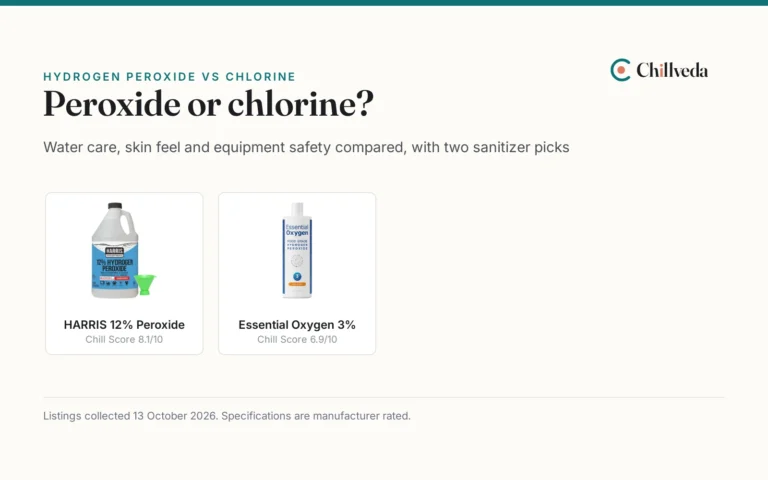
 HARRIS 12% Concentrated Hydrogen Peroxide, 128oz Chill Score 9.6/10Check price on Amazon
A 128 fluid ounce gallon of 12 percent concentrated hydrogen peroxide supplied with an easy fill funnel for home and surface cleaning.
-
2
 Essential Oxygen Food Grade Hydrogen Peroxide Chill Score 9.4/10Check price on Amazon
A 16 fluid ounce bottle of 3 percent USP food grade hydrogen peroxide packaged in a BPA-free bottle for household cleaning.

A 128 fluid ounce gallon of 12 percent concentrated hydrogen peroxide supplied with an easy fill funnel for home and surface cleaning.
Pros & ConsViewHide
Pros
- 128 fluid ounce gallon capacity
- 12 percent concentrated formula
- Includes an easy fill funnel in the box
- Unscented and bleach-free liquid
Cons
- No warranty term is stated
- Spec table notes not for pesticidal use
- Heavier bottle at 9.02 pounds
- No tub water directions on the listing

A 16 fluid ounce bottle of 3 percent USP food grade hydrogen peroxide packaged in a BPA-free bottle for household cleaning.
Pros & ConsViewHide
Pros
- BPA-free bottle and biodegradable formula
- 3 percent USP food grade concentration
- Compact bottle weighing 1.06 pounds
- Free of toxic stabilizers, per the listing
Cons
- Small 16 fluid ounce bottle requires frequent restocking
- No warranty term is stated
- Listing makes wound and oral claims we do not repeat
- No cold plunge water directions on the listing
More to compare
 HARRIS Hydrogen Peroxide Ready to UseCheck price on Amazon
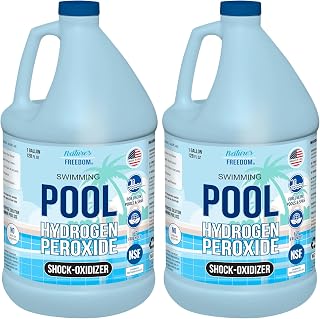 Hydrogen Peroxide for PoolsCheck price on Amazon
 Cold Plunge Hydrogen Peroxide H2O2 Test StripsCheck price on Amazon
 Bartovation Hydrogen Peroxide H2O2 Test StripsCheck price on Amazon
Hydrogen peroxide vs chlorine cold plunge at a glance
| Feature | Hydrogen peroxide | Chlorine |
|---|---|---|
| Sanitizing action | Oxidizer that breaks down into water and oxygen | Halogen oxidizer that forms hypochlorous acid |
| Water scent | Completely odorless | Noticeable chemical pool aroma |
| Skin and eye comfort | Gentle rinse feel with no residue when diluted | Can cause dryness, itching, or eye sting |
| Residual stability | Dissipates under light and organic load | Maintains a lingering sanitizer residual |
| Equipment impact | Gentle on acrylic, rubber seals, and liners when diluted | Can degrade rubber seals and corrode susceptible metal fittings |
| Organic waste handling | Oxidizes bather waste cleanly | Forms chloramines when bound to organic waste |
| Available listing data | Stated concentrations of 3 percent and 12 percent in featured picks | Not stated in current listings |
| Water check method | Peroxide indicator strips | Chlorine indicator strips |
How peroxide and chlorine sanitize cold plunge water
Water sanitization in a cold plunge tub requires neutralizing bacteria, algae, and organic bather waste introduced each time you plunge. Hydrogen peroxide acts as a direct oxidizer. When added to water, it breaks down into water and oxygen, oxidizing organic material without producing chemical byproducts. In our listing data, peroxide appears in liquid concentrations including the HARRIS 12 percent concentrate and the Essential Oxygen 3 percent USP formula. Because peroxide decomposes into pure water and oxygen, it leaves no chemical buildup in the tub.
Chlorine sanitizes through oxidation as well, but it relies on halogen chemistry. When dissolved in water, chlorine forms hypochlorous acid, which attacks bacterial cell walls. The primary operational advantage of chlorine is its residual staying power: once established, free chlorine lingers in the tub to neutralize new contaminants as they enter. However, when chlorine binds with sweat, oils, and skin cells from bathers, it produces chloramines. Chloramines cause the pungent chemical odor commonly associated with public swimming pools.
Skin comfort, odor and bather experience
For dedicated plungers who immerse daily, water comfort directly impacts the routine. When properly diluted in plunge water, hydrogen peroxide provides an odorless immersion session. Bathers step out of the tub without a lingering chemical smell on their skin, hair, or towels. The absence of harsh halogens makes diluted peroxide appealing for individuals with eczema, dry skin, or sensitivities to traditional pool sanitizers.
Chlorine can leave bathers with tight, dry skin and brittle hair after repeated morning sessions. In enclosed recovery spaces such as basements, spare bedrooms, or garages, the volatilization of chlorine into the air can create an unpleasant chemical scent that lingers long after you close the tub cover. For plungers who prioritize skin comfort and clean air in their workout room, hydrogen peroxide holds a distinct subjective advantage.
Tub liners, chillers and equipment safety
Sanitizing chemistry interacts directly with your tub components, including internal rubber seals, flexible plumbing lines, and chiller heat exchangers. At diluted tub concentrations, hydrogen peroxide is mild toward synthetic materials, making it compatible with PVC, drop-stitch inflatables, and rotomolded plastics. It will not bleach dark tub walls or brittle rubber plumbing o-rings when maintained at balanced water levels.
Chlorine is more chemically aggressive. Sustained high chlorine concentrations can bleach colored vinyl liners, harden silicone gaskets, and corrode unshielded copper or steel fittings inside plumbing loops. While titanium heat exchanger coils resist chlorine corrosion, plunge tub manufacturers frequently specify limits on halogen sanitizers in their user manuals to protect seals and fittings. If you operate an external chiller, consult our cold plunge water care guide before introducing chlorine tablets or granules.
Upkeep routines and water checks
Upkeep schedules differ substantially between these two approaches. Hydrogen peroxide degrades when exposed to light, organic matter, and heavy bather loads. As a result, peroxide requires frequent monitoring with dedicated peroxide indicator strips to confirm that active oxidizer remains present. Because neither the HARRIS listing nor the Essential Oxygen listing provides tub maintenance charts, users must calculate additions based on water volume and indicator strip checks.
Chlorine requires less frequent additions due to its residual stability, but it demands careful balance of pH and total alkalinity. If the pH drifts, chlorine rapidly loses its sanitizing efficacy. Chlorine also requires regular shock treatments to eliminate built-up chloramines. For dedicated filtration and maintenance equipment, explore our reviews of cold plunge water treatments and complete cold plunge tubs.
Gear for each route
These are scored on the Chill Score: performance 35, build 25, value 25, safety certifications 10 where it applies and warranty 5. Neither listing states a UL or ETL certification, so both score 0 for safety. Neither listing states a warranty term, so both score 0 for warranty.
| Product | Chill Score | Perf. /35 | Build /25 | Value /25 | Safety /10 | Warranty /5 |
|---|---|---|---|---|---|---|
| HARRIS 12% Peroxide | 9.6 | 30 | 21 | 21 | n/a | 0 |
| Essential Oxygen 3% | 9.4 | 26 | 19 | 18 | n/a | 0 |
Scores run from 9.2 to 9.8: each product’s point total is placed on that range, so more points always means a higher score. Safety counts only for powered gear or where the listing states safety features; where it does not apply, the score is taken over the remaining 90 points.
Choose hydrogen peroxide if
- You want completely odorless water without chemical fumes in your home or garage.
- You have sensitive skin, eczema, or an aversion to chlorine dryness and eye sting.
- You want a gentle oxidizer that protects delicate tub seals, liners, and plumbing components when diluted.
- You are willing to perform regular indicator strip checks to monitor oxidizer levels.
Choose chlorine if
- You want an established sanitizer that maintains a stable residual in the water.
- Your tub is set up in a well-ventilated or open-air space where chemical scents disperse freely.
- You want widely available pool and spa chemicals with standardized check strips.
- You plunge less frequently and need a persistent sanitizer between intermittent sessions.
Check Your Space First
Before setting up a sanitizing routine for your plunge area, verify your storage space and handling layout against the listing specifications:
- Vertical shelf clearance: The HARRIS bottle stands 14.25 inches tall (dimensions of 14.25 by 7.56 by 7.05 inches), requiring an upright storage shelf with adequate headspace.
- Shelf footprint: The HARRIS gallon container requires a shelf base of 7.56 by 7.05 inches, whereas the Essential Oxygen bottle needs a base of 2.45 by 2.45 inches.
- Weight capacity: A full 128 fluid ounce container of the HARRIS pick weighs 9.02 pounds, compared to 1.06 pounds for the Essential Oxygen bottle.
- Volume and handling: The HARRIS option provides 128 fluid ounces (one gallon), compared to the 16 fluid ounces bottle of the Essential Oxygen product, and includes an easy fill funnel for controlled pouring.
Common questions
Is hydrogen peroxide safer than chlorine for cold plunge tubs?
Hydrogen peroxide breaks down cleanly into water and oxygen, eliminating harsh fumes and residue on skin. Chlorine creates a durable sanitizer residual but can produce chloramines that cause eye and respiratory irritation in enclosed spaces. Both require safe handling when concentrated, but peroxide is milder on bathers once diluted in the tub.
Can you mix hydrogen peroxide and chlorine in a cold plunge?
Never mix hydrogen peroxide and chlorine in a cold plunge. Hydrogen peroxide reacts with chlorine by neutralizing it, canceling out the sanitizing capability of both chemicals and releasing oxygen gas rapidly. If transitioning between the two sanitizers, drain the tub completely, wipe down the interior, and refill with fresh water before adding the new product.
Will chlorine damage a cold plunge chiller or liner?
Over time, high concentrations of chlorine can degrade rubber gaskets, vinyl or acrylic liners, and vulnerable metal plumbing fittings inside water chillers. While titanium heat exchangers resist chlorine corrosion, hydrogen peroxide is less aggressive toward synthetic liners and internal chiller seals. Checking equipment compatibility with your tub maker before introducing halogen sanitizers is always recommended.
Why choose hydrogen peroxide over chlorine for cold water immersion?
Many cold plunge users choose hydrogen peroxide because it is completely odorless and does not dry out skin or hair during frequent immersion. Unlike chlorine, it leaves no chemical scent on the body after a session. However, peroxide degrades faster under light and organic load, requiring more diligent monitoring of water clarity.
How do you check water quality when using hydrogen peroxide?
Hydrogen peroxide levels cannot be checked with standard pool chlorine strips. Users must employ dedicated peroxide indicator strips to confirm that active oxidizer remains in the water. Pairing regular indicator checks with physical sediment filtration helps keep cold plunge water clean without chlorine odors.
Back to all cold plunge reviews.