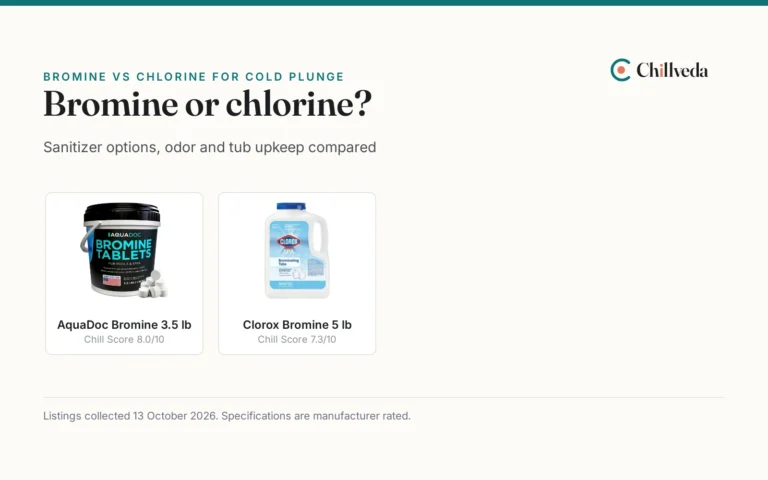
Stepping into a cold plunge in your garage or basement at dawn requires clean, clear water that does not overwhelm the room with harsh chemical fumes. Deciding between bromine vs chlorine for cold plunge comes down to odor comfort and water balance versus fast-acting sanitation. Bromine sanitizes with lower noticeable odor and is formulated for reduced pH sensitivity, making it popular for enclosed recovery spaces. Chlorine works rapidly to clear organic matter and maintain water clarity, but it produces a distinct chemical smell and requires closer pH tracking. Choose bromine if your tub sits indoors and you want minimal odor; choose chlorine if you need rapid sanitization and already maintain chlorine-based pools or tubs.
This comparison covers sanitizing performance, odor, water balance, container formats and tub upkeep, using the listings as concrete examples. It does not evaluate health claims, as clean water is strictly a matter of hygiene and equipment protection. Listings were collected 13 October 2026.
This article is informational and is not medical advice. Cold water triggers a gasp reflex and fast breathing, and your core temperature keeps falling after you get out (afterdrop). Never plunge alone, keep your head above water, and ask a clinician first if you have a heart condition, high blood pressure, or are pregnant. See our Medical Disclaimer and our cold plunge safety guide.
Chillveda earns a commission when you buy through links on this page, at no extra cost to you. As an Amazon Associate I earn from qualifying purchases. Affiliate disclosure.
Quick picks
-
1
 AquaDoc 1 Inch Bromine Tablets for Spas Chill Score 9.6/10Check price on Amazon
A 3.5 lb bucket of slow-dissolving 1-inch bromine tablets formulated for floaters or brominators in home spas and pools.
-
2
 Clorox® Pool&Spa™ Spa Bromine Tablets Chill Score 9.5/10Check price on Amazon
A 5 lb pack of slow-dissolving bromine tablets paired with app support for hot tubs and spas, though the listing leaves tablet size unstated.

A 3.5 lb bucket of slow-dissolving 1-inch bromine tablets formulated for floaters or brominators in home spas and pools.
Pros & ConsViewHide
Pros
- 1-inch slow-dissolving tablets fit floaters and brominators
- Label lists clear target pH range of 7.2 to 7.6
- 56 oz container made in the USA
- Formulated as a low-odor alternative to chlorine
Cons
- No warranty term stated
- Listing notes booster is needed at startup to build residual
- Smaller 3.5 lb pack than the Clorox 5 lb option
- No safety certifications listed

A 5 lb pack of slow-dissolving bromine tablets paired with app support for hot tubs and spas, though the listing leaves tablet size unstated.
Pros & ConsViewHide
Pros
- Larger 5 lb pack provides 80 oz of slow-dissolving tablets
- Compatible with the maker’s pool water guidance app
- Promotes low-odor sanitization without strong chemical smells
- Formulated to reduce pH sensitivity in spa water
Cons
- Spec table contradicts title by listing bacteria and clarity data as missing
- Tablet diameter and dimensions are not stated
- No warranty term stated
- No safety certifications listed
More to compare
 Bromine Tablets for SPA Hot Tub 50LB Tabs Brominating TabletsCheck price on Amazon
 ClearView Bromine Tablet for SpasCheck price on Amazon
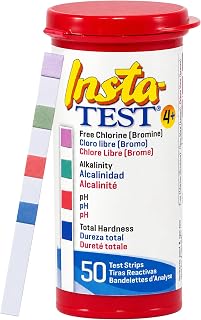 Lamotte Insta-Test 4 PlusCheck price on Amazon
Bromine vs chlorine for cold plunge at a glance
| Comparison point | Bromine | Chlorine |
|---|---|---|
| Odor profile | Lower noticeable odor reported in listings | Distinct chemical smell |
| pH stability | Formulated for reduced pH sensitivity in listings | Sanitizing activity varies with water pH |
| Featured product format | Slow-dissolving tablets in the featured listings | Sold in tablets, granules, or liquid options |
| Startup guidance | The AquaDoc listing recommends a startup booster | Generally active upon addition to water |
| Enclosed room comfort | Milder scent profile for indoor rooms | Requires good air exchange to avoid lingering smell |
| Water monitoring | Regular checks required to maintain sanitizer residual | Regular checks required to maintain sanitizer residual |
Comparing package weights and chemical volume
Sanitizer value depends on package weight and how steadily the tablets erode. Comparing the listings shows a clear difference in package size: the Clorox container provides 5 pounds (80 ounces) of chemical, while the AquaDoc container provides 3.5 pounds (56 ounces). However, container volume tells only part of the story. The AquaDoc listing specifies 1-inch tablets designed for slow dissolution in a floater or brominator, whereas the Clorox listing leaves tablet size unstated. In an unheated cold plunge, tablet surface area directly affects how quickly sanitizer dissolves into the water.
| Product listing | Stated net weight | Stated unit count | Tablet dimensions |
|---|---|---|---|
| Clorox Spa Bromine | 5 pounds | 80 ounces | Not stated |
| AquaDoc Bromine | 3.5 pounds | 56 ounces | 1 inch |
Tub compatibility, odor and water balance
Choosing a sanitizer affects not just sanitation, but the longevity of your tub components and the air quality of your recovery space. Bromine produces significantly less noticeable odor than chlorine, which is a major consideration for indoor plunge tubs placed in bedrooms, basements or home gyms. The Clorox listing highlights low-odor sanitization without strong chlorine smells, while the AquaDoc listing describes its tablets as a low-odor alternative to chlorine that generally has less noticeable smell in warm water environments.
Water balance is equally critical for protecting equipment and water clarity. The AquaDoc listing instructs users to keep pH between 7.2 and 7.6 to support dependable sanitation, while the Clorox listing notes that bromine reduces pH sensitivity in spa water. In cold water, chemical dissolution happens more slowly than in a heated spa. For slow-dissolving tablets, using an adjustable floating dispenser allows you to control water contact and erosion rate. For broader water care routines, see our cold plunge water care guide and our review of cold plunge water treatments.
Upkeep
Maintaining sanitary water in a cold plunge requires regular monitoring rather than guesswork. Water checks should be performed several times each week to confirm sanitizer residual and pH balance.
Because cold plunge water is kept cold, organic load builds up differently than in a hot tub. Bromine builds a sanitizer residual in the water, but the AquaDoc listing notes that users should pair tablets with a booster at startup and after refills to establish baseline levels. The Clorox listing highlights restoring water clarity and eliminating contaminants, but leaves startup booster details unstated. Whichever chemical you select, periodic water changes remain essential to prevent dissolved solids from degrading water quality.
Gear for each route
These are scored on the Chill Score: performance 35, build 25, value 25, safety certifications 10 where it applies and warranty 5. Neither product listing states a third-party safety certification or a concrete warranty term, so both score 0 in those categories.
| Product | Chill Score | Perf. /35 | Build /25 | Value /25 | Safety /10 | Warranty /5 |
|---|---|---|---|---|---|---|
| AquaDoc Bromine 3.5 lb | 9.6 | 29 | 21 | 21 | n/a | 0 |
| Clorox Bromine 5 lb | 9.5 | 27 | 19 | 20 | n/a | 0 |
Scores run from 9.2 to 9.8: each product’s point total is placed on that range, so more points always means a higher score. Safety counts only for powered gear or where the listing states safety features; where it does not apply, the score is taken over the remaining 90 points.
Choose bromine if
- Your cold plunge is located indoors, in a basement, garage or spare room where chlorine fumes would linger.
- You prefer a sanitizer formulated for reduced pH sensitivity, as highlighted on the Clorox listing.
- You want to use slow-dissolving tablets in a floater for steady chemical erosion.
- You prefer lower noticeable chemical odor during indoor recovery sessions.
Choose chlorine if
- Your cold plunge is in a well-ventilated space where chemical odor dissipates easily.
- You want rapid oxidation to clear cloudy water quickly without waiting for a bromine booster to build residual.
- You already maintain a pool or hot tub with chlorine and want to keep a single chemical system at home.
- You prefer versatile product formats, including quick-dissolving granules or liquid sanitizers.
Check Your Space First
- Chemical storage space: Keep sanitizer containers tightly closed in a cool, dry location out of reach of children. The Clorox container weighs 5 pounds (80 ounces) and the AquaDoc bucket weighs 3.5 pounds (56 ounces).
- Dispenser water clearance: If you use a floating dispenser, ensure your tub has enough open surface area for the unit to float freely; the AquaDoc listing specifies 1-inch tablets, while the Clorox listing leaves tablet dimensions unstated.
- Water balance baseline: The AquaDoc listing recommends maintaining water pH between 7.2 and 7.6 before adding sanitizer, whereas the Clorox listing claims reduced pH sensitivity without listing a specific numerical range.
- Container handling: Both products arrive as 1-pack tablet containers that must be sealed securely between uses to prevent moisture absorption.
Common questions
Can you use bromine in a cold plunge?
Yes, bromine is used in cold plunge tubs as a slow-dissolving sanitizer. It provides dependable water sanitation with lower noticeable chemical odor than chlorine, which makes it particularly popular for indoor plunge setups. The featured listings provide slow-dissolving tablets designed to sit in a floating dispenser or inline feeder.
Does bromine work as well as chlorine in cold water?
Bromine sanitizes effectively in cold water, but cold temperatures slow down tablet erosion. As noted in the AquaDoc listing, building an initial sanitizer residual may require pairing tablets with a startup booster. Chlorine dissolves and oxidizes rapidly in cold water, making it faster to establish initial sanitation.
Why does chlorine smell stronger than bromine?
Chlorine forms chloramines as it breaks down organic contaminants, which creates the pungent odor often noticed around pools. Bromine forms bromamines instead, which continue to sanitize and produce a much less noticeable odor in the room. The Clorox and AquaDoc listings both emphasize this low-odor profile compared to chlorine.
How often should I check water parameters in a cold plunge?
Water checks should be conducted several times per week using water check strips to monitor sanitizer residual and pH balance. The AquaDoc listing recommends maintaining a pH between 7.2 and 7.6 for proper sanitation. Regular monitoring ensures your water remains clear without causing damage to tub equipment.
Can I switch between chlorine and bromine in the same tub?
You should never mix chlorine and bromine chemicals directly in the same dispenser or container, as concentrated chemicals can react hazardously. If you decide to transition your cold plunge from chlorine to bromine or vice versa, drain the tub completely, rinse the surfaces and refill with fresh water before introducing the new chemical.
Back to all cold plunge reviews.