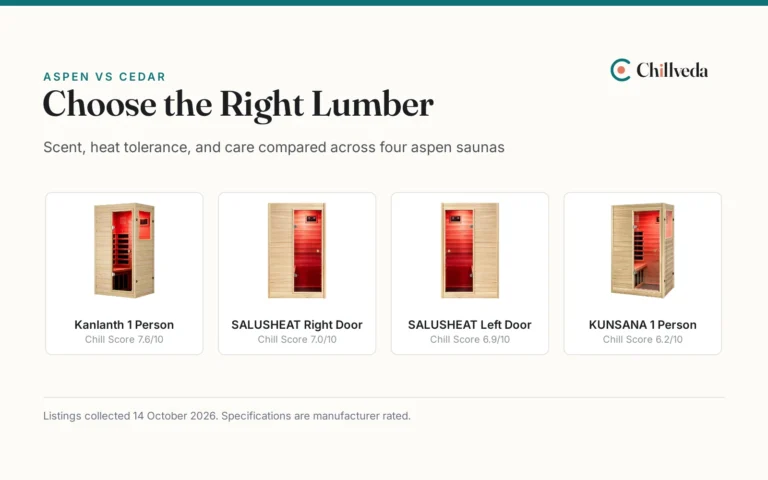
When you set aside a corner of your bedroom or spare room for an evening sweat session, choosing the right lumber shapes every moment you spend inside. In an aspen vs cedar sauna comparison, the decision comes down to scent sensitivity versus natural aroma and moisture defense: aspen is a pale, hypoallergenic hardwood that remains comfortable to the touch and releases no scent or resin under heat, while red cedar is an aromatic softwood prized for moisture resistance and rich wood scents that some people love and others find irritating. For home indoor cabins where you sit close to the heater, aspen provides a calm, odorless environment, whereas cedar suits those who want traditional sauna fragrance and superior outdoor rot resistance.
This guide compares how aspen and cedar perform under heat, who should choose each wood, and four compact aspen infrared cabins currently listed for home use. Listings were collected 14 October 2026.
This article is informational and is not medical advice. Heat exposure strains the heart and causes fluid loss. Do not use a sauna after alcohol, when pregnant, when unwell, or with a heart condition or low blood pressure without asking a clinician first. Leave at once if you feel dizzy, sick or confused. See our Medical Disclaimer.
Chillveda earns a commission when you buy through links on this page, at no extra cost to you. As an Amazon Associate I earn from qualifying purchases. Affiliate disclosure.
Quick picks
-
1
 Kanlanth 1 Person Infrared Sauna Chill Score 9.6/10Check price on Amazon
A 905W single-person European aspen infrared cabin with five far-infrared panels, low EMF engineering, and a 3-year limited warranty.
-
2
 1 Person Infrared Saunas European Aspen Wood Far Chill Score 9.5/10Check price on Amazon
A 905W European aspen cabin with a right-opening tempered glass door, five low-EMF carbon panels, and an overhead red light.
-
3
 1 Person Infrared Saunas European Aspen Wood Far Chill Score 9.4/10Check price on Amazon
A left-hinged European aspen infrared cabin with five carbon panels, 905W power, and dual red and reading lights.
-
4
 1 Person Infrared Saunas with Red Light Therapy Chill Score 9.3/10Check price on Amazon
A compact European aspen infrared cabin with 905W heating, an interior red light, and 180-degree tempered glass door opening.

A 905W single-person European aspen infrared cabin with five far-infrared panels, low EMF engineering, and a 3-year limited warranty.
Pros & ConsViewHide
Pros
- Stated 3-year limited warranty
- European aspen wood is resin-free
- Runs on standard 120V, 15A outlet
- Stated 230 F overheat protection
Cons
- No third-party safety certification stated
- Height recommendation caps at 5 ft 11 in
- Single person capacity only
- No stated ambient reading light

A 905W European aspen cabin with a right-opening tempered glass door, five low-EMF carbon panels, and an overhead red light.
Pros & ConsViewHide
Pros
- Adjustable heat from 77 F to 140 F
- Durable 6mm tempered glass door
- Mortise-and-tenon tool-free assembly
- Two Bluetooth speakers and red light
Cons
- No warranty term is stated
- No third-party safety certification stated
- Substantial 167.9 lb net weight
- Fixed right-hinge door swing

A left-hinged European aspen infrared cabin with five carbon panels, 905W power, and dual red and reading lights.
Pros & ConsViewHide
Pros
- Left-door hinge fits opposite wall layouts
- Adjustable heat from 77 F to 140 F
- Mortise-and-tenon tool-free assembly
- Durable 6mm tempered glass door
Cons
- No warranty term is stated
- No third-party safety certification stated
- Substantial 167.9 lb net weight
- Fixed left-hinge door swing

A compact European aspen infrared cabin with 905W heating, an interior red light, and 180-degree tempered glass door opening.
Pros & ConsViewHide
Pros
- Door opens a full 180 degrees
- Built-in leakage protection switch
- Includes red light and reading light
- European aspen tongue-and-groove build
Cons
- Restrictive 161 lb seat load capacity
- Conflicting dimensions between bullets and table
- No warranty term is stated
- No third-party safety certification stated
More to compare
 Vindar Sauna Room Air Vent 3.58" Round Aspen Wooden SaunaCheck price on Amazon
 Vindar Sauna Room Air Vent 3.74" Round Aspen Wooden SaunaCheck price on Amazon
Aspen vs cedar sauna differences at a glance
| Feature | Aspen Wood | Western Red Cedar |
|---|---|---|
| Wood classification | Deciduous hardwood | Coniferous softwood |
| Aroma and scent | Virtually odorless | Strong natural aromatic scent |
| Resin and pitch | Resin-free, no pitch bleeding | Natural aromatic oils, low pitch |
| Allergy profile | Hypoallergenic, gentle on airways | Aromatic oils can irritate sensitive airways |
| Surface heat transfer | Low conductivity; comfortable to touch | Low conductivity; comfortable to touch |
| Visual appearance | Pale blonde, uniform fine grain | Warm amber to reddish-brown tones |
| Moisture resistance | Moderate; intended for dry indoor rooms | Naturally rot and moisture resistant |
| Recommended setting | Indoor home cabins and benching | Indoor and outdoor sauna structures |
The contrast in the table highlights why makers select each material. Western red cedar contains natural organic compounds called thujaplicins that defend against rot and fungal decay, making it the classic standard for outdoor barrel and cabin saunas. However, those same aromatic oils vaporize in heat, which can trigger headaches, skin flare-ups, or breathing discomfort for people sensitive to fragrances. European aspen is an odorless hardwood free of pitch and resin. Because wood has low thermal conductivity, aspen transfers heat slowly and remains comfortable against bare skin even when cabin temperatures reach 140 F (60 C).
Scent, air quality, and skin comfort under heat
In an enclosed home sauna, air volume is small and you sit only inches from the walls and heaters. If a cabin uses cedar, the entire room fills quickly with a rich, woodsy scent. Many bathers consider that fragrance an essential part of the ritual. But for anyone with asthma, chemical sensitivities, or reactive skin, breathing heated wood oils in a confined space can turn a relaxing routine into an irritant.
Aspen provides an odorless alternative. It does not off-gas volatile aromatic oils, contains no pitch pockets, and stays remarkably smooth. That is why European sauna builders have used aspen for benches and headrests for decades, even inside rooms walled with other timbers. If you want to compare how other low-odor timbers stack up against cedar, read our cedar vs hemlock sauna comparison and our guide on how to choose a home sauna.
Power draw, outlets, and installation needs
All four aspen cabins reviewed below are designed for 1-person indoor use and list a 905-watt power rating. In home wellness equipment, power draw dictates your circuit needs and floor space planning.
Electrical requirements vary by listing. Kanlanth explicitly specifies compatibility with a standard 120V, 15A household outlet, while KUNSANA and SALUSHEAT list their 905-watt power without specifying breaker sizes. At 905 watts on typical household voltage, these units are designed for standard residential circuits rather than high-voltage commercial feeds.
Floor space requirements are similarly compact. For instance, Kanlanth and SALUSHEAT list assembled footprints of 36.6 by 29.3 inches with a 63-inch height, while KUNSANA lists 36.6 by 28.7 inches in its spec table. Assembled weights also differ across designs: Kanlanth lists an item weight of 132.2 pounds, whereas SALUSHEAT lists 167.9 pounds, and KUNSANA does not state an assembled weight. For deeper details on circuit loads and wiring, check our guides on sauna electrical requirements and home sauna running cost.
Aspen home saunas worth considering
These are scored on the Chill Score, which weighs performance 35, build 25, value 25, safety certifications 10 where it applies and warranty 5. None of these listings state a third-party UL or ETL safety certification, so all four score 0 for safety.
| Product | Chill Score | Perf. /35 | Build /25 | Value /25 | Safety /10 | Warranty /5 |
|---|---|---|---|---|---|---|
| Kanlanth 1 Person | 9.6 | 30 | 21 | 21 | 0 | 4 |
| SALUSHEAT Right Door | 9.5 | 29 | 21 | 20 | 0 | 0 |
| SALUSHEAT Left Door | 9.4 | 29 | 21 | 19 | 0 | 0 |
| KUNSANA 1 Person | 9.3 | 26 | 18 | 19 | 0 | 0 |
Scores run from 9.2 to 9.8: each product’s point total is placed on that range, so more points always means a higher score.
For more home cabin options and larger layouts, see our best 1 person saunas and best 2 person home saunas roundups.
Choosing between aspen and cedar in practice
- Assess your fragrance tolerance. If you enjoy cedar chest aromas and have no respiratory complaints, cedar offers traditional ambiance. If you want a neutral space or suffer from allergies, choose aspen.
- Check door swing clearance. Compact cabins like SALUSHEAT come in dedicated left-door and right-door configurations. Plan your corner layout and wall outlets before ordering so the tempered glass door swings freely.
- Respect bench load limits. Verify the maker’s stated weight ratings. While Kanlanth accommodates users up to 5 ft 11 in (180 cm), KUNSANA lists a strict 161 lb seat load capacity.
- Keep indoor cabins inside. Aspen is an untreated hardwood suitable for dry indoor rooms. Makers specifically state that putting these cabins outdoors will shorten their service life.
- Allow proper preheat time. Infrared panels warm your body directly, while the enclosed cabin gradually reaches your selected temperature up to the stated 140 F (60 C) maximum.
Common mistakes
- Assuming natural cedar scent is always hypoallergenic when its volatile oils can provoke breathing sensitivities.
- Placing an indoor European aspen cabin on an outdoor deck where humidity and weather cause wood weathering.
- Overlooking user weight and height restrictions, such as the 161 lb seat load noted on KUNSANA.
- Expecting air temperatures to match traditional rock saunas when far-infrared panels operate efficiently at 140 F (60 C).
Common questions
Is aspen wood good for a sauna?
Yes, European aspen is widely regarded as an excellent sauna wood, particularly for benches and indoor cabins. It is a dense, knot-free hardwood that is naturally resin-free and odorless. Because it transfers heat slowly under high temperatures and contains no pitch, it provides a comfortable and clean bathing surface.
Why do some people prefer cedar over aspen?
Cedar remains popular for its rich color, pleasant natural aroma, and superior resistance to rot and decay. Those qualities make western red cedar a classic choice for outdoor saunas exposed to rain and snow. Many bathers also appreciate the traditional woodsy scent during relaxation.
Can cedar sauna wood cause allergic reactions?
Yes, the natural thujaplicins and aromatic oils in western red cedar can trigger contact dermatitis or respiratory irritation in sensitive individuals. People prone to allergies, asthma, or fragrance sensitivities often find cedar uncomfortable in an enclosed space. Aspen serves as a hypoallergenic alternative because it produces no aromatic oils.
Does an aspen wood sauna need chemical sealing or staining?
No, indoor sauna lumber should never be treated with chemical paints, varnishes, or synthetic sealers. Under high temperatures, synthetic coatings can release fumes into the cabin air. Aspen performs well bare and unfinished when kept in a dry indoor room with adequate ventilation.
How hot do aspen infrared saunas get compared to traditional saunas?
Makers of these 1-person aspen cabins list a maximum operating temperature of 140 F (60 C). Traditional saunas with electric or wood stoves operate at higher air temperatures to heat the room. Because far-infrared panels warm your body directly rather than heating only the air, lower ambient temperatures still produce a thorough sweat.
Sources: Amazon product listings for the saunas named above, collected 14 October 2026. Related: our infrared vs traditional sauna guide and sauna electrical requirements.
Back to all sauna reviews.