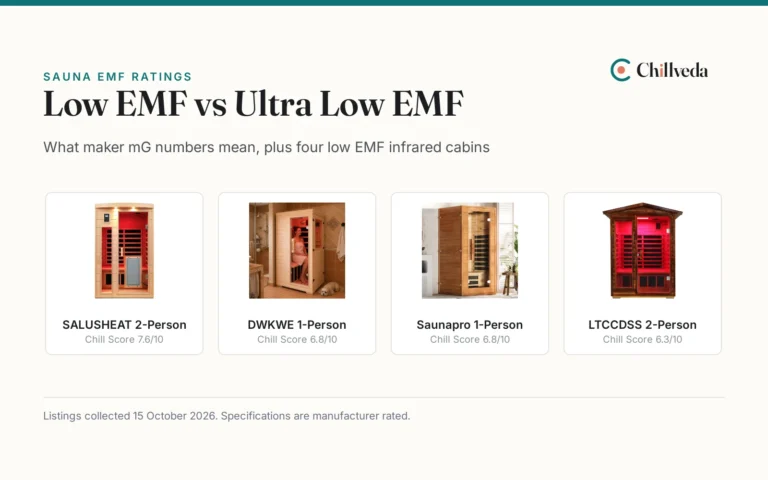
When you set aside a corner of your basement or spare bedroom for an evening session, checking the power outlet and reading the heater specifications are the first steps before buying. The central question for many buyers is the distinction between a low emf vs ultra low emf sauna. In consumer listings, low EMF is used by makers to claim reduced electromagnetic field emissions without necessarily publishing a specific number, while ultra low EMF is typically used by brands that publish low milligauss (mG) targets on their product pages. Because neither term is defined or enforced by federal standards, the distinction depends entirely on what individual manufacturers publish on their spec sheets.
This guide examines how electromagnetic field ratings are reported, how panel shielding works in home cabins, and what electrical demands each heater places on your home wiring. We also compare four low EMF and ultra low EMF infrared saunas from current maker listings collected 15 October 2026.
This article is informational and is not medical advice. Heat exposure strains the heart and causes fluid loss. Do not use a sauna after alcohol, when pregnant, when unwell, or with a heart condition or low blood pressure without asking a clinician first. Leave at once if you feel dizzy, sick or confused. See our Medical Disclaimer.
Chillveda earns a commission when you buy through links on this page, at no extra cost to you. As an Amazon Associate I earn from qualifying purchases. Affiliate disclosure.
Quick picks
-
1
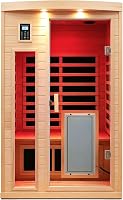 2 Person Infrared Sauna, 0-5mG Ultra Low EMF Chill Score 9.6/10Check price on Amazon
A 2-person Canadian hemlock cabin with 8 far infrared panels rated at 0 to 5 mG, 1750 W power, and a 2-year warranty.
-
2
 Far Infrared Home Sauna for 1 Person |1050W Chill Score 9.4/10Check price on Amazon
A 1-person Canadian hemlock sauna with 5 low-EMF carbon panels delivering 1050 W and a 1-year warranty.
-
3
 1- Person Infrared Sauna for Home Chill Score 9.4/10Check price on Amazon
A 1-person indoor cabin drawing 1200 W with WiFi app control, flame-retardant panels, and 30-minute auto shutdown.
-
4
 Full Spectrum Ultra-Low EMF Outdoor Sauna Chill Score 9.3/10Check price on Amazon
An outdoor Canadian red cedar cabin with full-spectrum infrared heating and a stated EMF rating under 1.0 mG.
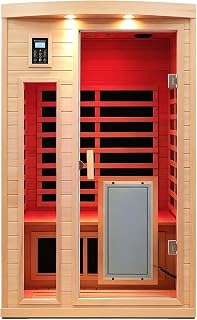
A 2-person Canadian hemlock cabin with 8 far infrared panels rated at 0 to 5 mG, 1750 W power, and a 2-year warranty.
Pros & ConsViewHide
Pros
- Stated ultra low EMF rating of 0 to 5 mG
- 8 far infrared heating panels with door heater plate
- Canadian hemlock wood with 6 mm tempered glass
- Stated 2-year quality assurance warranty
Cons
- High 1750W 15A power draw
- Heavy cabin at 294 lb
- No third-party electrical safety certification stated
- Returns not due to seller error require shipping to California warehouse

A 1-person Canadian hemlock sauna with 5 low-EMF carbon panels delivering 1050 W and a 1-year warranty.
Pros & ConsViewHide
Pros
- Stated 1-year warranty
- Solid Canadian hemlock wood construction
- 5 carbon heating panels at 1050W
- Tool-free clasp assembly designed for single-room setup
Cons
- No specific milligauss EMF number stated
- Cabinet dimensions and item weight are not stated
- Operating temperature range is not stated
- No third-party electrical safety certification stated

A 1-person indoor cabin drawing 1200 W with WiFi app control, flame-retardant panels, and 30-minute auto shutdown.
Pros & ConsViewHide
Pros
- WiFi app and Bluetooth remote control
- Reaches 122 F in 10 minutes at 1200W
- Automatic 30-minute shutdown safety timer
- Stated dimensions of 31.5 by 33.86 by 68.9 inches
Cons
- No warranty term is stated
- No specific milligauss EMF number stated
- Maximum operating temperature is not stated beyond 122 F
- No third-party electrical safety certification stated

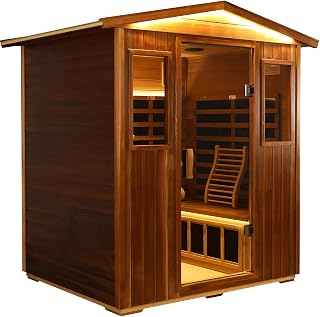
An outdoor Canadian red cedar cabin with full-spectrum infrared heating and a stated EMF rating under 1.0 mG.
Pros & ConsViewHide
Pros
- Stated EMF rating of 0.1 to 2 mG with average under 0.8 mG
- Full-spectrum infrared with near, mid, and far infrared panels
- Canadian red cedar wood rated for outdoor temperatures from -15 F to 149 F
- Separate exterior and interior dimensions stated
Cons
- No warranty term is stated
- Wattage and electrical draw are not stated
- Contradiction claiming 5 to 6 people fit in a 39.4 by 33.5 inch interior
- No third-party electrical safety certification stated
More to compare
 LTCCDSS Full Spectrum Ultra-Low EMF Red Cedar Sauna 4 PersonCheck price on Amazon
 2 Person Corner Sauna 0-5mG Ultra Low EMF Sauna w/ Front DoorCheck price on Amazon
 Red Cedar SaunaCheck price on Amazon
 LTCCDSS Ultra-Low EMF Red Cedar Sauna 4 PersonCheck price on Amazon
 Durasage Ultra Low EMF Infrared Sauna BoxCheck price on Amazon
 1-Person Low EMF Far Infrared Sauna for Home UseCheck price on Amazon
Understanding low emf vs ultra low emf sauna ratings
| Model | Stated EMF rating | Stated power | Stated wood |
|---|---|---|---|
| SALUSHEAT 2-Person | 0 to 5 mG | 1750W, 15A | Canadian hemlock |
| DWKWE 1-Person | Low-EMF (mG not stated) | 1050W | Canadian hemlock |
| Saunapro 1-Person | Low EMF (mG not stated) | 1200W | Wood (species not stated) |
| LTCCDSS 2-Person | 0.1 to 2 mG (<=1.0 mG in bullets) | Not stated | Canadian red cedar |
A look across these four current listings shows that manufacturers treat EMF labeling inconsistently. Two models publish concrete milligauss ranges on their listings: SALUSHEAT advertises 0 to 5 mG across 8 far infrared panels, while LTCCDSS lists 0.1 to 2 mG in its title and states an average at or below 0.8 mG in its product details. In contrast, DWKWE and Saunapro label their units as low EMF without providing any milligauss measurement on their specification sheets.
Without a published milligauss value, a low EMF claim indicates that the maker aimed for reduced emissions compared to unshielded heating elements, but offers no verified numeric threshold. For buyers seeking minimal exposure, prioritizing listings that publish specific milligauss targets provides a clearer basis for comparison.
How heater shielding affects electromagnetic field levels
Electromagnetic fields in an infrared sauna originate from the electrical current flowing through the heater wiring and heating elements. In basic electrical elements, current passing through standard wires generates alternating magnetic fields that project outwards into the cabin. To mitigate this, makers employ low EMF and ultra low EMF engineering techniques.
To reduce electromagnetic fields, manufacturers rely on heater layout and shielding. For example, the LTCCDSS listing describes an internal shielding structure stated to block over 95 percent of extremely low frequency (ELF) and electromagnetic fields. For more background on these measurements, see our guide on what EMF in an infrared sauna actually represents.
Cabin construction also affects your distance from the heaters. Wooden battens and framing keep bathers from leaning directly against the heating surfaces. You can learn more about cabinet materials in our breakdown of cedar vs hemlock sauna construction.
Why measurement distance matters for sauna EMF
When evaluating EMF figures, the distance between the sensor and the heating panel is just as important as the number itself. Magnetic field strength drops off quickly as distance from the heater increases. A reading taken directly against a heating surface will be higher than a reading taken across the bench at your seated position.
However, product listings rarely state the exact distance at which their milligauss figures were recorded. In practical use, when you sit on the bench, your body rests away from the wall panels, which naturally lowers exposure. Cabins that install heating surfaces closer to your extremities, such as the door heating plate on the SALUSHEAT 2-Person, make low emission ratings across all panels relevant.
Low EMF and ultra low EMF saunas compared
These are scored on the Chill Score, which weighs performance 35, build 25, value 25, safety certifications 10 where it applies and warranty 5. None of these listings state a third-party electrical safety certification, so all four score 0 for safety.
| Product | Chill Score | Perf. /35 | Build /25 | Value /25 | Safety /10 | Warranty /5 |
|---|---|---|---|---|---|---|
| SALUSHEAT 2-Person | 9.6 | 30 | 21 | 21 | 0 | 3 |
| DWKWE 1-Person | 9.4 | 27 | 19 | 20 | 0 | 2 |
| Saunapro 1-Person | 9.4 | 28 | 20 | 20 | 0 | 0 |
| LTCCDSS 2-Person | 9.3 | 27 | 18 | 19 | 0 | 0 |
Scores run from 9.2 to 9.8: each product’s point total is placed on that range, so more points always means a higher score.
For more options and room layouts, explore our guides to the best 2 person home saunas and best 1 person saunas.
Choosing between low EMF and ultra low EMF in practice
When selecting between these cabin designs for your home wellness routine, consider how electrical demands, installation requirements, and published specifications align with your space:
- Check electrical circuit capacity. Heater wattage determines household electrical demands. The DWKWE is rated at 1050W and the Saunapro at 1200W, which fall well within the capacity of standard 15A household circuits. In contrast, the SALUSHEAT lists a 1750W 15A rating. Because a 1750W heater uses virtually all the capacity of a 15A circuit, running it alongside other active household loads on the same circuit can trip the breaker, making a dedicated circuit advisable.
- Examine cabinet dimensions and space. For a 2-person cabin, the SALUSHEAT measures 47.2 by 39.4 by 75.6 inches and weighs 294 pounds, accommodating users up to 75 inches in height. The LTCCDSS outdoor cabin has exterior dimensions of 57.7 by 40.5 by 81.1 inches with an interior measuring 39.4 by 33.5 by 71.7 inches. For single users, the Saunapro measures 31.5 by 33.86 by 68.9 inches. Check your door frames and floor space before delivery.
- Review heater counts and panel placement. The SALUSHEAT provides 8 far infrared panels plus an extra heating plate on the door for 360-degree coverage. The DWKWE incorporates 5 carbon heating panels, while the Saunapro divides its 1200W heaters between back panels and dedicated lower panels for legs and feet.
- Verify warranty and support terms. Written warranty protection varies across listings. SALUSHEAT provides a 2-year quality assurance term and DWKWE lists a 1-year warranty, while Saunapro and LTCCDSS state no formal warranty period.
Common mistakes
- Assuming low EMF means zero EMF. Every electrical appliance creates a small field when active; ultra low EMF designs simply minimize field escape.
- Ignoring circuit amperage limits. Plugging a 1750W cabin into a shared 15A circuit with other active household appliances can trip the breaker.
- Measuring only at the power entry point rather than where you sit. Electromagnetic fields around the control box or incoming power cord do not reflect the exposure at your seated bench position.
- Confusing marketing labels with official safety certifications. Low EMF and ultra low EMF are seller terms; they do not replace electrical listings like UL or ETL.
Common questions
What is considered low EMF for an infrared sauna?
There is no official regulatory standard defining low EMF. In consumer listings, brands use the term to indicate reduced magnetic fields compared to standard heating elements. However, models labeled low EMF frequently do not state a specific milligauss rating on their product sheets.
What does ultra low EMF mean in a sauna?
Ultra low EMF is also an unregulated marketing term rather than a certified safety classification. Brands using this label typically publish specific numeric targets, such as SALUSHEAT listing 0 to 5 mG or LTCCDSS listing an average at or below 0.8 mG.
Does a low EMF sauna cost more to operate?
No. Reducing magnetic field emissions does not increase electrical power consumption. Operating cost depends strictly on the heater wattage and how long the cabin runs during each session, not on the presence of EMF shielding.
Can you run an infrared sauna on a standard household outlet?
Cabins listed at 1050W or 1200W operate on standard 15A household circuits without specialized wiring. However, a cabin like the SALUSHEAT listed at 1750W and 15A uses the full rating of a 15A circuit, making a dedicated line advisable to prevent breaker trips.
Do low EMF heating panels take longer to warm up?
No. Field reduction techniques do not lower infrared heat emission. For example, the Saunapro lists reaching 122 F in 10 minutes with its 1200W heaters, showing that low EMF heating elements warm up at standard rates.
Sources: Amazon product listings for the saunas named above, collected 15 October 2026. Related: our sauna electrical requirements and home sauna running cost.
Back to all sauna reviews.