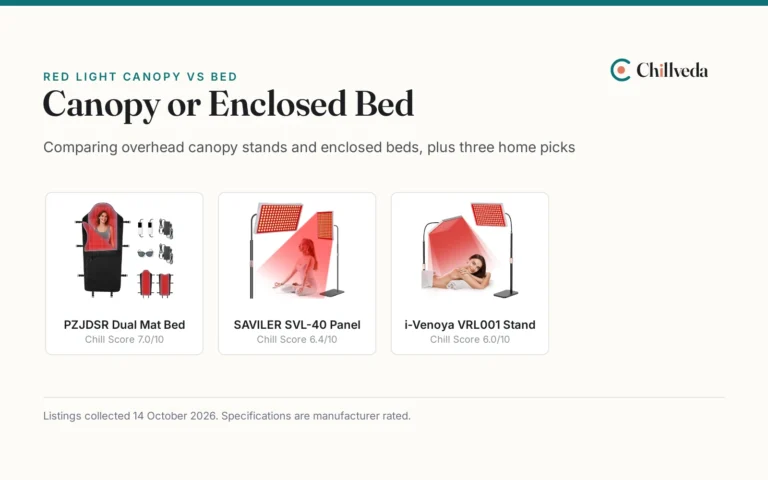
When planning a recovery space around your bedroom or home workout area, choosing between a red light therapy canopy vs red light bed comes down to footprint, budget, and treatment routine. An overhead red light canopy uses an adjustable stand or gooseneck positioned over an existing bed or chair, providing overhead light for one side of the body at a time while keeping floor space open. In contrast, an enclosed therapy bed or dual-mat system surrounds front and back simultaneously, providing full-body coverage in a single session while requiring a full-length layout space.
This guide compares how overhead canopies and enclosed beds deliver light, how their power demands and space footprints differ, and three home picks scored on stated specifications. Listings were collected 14 October 2026.
This article is informational and is not medical advice. Red light and near-infrared devices emit concentrated light; always use appropriate eye protection and never stare directly into the LEDs. If you are pregnant, take photosensitizing medications, or have a medical condition, consult your physician before starting light therapy. See our Medical Disclaimer.
Chillveda earns a commission when you buy through links on this page, at no extra cost to you. As an Amazon Associate I earn from qualifying purchases. Affiliate disclosure.
Quick picks
-
1
 Red Light Therapy Mat for Full Body Chill Score 9.5/10Check price on Amazon
A full-body dual-mat red light system with 2,704 dual-chip LEDs that snaps into an enclosed cocoon bed or unzips flat.
-
2
 Red Light Therapy Panel, 160 LED Dual-Wavelength Chill Score 9.4/10Check price on Amazon
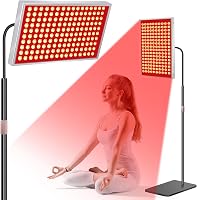
A 30W overhead red light panel featuring 160 dual-wavelength LEDs mounted on an adjustable stand.
-
3
 Red Light Therapy for Body Face Chill Score 9.3/10Check price on Amazon
An adjustable stand panel with 150 dual-wavelength LEDs and reflecting cups designed for home light sessions.
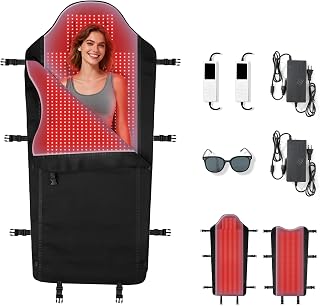
A full-body dual-mat red light system with 2,704 dual-chip LEDs that snaps into an enclosed cocoon bed or unzips flat.
Pros & ConsViewHide
Pros
- 2,704 dual-chip LEDs covering 660nm red and 850nm near-infrared
- Dual-mat design zips together into an enclosed cocoon sleep bag
- Offers 10Hz and 40Hz pulsed modes alongside constant light
- Generous stated footprint of 73 by 36 inches
Cons
- Listing contradicts itself on power, stating 288W in title and 140W in bullets
- Dimensions conflict between 73 by 36 inches in title and 73 by 33 inches in text
- No warranty term is stated
- Heaviest package here at 18 pounds
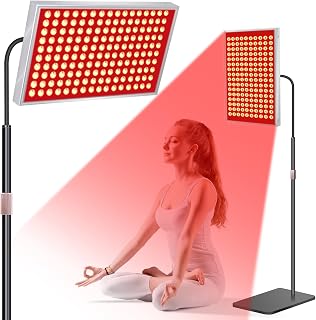
A 30W overhead red light panel featuring 160 dual-wavelength LEDs mounted on an adjustable stand.
Pros & ConsViewHide
Pros
- 160 dual-wavelength LEDs combining 660nm and 850nm light
- Stated 30W power rating with recessed LED groove design
- Hands-free stand with flexible gooseneck and 360-degree rotating head
- Enables overhead positioning while lying down or seated
Cons
- No warranty term is stated
- Product dimensions are not stated, listing package size only
- Only 30W output covers a single zone at a time rather than full body
- No safety certifications are stated

An adjustable stand panel with 150 dual-wavelength LEDs and reflecting cups designed for home light sessions.
Pros & ConsViewHide
Pros
- 150 LEDs delivering 660nm visible red and 850nm near-infrared light
- Built-in reflecting cups designed to focus light output
- Adjustable stand extends to 50 inches for bed or chair use
- Lightweight assembly weighing 5.8 pounds
Cons
- Spec table lists table mount while bullets describe a 50-inch floor stand
- Operating wattage is not stated
- No warranty term is stated
- Small 12 by 9 inch panel requires repositioning for full-body coverage
Red light therapy canopy vs red light bed: key differences
| Feature | Overhead canopy stand | Enclosed therapy bed |
|---|---|---|
| Coverage style | Single-sided (front or back per session) | Simultaneous two-sided coverage |
| Furniture use | Positions over existing bed or chair | Dedicated floor layout or mattress space |
| Storage footprint | Stands upright or folds away | Rolls or folds into storage bag |
| Light delivery | Suspended at a distance above body | Close proximity wrap or enclosed cocoon |
The primary distinction is coverage geometry. An overhead canopy suspends an LED panel above you, allowing you to recline on a mattress or treatment table while illuminating one side of the body per session. To treat both front and back, users rotate during their routine. An enclosed therapy bed or dual-mat system illuminates front and back at the same time, covering both surfaces in a single session while taking up dedicated floor space.
How canopy stands and enclosed beds deliver light
The listings reviewed here combine 660nm visible red light and 850nm near-infrared light. In optical specifications, 660nm red light targets superficial skin layers, while 850nm near-infrared light penetrates deeper into tissue. For an explanation of how these bands behave, see our guide on red light wavelengths.
How light reaches the body depends on optical design and positioning distance. Stand-mounted panels use reflecting cups or recessed LED grooves to direct light toward the body from an overhead position, with light concentration naturally tapering as distance increases. For guidance on assessing light concentration numbers, see our guide on how to read a red light irradiance number. Enclosed dual mats position LEDs in close proximity, delivering light directly across front and back surfaces.
Power ratings and room setup
Power ratings and physical dimensions differ markedly between stand-mounted canopies and dual-mat bed systems. The SAVILER overhead lamp lists a power rating of 30W for its 160 LEDs. The PZJDSR dual-mat bed listing shows conflicting power figures, stating up to 288W in the title and up to 140W in the bullet text for its 2704 LEDs. The i-Venoya listing does not state operating wattage for its 150 LEDs.
Room requirements also differ based on equipment layout. The PZJDSR requires a dedicated space matching its 73 by 36 inch footprint (described as 73 by 33 inches in the bullets), and packs away into a 28 by 9 by 9 inch package weighing 18 pounds. An overhead canopy like the i-Venoya uses a stand measuring 12 by 9 by 50 inches with a total weight of 5.8 pounds (2.63 kg), allowing the base to rest beside existing furniture while the lamp extends above your mattress.
Canopy stands and full body therapy pads worth considering
These are scored on the Chill Score, which weighs performance 35, build 25, value 25, safety certifications 10 where it applies and warranty 5. Because none of these three listings state safety certifications or concrete warranty terms, all three score 0 for safety and warranty.
| Product | Chill Score | Perf. /35 | Build /25 | Value /25 | Safety /10 | Warranty /5 |
|---|---|---|---|---|---|---|
| PZJDSR Dual Mat Bed | 9.5 | 29 | 20 | 21 | 0 | 0 |
| SAVILER SVL-40 Panel | 9.4 | 26 | 19 | 20 | 0 | 0 |
| i-Venoya VRL001 Stand | 9.3 | 23 | 18 | 19 | 0 | 0 |
Scores run from 9.2 to 9.8: each product’s point total is placed on that range, so more points always means a higher score.
For more choices, including modular panels, see our best full body red light panels roundup.
Setting up your home routine in practice
- Start with conservative sessions. The i-Venoya listing recommends 10 to 30 minutes per time, 3 to 7 times a week. Begin on the shorter end to gauge comfort.
- Wear eye protection every session. Near-infrared light at 850nm is invisible to the human eye, but the LEDs emit strong optical energy. Always use protective goggles, as outlined in our guide on red light therapy eye safety.
- Position overhead stands carefully. When using a canopy stand over a bed, ensure the base plate is firmly anchored on the floor and the tube is locked tight before reclining underneath.
- Keep mat surfaces clean. If using an enclosed dual-mat bed, wipe down the leather and TPU surfaces after use to maintain hygienic conditions.
Common mistakes
- Assuming an overhead canopy provides full two-sided coverage without turning over during a session.
- Confusing exterior package dimensions with actual illuminated LED panel dimensions.
- Skipping eye goggles because near-infrared light appears dim or invisible.
- Ignoring power and sizing discrepancies between listing titles and spec bullets.
Common questions
Does a red light therapy canopy cover both sides of the body at once?
No. An overhead canopy or panel on an adjustable stand shines light from above, covering either your front or back depending on how you recline. To treat both sides, you must turn over during your session. Enclosed therapy beds and dual-mat cocoons illuminate both sides simultaneously.
How much space does a red light therapy bed require compared to a canopy?
A full-body bed or mat layout requires dedicated space matching dimensions like the 73 by 36 inch footprint stated for the dual mat (or 73 by 33 inches in its bullets). An overhead canopy uses a vertical pole or stand, such as the 50 inch height listed for the i-Venoya, positioning over existing furniture without taking over floor space.
What settings and timer controls do canopy stands and therapy beds provide?
Controls vary across equipment types. For example, the PZJDSR dual mat includes 5 levels of lightness, a timer with 9 settings, and selectable 10Hz and 40Hz pulsing modes alongside constant light. Stand-mounted canopy models like SAVILER focus on simple operation with a single power setting on an adjustable stand.
Why do both canopy and bed listings feature 660nm and 850nm lights?
Makers combine 660nm visible red light and 850nm near-infrared light to target different tissue depths. Red light is absorbed in superficial skin layers, while near-infrared penetrates deeper toward muscles and joints. Our guide on red light wavelengths breaks down how these dual wavelengths function.
Do you need eye protection when using an overhead canopy or bed?
Yes. High-intensity LED arrays emit concentrated red and invisible near-infrared light. You should always wear protective goggles during your session, as detailed in our guide to red light therapy eye safety.
Sources: Amazon product listings for the red light therapy devices named above, collected 14 October 2026. Related: our red light therapy pad vs panel comparison and FDA clearance explained.
Back to all red light therapy reviews.