


We looked at eighteen cold plunge tubs available in the United States. Not one of them publishes a safety listing, and only four publish a warranty term of any kind. That single fact shapes this entire article, and it is why the highest Chill Score on this page is 66 out of 100.
Here is what the listings do tell you, which products are worth your money, and what the category as a whole is quietly not saying.
This article is informational and is not medical advice. Cold water immersion triggers involuntary physiological responses and carries real risk. Please read our Medical Disclaimer and our guide to cold plunge safety before your first session, and speak to a clinician first if you have any health condition.
Our picks




Why every score on this page is low
Our Chill Score weighs five things: performance 30, build quality 20, value including running cost 20, safety certifications 15, and warranty and support 15.
Across all eighteen tubs we reviewed, none states a UL, ETL or CSA listing. Several are sold as chiller compatible or ship with a chiller, which means a mains powered compressor sitting beside a tub of water. That is precisely the configuration where an independent electrical safety listing matters most, and the category simply does not mention it.
So every product here loses all fifteen safety points. Fourteen of the eighteen also publish no warranty, losing fifteen more. That is why a perfectly decent tub lands in the forties rather than the seventies. The scores are not saying these products are broken. They are saying the brands will not commit to anything in writing.
What separates them
Does a chiller come with it, or not
This is the real fork in the category, and it is worth more than any other specification.
A tub on its own is a container. You bring the ice, every session, forever. A tub with a chiller holds temperature on its own and costs a few dollars a month in electricity instead. We ran that comparison in what a cold plunge costs to run, and bagged ice at four sessions a week generally costs more per month than the worst case chiller scenario, permanently.
Two of our picks include one. The JUGRFIT listing states a 1050W chiller in the package with a one year warranty on all equipment included. The 1stplunge kit states a 1/3 horsepower chiller with an external filter and pump and a stated 42 degree Fahrenheit capability, also with a one year limited warranty.
Those two score highest here, and it is not a coincidence that they are also the two that put a warranty in writing.
Capacity, and what it costs you
Manufacturer stated volumes across our picks run from 86 gallons up to 216. Bigger is not better. A larger tub takes more ice to cool, more energy for a chiller to hold, and more water to change. It also takes longer to get cold.
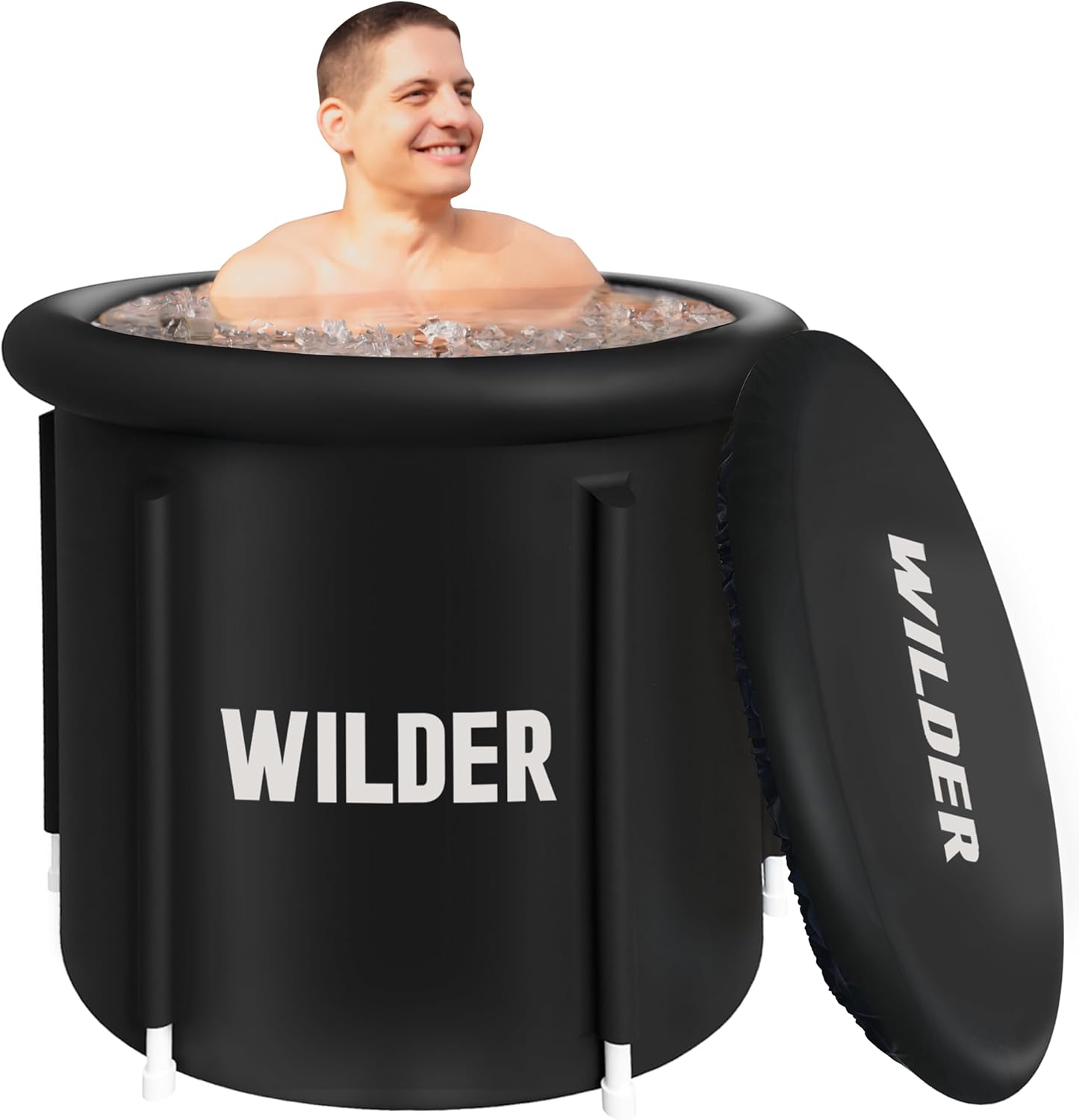
Unless you are tall or intend to share it, the smaller end of this range is usually the better buy, and the Wilder XL at a stated 86 gallons is the most sensible footprint here for one adult.
Insulation and the cover
Every degree the water gains from the surrounding air is a degree that ice or a compressor has to remove again. Multi layer walls and a fitted cover are the difference between a tub that holds temperature overnight and one that does not.
The Cold Pod states full wrap insulation, and the Bubplay ships with a cover. Layer counts across this category are quoted freely and inconsistently, so treat any specific number as manufacturer rated.
Buyer history
Two of our picks carry over 700 customer reviews each, and one carries over a thousand. Several others in the wider pool carry fewer than ten. For a product that holds a couple of hundred gallons of water in your home, a long history of people actually living with it is worth more than a five star average on four reviews.
What it costs to run
If you buy a tub with a chiller, budget roughly seven dollars a month in a cold garage in winter, about twenty in a temperate insulated setup, and up to forty in a hot garage in summer, using the June 2026 US residential average of 18.34 cents per kWh.
If you buy a tub without one and use bagged ice, expect that figure to be higher and permanent. The full arithmetic, including why the spec sheet wattage misleads, is in what a cold plunge costs to run.
Then add the maintenance. Filters, pH checks, and water changes are not optional, and we set out the real cadence in cold plunge water care.
Who should not buy one of these
If you have a heart condition, are pregnant, take medication affecting blood pressure or heart rate, or have a circulatory condition, speak to a doctor before buying anything in this category. This is not a formality.
If you plunge once or twice a week, a chiller running continuously to serve eight sessions a month is poor value, and a plain tub you fill and drain is the honest answer.
If you have never done cold exposure regularly, cold showers cost nothing. Find out whether you will keep doing this before buying two hundred gallons of anything.
And if a listing is chiller compatible but states no safety listing and no warranty, understand what you are accepting. That is most of this category, which is the uncomfortable conclusion of this article.
Safety
Never plunge alone. Cold shock causes an involuntary gasp in the first seconds, and afterdrop means your core keeps cooling after you get out. Enter slowly, keep your head clear of the water, start warmer and shorter than you think, and never combine cold immersion with alcohol.
For the equipment: a chiller is a mains powered appliance next to water, so ground fault protection is required and the electrical work belongs to a licensed electrician. Keep cords out of puddles and keep the tub covered and secured around children.
Common questions
Do I need a chiller?
Not to start. But if you plunge more than twice a week, the ice bill and the hauling will decide it for you within a couple of months.
What temperature should I set?
Start warmer than the internet suggests and work down over weeks. Holding water at the bottom of a chiller’s range also costs meaningfully more to run.
How often do I change the water?
Typically every two to three months, shorter with more bathers or warm ambient temperatures. Rinsing off before you get in extends that considerably.
Why is the top score only 66?
Because no product in this category publishes a safety listing, and most publish no warranty. We score non-disclosure as zero rather than ignoring it, for the reasons set out on our How We Review page.
Sources: Product specifications, warranty statements and customer review counts are as published on the retailer listings and were collected on 19 September 2026. Capacities, wattages, temperature capabilities and insulation claims are manufacturer rated. Electricity figures use the US Energy Information Administration residential average for June 2026, 18.34 cents per kWh.

Write Your Review
No reviews yet. Be the first to share your experience!