A chiller is what turns a cold plunge from a chore into a habit. No ice runs, no hauling bags, no planning your week around what the freezer can produce. It is also the most expensive single item in home cold therapy, and the category with the thinnest buyer evidence of anything we cover.
We looked at every standalone cold plunge chiller we could find sold in the United States. There are not many. We are telling you that up front because it changes how you should read this page.
The good news is that this is the one category on this site where the listings publish real numbers. Horsepower, wattage, temperature floors and gallon ratings are stated on most of these, which means you can actually work out what fits your tub and what it costs to run.
This article is informational and is not medical advice. Cold water immersion carries real risk, and these are mains powered appliances installed beside water. Please read our Medical Disclaimer and our guide to cold plunge safety before your first session.
Chillveda earns a commission when you buy through links on this page, at no extra cost to you. As an Amazon Associate I earn from qualifying purchases. Affiliate disclosure.
Quick picks
-
1
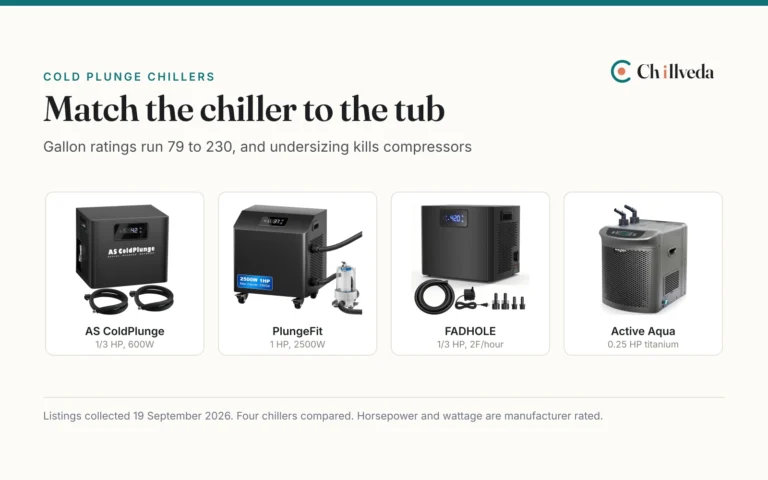
 AS ColdPlunge 1/3HP Cold Plunge Chiller Chill Score 9.5/10Check price on Amazon
The best evidenced chiller in a category that barely has evidence, and the one whose published figures actually let you plan.
-
2
 Cold Plunge Chiller, 1 HP Ice Bath Water Chiller Chill Score 9.5/10Check price on Amazon
The most powerful unit here by a wide margin, and the only one rated for a genuinely large tub.
-
3
 Cold Plunge Chiller for Ice Bath Tub Chill Score 9.5/10Check price on Amazon
The only unit here that publishes a cooling rate, which is the figure that tells you how long you actually wait.
-
4
 Active Aqua Hydroponic Water Chiller, 0.25 HP Chill Score 9.5/10Check price on Amazon
Not sold as a cold plunge chiller at all, which is exactly why it has eight years of buyer history behind it.
What we picked for home recovery

The best evidenced chiller in a category that barely has evidence, and the one whose published figures actually let you plan.
Pros & ConsViewHide
Pros
- Publishes 1/3 HP, 600W, a 39F floor and a 79 gallon rating, the fullest disclosure here
- Built in filter and pump, so it is a complete solution rather than a cooling block
- 600W is a normal household appliance load, not a circuit problem
Cons
- 79 gallons is a modest capacity rating, so it will struggle on larger tubs
- 35 lb unit that needs floor space beside the tub
- No UL, ETL or CSA listing and no warranty term published

The most powerful unit here by a wide margin, and the only one rated for a genuinely large tub.
Pros & ConsViewHide
Pros
- 1 HP and a 230 gallon capacity rating, the only unit here sized for a large tub
- Publishes a 37F floor, the coldest stated figure in this roundup
- External pump and filtration with insulated hoses per the listing
- Publishes 2500W, so the electrical load can be planned properly
Cons
- 2500W is a heavy continuous draw that needs its own circuit
- 73 lb, more than twice the weight of the 1/3 HP units here
- No UL, ETL or CSA listing and no warranty term published

The only unit here that publishes a cooling rate, which is the figure that tells you how long you actually wait.
Pros & ConsViewHide
Pros
- Publishes a 2F per hour cooling rate, the only unit here to state one
- Built in filter and a submersible pump included
- 38F floor with insulated hoses, published on the listing
Cons
- The warranty field on the listing reads simply 1, with no unit or scope
- 79 gallon capacity rating, so not suited to large tubs
- No UL, ETL or CSA listing published

Not sold as a cold plunge chiller at all, which is exactly why it has eight years of buyer history behind it.
Pros & ConsViewHide
Pros
- Pure titanium heat exchanger, the most corrosion resistant build here
- Rated for 40 to 92 gallons, a usable range for a single person tub
- Sold by an established equipment brand rather than a marketplace storefront
Cons
- Sold as a hydroponics chiller, so cold plunge use is outside its marketed purpose
- 0.25 HP is the least powerful unit here
- No UL, ETL or CSA listing and no warranty term published
More to compare
 Active Aqua Water Chiller with BoostCheck price on Amazon
 The Pod Company Standard Water ChillerCheck price on Amazon
 Inflatable Cold Plunge TubCheck price on Amazon
 Cold Plunge Tub with Water ChillerCheck price on Amazon
Only four picks, and why
This is the shortest roundup on the site. We found five standalone chillers with enough published specification to evaluate, and we left one out.
That is the worst distribution of any product we have looked at in any category. We are naming it rather than quietly omitting it, because in a category this small a reader deserves to know what we rejected and why.
Match the chiller to the tub, not to the price
The single most common mistake here is buying a chiller rated for less water than you own. Every unit publishes a gallon rating and it is not marketing, it is the volume the compressor can actually hold at the stated temperature.
The 1/3 HP units here are rated for 79 gallons. The 1 HP PlungeFit is rated for 230. If you bought a 175 gallon tub from our inflatable ice bath roundup, a 79 gallon chiller will run constantly and still not reach its stated floor.
Undersizing does not just disappoint. A compressor running continuously against a load it cannot meet is a compressor that fails early, and none of these publish a warranty.
How long you actually wait
Buyers expect a chiller to behave like a refrigerator. It does not. These pull heat out slowly, and only one listing here is honest enough to say how slowly.
The FADHOLE publishes a cooling rate of 2F per hour. Taking 79 gallons from a tap temperature of around 70F down to 50F is a 20F drop, so roughly ten hours. Every other chiller in this class behaves similarly and simply does not publish the figure.
The practical consequence: run it overnight, keep the cover on, and treat the chiller as something that maintains temperature rather than something that produces it on demand.
What it costs to run
This is the one number people fear most and it is smaller than expected. Using the US average residential electricity rate of 18.34 cents per kWh reported by the EIA for June 2026:
- The 600W AS ColdPlunge costs about 11 cents per hour of compressor run time.
- The 2500W PlungeFit costs about 46 cents per hour of compressor run time.
Chillers cycle rather than running constantly. An insulated tub with the cover on might need a few hours of compressor time a day to hold temperature, which puts the 1/3 HP units well under a dollar a day and the 1 HP unit somewhere above it. Over a year, that is comfortably less than most people spend on ice, which is the real argument for buying one. Our running cost guide works through where the crossover sits.
The electrical work is the part to plan
The wattage figures here are usable and you should use them. A 600W chiller is an ordinary appliance and will sit happily on a normal circuit. A 2500W chiller draws roughly 21 amps at 120V, which is more than a standard 20A circuit should carry continuously. That unit wants a dedicated circuit and an electrician’s quote before you buy, not after.
Whatever you buy, this is a mains powered appliance next to a tub of water. Ground fault protection is not optional. Our guide to home circuits covers how to check what a circuit can carry and what to ask an electrician for.
Filtration is a separate question
A chiller cools water. It does not clean it. Some of these bundle a filter and pump, some do not, and the listings are not always clear which.
The AS ColdPlunge and the FADHOLE both state built in filtration. The PlungeFit states external pump and filtration. The Active Aqua is a cooling unit only.
Either way, filtration is not sanitation. Standing cold water still needs a routine, and our water care guide sets out the intervals.
Who should not buy one of these
If you plunge once or twice a week seasonally, ice is cheaper and simpler. A chiller earns its cost through frequency, not through convenience alone.
If your tub is inflatable and has no chiller ports or conversion kit, sort that out before buying a chiller. Not every tub can take one.
If the only available outlet is shared with other appliances, and the unit you want draws 2500W, treat the electrician’s quote as part of the purchase price rather than an afterthought.
And if you are buying primarily because you saw a claim about what cold water does for recovery or inflammation, read our safety guide first. We do not make those claims and we do not score them.
Safety
Ground fault protection, a licensed electrician for any new circuit, cords out of puddles, unit above the waterline, air intake and exhaust clear. None of these units publishes a UL, ETL or CSA listing, which on this class of product is the omission that concerns us most.
Cold water safety applies as it does everywhere on this site. Never plunge alone, start warmer than you think, and keep early sessions short.
Common questions
What size chiller do I need?
Match or exceed your tub’s gallon capacity with the chiller’s published gallon rating, and allow margin if the tub lives outdoors in a warm climate. Undersizing is the most common and most expensive mistake in this category.
How cold will it actually get?
The stated floors here are 37F to 41F, and those are manufacturer rated under favorable conditions. An uninsulated tub in summer sun will not reach them. A well insulated tub with a cover will get close.
Do I still need to change the water?
Yes. Filtration removes particles. It does not sanitise. Follow a water care routine regardless of what the chiller includes.
Why is the top score only 56?
Thirty of a hundred points depend on publishing a safety listing and a warranty term, and not one chiller here publishes either. On a mains powered appliance installed beside water, we are not willing to assume a safety listing exists because a product looks well made.
Sources: Horsepower, wattage, temperature ratings, gallon ratings, dimensions, weights and customer review counts are as published on the retailer listings and were collected on 19 September 2026. All performance figures are manufacturer rated. Electricity costs use the US average residential rate of 18.34 cents per kWh reported by the US Energy Information Administration for June 2026.