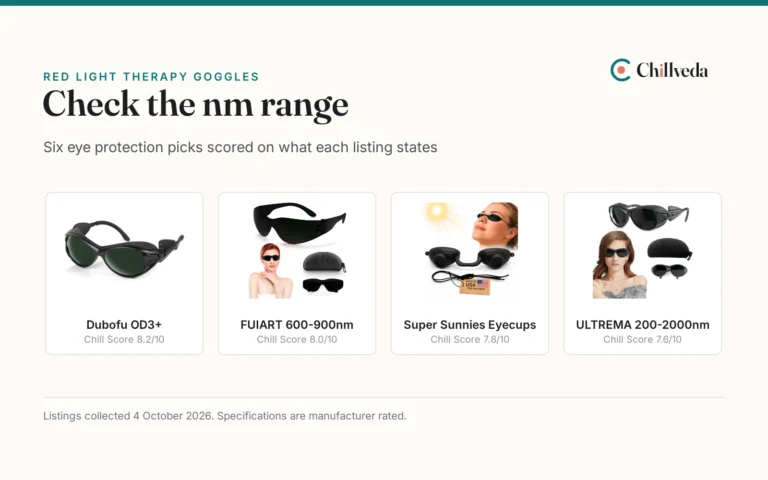
Red light therapy goggles protect your eyes from bright red and near infrared LEDs during a session. There are two kinds: opaque eyecups that block everything, and tinted see-through glasses that cut red and near infrared light but let you see. Which one you need depends on what you are doing during the session.
This roundup scores six picks sold on Amazon on what each listing states. Listings were collected 4 October 2026.
This article is informational and is not medical advice. If you have an eye condition, have had eye surgery, or take medication that makes you sensitive to light, ask an eye doctor before using red light devices. None of these products is rated here for laser protection. See our Medical Disclaimer.
Chillveda earns a commission when you buy through links on this page, at no extra cost to you. As an Amazon Associate I earn from qualifying purchases. Affiliate disclosure.
Quick picks
-
1
 Red Light Therapy Glasses Chill Score 9.7/10Check price on Amazon
See-through glasses designed for 660nm red and 850nm near infrared, with a stated optical density of 3 or more, about 10 percent visible light transmission and a one year warranty.
-
2
 Red Light Therapy Glasses Chill Score 9.6/10Check price on Amazon
Polycarbonate glasses that the brand says filter 600 to 900nm red and near infrared light by about 95 percent, with a case and a 12 month warranty.
-
3
 Super Sunnies Flexible UV Eye Tanning Bed Goggles Chill Score 9.6/10Check price on Amazon
Opaque flexible eyecups on a strap, sold mainly for tanning beds and also for red light therapy.
-
4
 ULTREMA Red Light Therapy Glasses Chill Score 9.6/10Check price on Amazon
Wraparound glasses with soft rubber side shields that the brand says protect against 200 to 2,000nm light, sold for red light, tanning and IPL.
-
5
 Mito Red Light Therapy Glasses Chill Score 9.6/10Check price on Amazon
Glasses from a red light panel maker that attenuate the 600 to 900nm band used by most devices while letting some visible light through.
-
6
 Mito Red PRO Red Light Therapy Goggles for Near Chill Score 9.5/10Check price on Amazon
Low profile goggles in two tints for 600 to 900nm: IR3 cuts light about 80 percent and IR5 about 95 percent, per the brand.
What we picked for home recovery

See-through glasses designed for 660nm red and 850nm near infrared, with a stated optical density of 3 or more, about 10 percent visible light transmission and a one year warranty.
Pros & ConsViewHide
Pros
- States optical density, OD3+
- Names the wavelengths it is built for, 660 and 850nm
- About 10 percent visible light, so you can still see
- One year warranty stated
Cons
- No test standard cited for the OD figure
- OD stated without saying at which wavelength
- Glasses style, light can enter at the edges

Polycarbonate glasses that the brand says filter 600 to 900nm red and near infrared light by about 95 percent, with a case and a 12 month warranty.
Pros & ConsViewHide
Pros
- States a 600 to 900nm range
- About 95 percent reduction, per the brand
- 12 month warranty stated
- Light polycarbonate, case included
Cons
- No optical density figure
- No test standard cited
- Also sold for laser and IPL use without a laser rating

Opaque flexible eyecups on a strap, sold mainly for tanning beds and also for red light therapy.
Pros & ConsViewHide
Pros
- Opaque, blocks the view entirely
- Slim cups on a strap, fit under a mask or panel
- Lowest price here
Cons
- You cannot see while wearing them
- Ratings shared across colors
- No wavelength range for red light stated
- No warranty stated

Wraparound glasses with soft rubber side shields that the brand says protect against 200 to 2,000nm light, sold for red light, tanning and IPL.
Pros & ConsViewHide
Pros
- Soft rubber side shields
- Broad 200 to 2,000nm claim
- Brand states UV blocking for tanning
Cons
- So broad a range with no detail is hard to trust
- No test standard cited
- No warranty stated
- Laser use claimed without a laser rating

Glasses from a red light panel maker that attenuate the 600 to 900nm band used by most devices while letting some visible light through.
Pros & ConsViewHide
Pros
- From a red light device brand
- States a 600 to 900nm band
- Clear note that sunglasses are not enough
Cons
- No optical density or percentage stated
- No test standard cited
- No warranty stated
- Glasses style, open at the edges

Low profile goggles in two tints for 600 to 900nm: IR3 cuts light about 80 percent and IR5 about 95 percent, per the brand.
Pros & ConsViewHide
Pros
- Two tints with stated reduction, about 80 or 95 percent
- States a 600 to 900nm band
- Slim glasses style frame
Cons
- No optical density or test standard
- No warranty stated
- Highest price here
What each listing states
| Pick | Type | Range stated | Strength stated | Warranty |
|---|---|---|---|---|
| Dubofu OD3+ | See-through | 660 and 850nm | OD3+, about 10% visible light | 1 year |
| FUIART 600-900nm | See-through | 600 to 900nm | About 95% reduction | 12 months |
| Super Sunnies Eyecups | Opaque | Not stated | Blocks view | Not stated |
| ULTREMA 200-2000nm | See-through | 200 to 2,000nm | Not stated in the bullets we read | Not stated |
| Mito Red Light | See-through | 600 to 900nm | Not stated | Not stated |
| Mito Red PRO IR5 | See-through | About 600 to 900nm | About 80% or 95% | Not stated |
Reading the numbers
Range should cover your device. Most home devices use red around 630 to 670nm and near infrared around 810 to 850nm, so a 600 to 900nm range covers them. Check your device’s listing.
Optical density (OD) is a log scale: OD1 lets through a tenth of the light, OD2 a hundredth, OD3 a thousandth. Only one listing here states it. A percentage reduction, such as 95 percent, is roughly OD1.3, much less blocking than OD3.
Near infrared is invisible. A lens can make a panel look dim while letting through much of its 850nm light. That is why a stated range and strength matter more than how dark the glasses look.
We read 20 listings. Four state a wavelength range, 8 state a warranty, 6 claim FDA compliance (those are tanning goggles, where FDA rules cover sunlamp eyewear), and none names a test standard for red or near infrared protection.
Opaque or see-through?
Lying under a panel or mat with nothing to look at, opaque eyecups are the simplest and block the most. If you need to see, for example to hold a handheld device or read the controls, use see-through glasses with a stated range and strength. With a face mask, follow the mask maker’s instructions, since goggles may not fit underneath.
Score notes
The Chill Score weighs performance 35, build 25, value 25, safety certifications 10 where it applies and warranty 5. Here, performance covers a stated wavelength range and a stated strength. No listing cites a test standard for red or near infrared, so all score zero for safety certifications.
| Product | Chill Score | Perf. /35 | Build /25 | Value /25 | Safety /10 | Warranty /5 |
|---|---|---|---|---|---|---|
| Dubofu OD3+ | 9.7 | 29 | 20 | 22 | n/a | 2 |
| FUIART 600-900nm | 9.6 | 28 | 19 | 22 | n/a | 2 |
| Super Sunnies Eyecups | 9.6 | 28 | 19 | 24 | n/a | 0 |
| ULTREMA 200-2000nm | 9.6 | 27 | 20 | 21 | n/a | 0 |
| Mito Red Light | 9.6 | 27 | 20 | 21 | n/a | 0 |
| Mito Red PRO IR5 | 9.5 | 29 | 20 | 19 | n/a | 0 |
Scores run from 9.2 to 9.8: each product’s point total is placed on that range, so more points always means a higher score. Safety counts only for powered gear or where the listing states safety features; where it does not apply, the score is taken over the remaining 90 points.
Dubofu leads as the only listing with an optical density figure and named wavelengths, plus a warranty. FUIART states a range, a reduction figure and a warranty. Super Sunnies is the cheap, proven opaque option.
Who should not buy one
If your device came with goggles that state a range and strength, use those. Do not use any of these for laser work; laser eyewear must be rated for that laser’s wavelength and power to a recognized standard.
For devices, see full body red light panels, red light therapy masks and red light therapy mats. To understand wavelengths, read red light wavelengths explained.
Common questions
Do I need goggles for red light therapy?
Most device makers tell you not to look into the LEDs and to use eye protection, especially with bright panels. Follow your device’s manual.
Are sunglasses enough?
No. Sunglasses are built for daylight and UV, not for close-range red and near infrared LEDs.
Can I keep my eyes closed instead?
Eyelids let some red and near infrared light through. Goggles are the safer habit with bright devices.
Back to all red light therapy reviews.