Short answer
Can compression boots replace a massage gun?
Not entirely, because they serve different recovery purposes. Compression boots provide hands-free sequential compression over the lower limbs, making them suitable for overall leg fatigue. A massage gun provides targeted percussive strokes for localized muscle knots across both the upper and lower body. Many athletes use boots for post-exercise leg relaxation and keep a massage gun for specific tight spots.
Choosing between compression boots vs massage gun recovery comes down to whether you need broad lower-limb compression or focused trigger-point relief. Compression boots use inflatable air chambers to deliver sequential pneumatic pressure across the lower limbs, making them best for hands-free post-workout leg recovery while resting. Massage guns deliver rapid, localized percussive pulses via a motor-driven head, making them ideal for pinpointing tight knots in specific muscles anywhere on the body, from shoulders and back to hamstrings and calves.
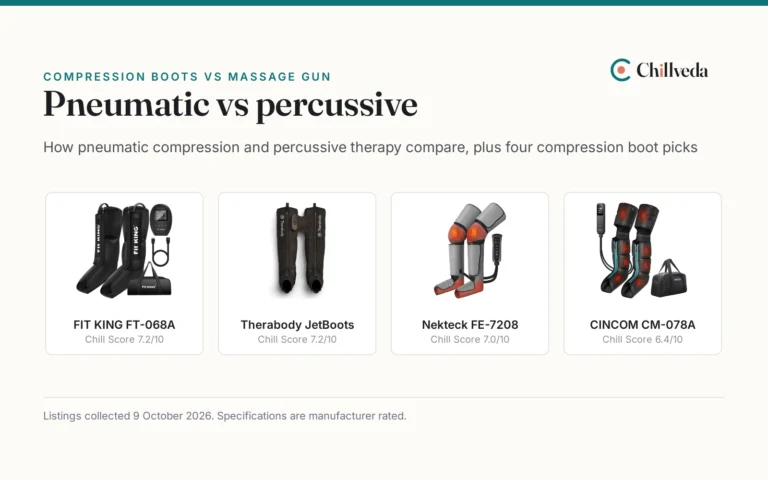
This guide compares pneumatic compression sleeves and percussive massagers across treatment area, effort, portability, and maker specifications, featuring four compression boot systems to show what current models offer. Listings were collected 9 October 2026.
This article is informational and is not medical advice. Percussive massagers and compression boots apply mechanical pressure to muscular tissue. Avoid using massage guns on the neck, spine, carotid arteries, bony areas, or acute injuries. Do not use compression boots if you have a history of deep vein thrombosis, blood clots, severe vascular disorders, or active skin infections without consulting a doctor first. Stop use immediately if you experience sharp pain, skin numbness, or dizziness. See our Medical Disclaimer.
Chillveda earns a commission when you buy through links on this page, at no extra cost to you. As an Amazon Associate I earn from qualifying purchases. Affiliate disclosure.
Quick picks
-
1
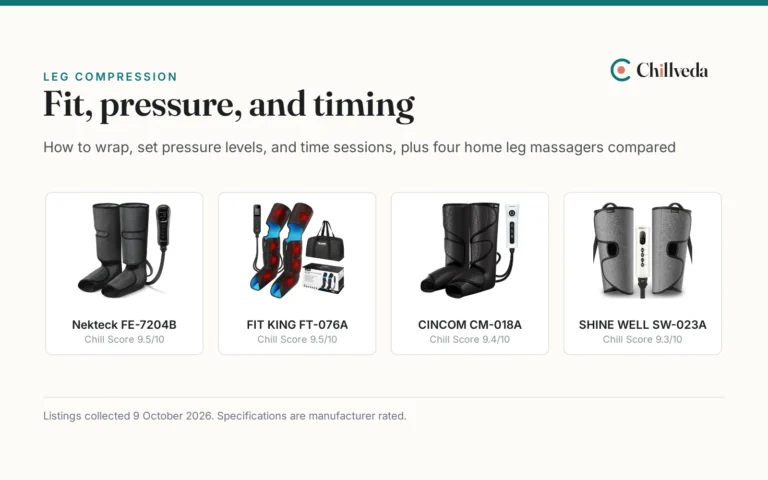
 FIT KING Air Compression Leg Massager Chill Score 9.5/10Check price on Amazon
A corded compression boot system with three airbag chambers, nine pressure intensities, and two years of worry-free service.
-
2
 Therabody JetBoots Prime Wireless Compression Chill Score 9.5/10Check price on Amazon
A fully wireless pair of compression boots with four overlapping air chambers, four pressure levels, and a stated three-hour battery life.
-
3
 Nekteck Leg Massager for Circulation and Pain Chill Score 9.5/10Check price on Amazon
A full-leg wrap combining air compression, calf vibration, and knee heat, supported by a stated one-year warranty.
-
4
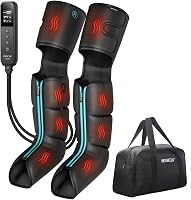 CINCOM Leg Massager with Heat and Air Compression Chill Score 9.4/10Check price on Amazon
A zippered four-zone leg massager providing sequential air compression and heat with three intensity levels.

A corded compression boot system with three airbag chambers, nine pressure intensities, and two years of worry-free service.
Pros & ConsViewHide
Pros
- Two years of worry-free after-sales service
- Nine pressure intensity settings
- Three massage modes and pressure sensor
- Lightweight build at 3.5 pounds
Cons
- Corded operation requires hose connections
- Covers only the feet and calves
- No safety certification stated
- Spec table lists only home grade plastic and nylon

A fully wireless pair of compression boots with four overlapping air chambers, four pressure levels, and a stated three-hour battery life.
Pros & ConsViewHide
Pros
- Completely wireless with built-in pumps
- Four overlapping air chambers
- Four pressure levels and time intervals
- Three-hour stated battery run time
Cons
- Heaviest unit here at 9.46 pounds
- No warranty term stated in the listing
- Charging time is listed simply as 5
- Large size requires a 35-inch minimum inseam

A full-leg wrap combining air compression, calf vibration, and knee heat, supported by a stated one-year warranty.
Pros & ConsViewHide
Pros
- One-year warranty stated in listing
- Full-leg coverage from feet to thighs
- Includes two heat and three vibration settings
- Adjustable Velcro fits up to 29.92 inch thighs
Cons
- Does not provide mechanical kneading
- Spec table mislabels technique as vibration only
- Corded design with multiple connecting straps
- No safety certification stated
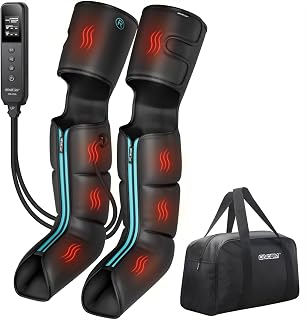
A zippered four-zone leg massager providing sequential air compression and heat with three intensity levels.
Pros & ConsViewHide
Pros
- Four independent air compression chambers
- Three compression modes and three intensities
- Built-in heat function and overheat protection
- Zippered leg wraps for easy adjustment
Cons
- No warranty term stated in the listing
- Listing contradicts itself on body coverage
- Corded wall-plug operation only
- No safety certification stated
More to compare
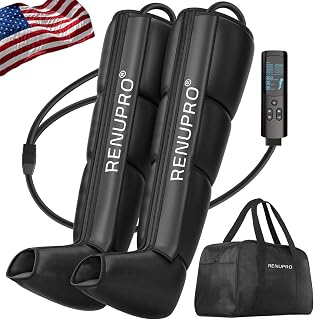 Leg Compression MassagerCheck price on Amazon
 SAN HIMA Air Compression Leg MassagerCheck price on Amazon
 Air Relax Plus AR-3 Professional Compression BootsCheck price on Amazon
 DEKEMASTER Full Leg Compression MassagerCheck price on Amazon
 JZBRAIN Professional Sequential Air Compression Boots forCheck price on Amazon
 Compex Ayre Wireless Rapid Recovery Compression BootsCheck price on Amazon
Compression boots vs massage gun comparison, from maker specs
| Feature | Compression boots | Massage gun |
|---|---|---|
| Primary mechanism | Dynamic pneumatic air compression | Rapid percussive mechanical strokes |
| Treatment area | Lower limbs (calves and feet, with some models extending to thighs) | Targeted muscle areas across the body |
| User effort | Passive, hands-free while seated or reclined | Active manual application holding the device |
| Typical session format | Automated timed cycles | Brief sweeps over specific muscle groups |
| Portability and storage | Larger leg sleeves, corded or rechargeable | Compact handheld unit in a small carrying case |
| Common settings | Multiple pressure levels and sequential modes | Multiple speed ranges and interchangeable heads |
The comparison highlights two distinct recovery modalities. Compression boots wrap the lower limbs in segmented sleeves, inflating and deflating air chambers to produce rhythmic pressure waves. A massage gun uses a motorized percussive head to pulse against muscle tissue. While boots automate seated sessions over the legs, a massage gun requires active manual effort to position and hold the tool against each muscle group.
How pneumatic compression and percussive therapy work
Pneumatic compression boots work through sequential air compression. An internal or external air pump fills distinct bladder chambers in sequence, typically starting at the foot and progressing upward through the calf and, on full-leg models, the thigh. This sequential squeeze creates a pressure gradient designed to facilitate fluid movement and circulation in healthy individuals after long workouts or extended standing. Because the boots remain attached to your legs, you remain stationary while the system cycles through preset compression routines.
Percussive therapy relies on mechanical amplitude and stall force rather than air bladders. When you press a massage gun against a muscle, the head pulses repeatedly into the tissue, producing localized vibrations and tissue distortion. This mechanical action helps ease isolated muscle stiffness and trigger points that broad air chambers cannot isolate. For deeper detail on how amplitude and motor power function, see our guide on massage gun specs explained.
Where each recovery tool fits best
Choosing between these recovery tools depends largely on where your soreness occurs and how much effort you wish to exert. If your primary fatigue is concentrated in the calves, or across the full leg on extended models, compression boots offer passive convenience. You zip or strap the sleeves around your legs, select a program, and rest while the device runs. Conversely, boots cannot treat upper body areas such as the traps, shoulders, lower back, or chest.
A massage gun excels at targeted spot treatments across the entire body. If you have an isolated knot in your shoulder blade or tight glutes, a handheld gun can address that exact point directly. However, treating both legs thoroughly requires manually holding and sweeping the device across each muscle group, which eliminates the passive rest that boots provide. Review our massage gun safety overview to learn where percussion should never be applied.
Storage and dimensions also differentiate the two. For example, the Therabody JetBoots list package dimensions of 14.5 by 10.5 by 20.5 inches, and Nekteck lists product dimensions of 16.14 by 9.84 by 8.27 inches. These multi-chamber sleeves require dedicated shelf or floor space when packed away. Handheld massage guns, by comparison, fit into a compact case that slips easily into a gym bag or drawer.
Compression boots worth considering
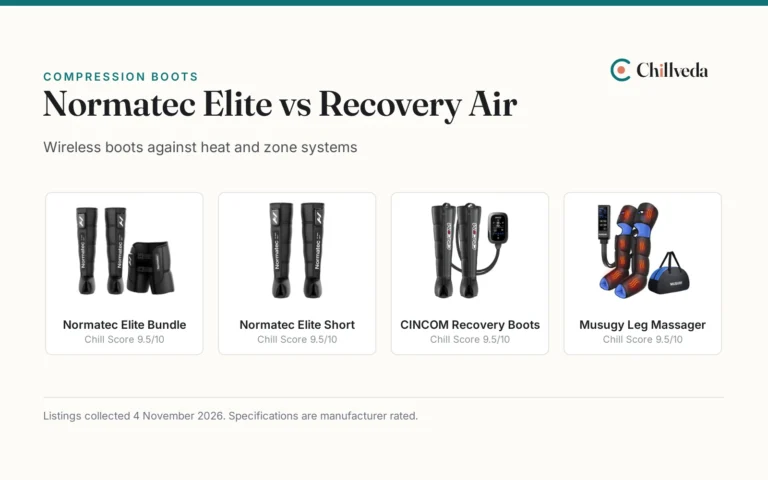
These are scored on the Chill Score, which weighs performance 35, build 25, value 25, safety certifications 10 where it applies and warranty 5. None of these four listings states a recognized electrical safety certification, so all four score 0 for safety.
| Product | Chill Score | Perf. /35 | Build /25 | Value /25 | Safety /10 | Warranty /5 |
|---|---|---|---|---|---|---|
| FIT KING FT-068A | 9.5 | 29 | 20 | 21 | 0 | 2 |
| Therabody JetBoots | 9.5 | 33 | 22 | 19 | 0 | 0 |
| Nekteck FE-7208 | 9.5 | 29 | 19 | 21 | 0 | 1 |
| CINCOM CM-078A | 9.4 | 27 | 18 | 20 | 0 | 0 |
Scores run from 9.2 to 9.8: each product’s point total is placed on that range, so more points always means a higher score.
For more options, see our dedicated guides to the best compression boots and best massage guns.
Using recovery tools in practice
- Start on the lowest pressure setting. Both pneumatic boots and massage guns apply significant force. Nekteck specifically advises starting on the lowest intensity and increasing air pressure gradually as you adapt.
- Follow stated cycle durations. Automated boots feature preset automatic shut-off timers. Keep percussive treatments brief rather than lingering excessively on a single spot.
- Avoid direct contact on bone and joints. Percussion heads should only contact muscular tissue. Never press a massage gun into the shin bone, kneecap, spine, or neck.
- Check sizing and fit before ordering. Compression boots require proper limb length and circumference to work effectively. Therabody, for instance, requires a 35-inch minimum inseam for its large size, while Nekteck accommodates thigh circumferences up to 29.92 inches.
- Keep corded units safely routed. Corded boots like the FIT KING FT-068A require connecting air hoses and power adapters. Keep cords clear of walkways to prevent trips or damaged connectors.
Common mistakes
- Using a massage gun over bony areas, the spine, or the front of the neck instead of soft muscle bellies.
- Pumping compression boots to maximum pressure immediately rather than letting muscles adapt to lower pressure.
- Expecting compression boots to treat upper-body stiffness or tight back muscles.
- Relying on seller marketing claims rather than checking stated dimensions, power requirements, and warranty terms.
Common questions
Can compression boots replace a massage gun?
Not entirely, because they serve different recovery purposes. Compression boots provide hands-free sequential compression over the lower limbs, making them suitable for overall leg fatigue. A massage gun provides targeted percussive strokes for localized muscle knots across both the upper and lower body. Many athletes use boots for post-exercise leg relaxation and keep a massage gun for specific tight spots.
Which is better for sore calves, boots or a massage gun?
Both tools can address calf tightness, but the application differs. Compression boots wrap the lower leg and apply rhythmic pressure waves without requiring manual effort. A massage gun lets you pinpoint specific calf muscle areas directly, but requires active holding and careful avoidance of the Achilles tendon. If you want to relax passively, boots are generally more convenient.
Are compression boots safe to use every day?
Most manufacturers design compression boots for regular use following workout sessions or long periods on your feet. Models in this guide include automated shut-off timers to prevent excessive use. However, anyone with circulatory disorders, deep vein thrombosis, or sensory neuropathy should consult a physician before using pneumatic compression.
How do you use an air compression leg massager properly?
To use compression boots, sit or recline comfortably with your legs extended before securing the zippers or straps. For corded models, connect the air hoses and power adapter; wireless designs use integrated controls on the boot cuff. Always select the lowest intensity setting first. Learn more about setup steps in our guide on how to use air compression leg massager systems.
When should you not use a massage gun?
You should never use a massage gun on your neck, face, spine, groin, or directly over bones and joints. Avoid percussive treatment over acute muscle tears, sprains, open wounds, or bruised skin. For a detailed breakdown of caution areas, read our guide on how to use a massage gun safely.
Sources: Amazon product listings for the compression boots named above, collected 9 October 2026. Related: our air compression massager guide and massage gun safety overview.
Back to all recovery tools reviews.