


A massage gun delivers rapid, forceful percussion into whatever you point it at. That is the entire function, and it is why the question of where not to point it is not a footnote.
This guide covers the areas to avoid, the conditions that mean you should ask a clinician first, and how to use the device sensibly on the areas where it is appropriate.
This article is informational and is not medical advice. It is not a substitute for advice from a qualified clinician. Please read our full Medical Disclaimer, and speak to your doctor before using a percussion device if you have any health condition.
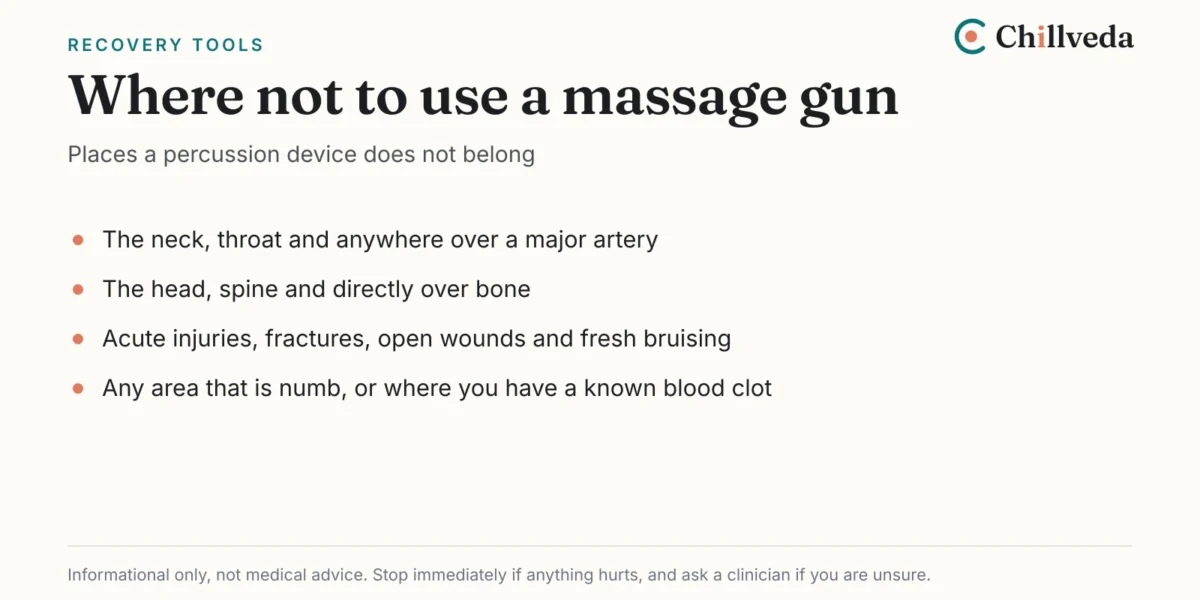
The areas to avoid
The neck and throat
The front and sides of the neck contain the carotid arteries and a dense cluster of nerves and other structures close to the surface. Percussion here is not something to experiment with. If neck tension is the reason you bought the device, that is a conversation for a physical therapist.
The head and spine
Do not use a percussion device on the skull, the face, or directly over the vertebrae of the spine. The muscles either side of the spine are a different matter, but the bony column itself is not a target.
Over bone, and over joints
Percussion is for muscle. Driving a hard head into a shin, a kneecap, an elbow, or a hip bone is painful and pointless. Work on the muscle belly, away from the joint.
Major arteries and the abdomen
Avoid the inside of the upper arm, the groin, the front of the neck, and the abdomen, all of which have significant vessels or organs close to the surface.
Conditions that mean asking first
Speak to a clinician before using a percussion device at all if any of the following apply:
- A known or suspected blood clot, deep vein thrombosis, or any clotting disorder
- Anticoagulant medication
- Osteoporosis or any condition affecting bone density
- Diabetes or any condition causing neuropathy or reduced sensation
- Varicose veins in the area you want to work on
- Pregnancy
- A pacemaker or other implanted device
- Recent surgery, a fracture, or an implant in the area
- Any inflammatory condition affecting the muscles or joints
The common thread is that percussion applies mechanical force to tissue and moves blood. Where either of those is a problem for you, the device is a problem for you.
Injuries: not on anything acute
Do not use a massage gun on a fresh injury. That means sprains, strains, tears, fresh bruising, open wounds, burns, rashes, or anything swollen and hot.
Percussion on an acute injury can worsen bleeding into the tissue and delay recovery. The usual advice for the first days after an injury does not include hitting it repeatedly.
If you have an injury that is not resolving, see somebody qualified rather than treating it with a consumer device.
Sensible use where it is appropriate
Keep sessions short. A minute or two on a muscle group is plenty, and there is no benefit to grinding away at one spot.
Keep the head moving rather than holding it in one place. Move along the muscle slowly.
Use light pressure. The device does the work; leaning into it does not make it more effective, and it is how people cause bruising.
Stop if it hurts. Discomfort that feels like pressure is one thing. Sharp pain, numbness, or tingling means stop immediately, and if it persists, get it looked at.
Do not use one on somebody else’s body unless you know what you are doing. You cannot feel what they feel.
Children and older adults
These devices are not toys. Keep them away from children, and do not use one on a child without guidance from a clinician.
For older adults, the concerns around bone density, skin fragility, medication, and circulation all rise at once. Ask first.
What a massage gun does not do
You will see claims that percussion breaks up scar tissue, removes lactic acid, releases fascia, or speeds healing. Chillveda does not make those claims and does not endorse them when a seller does.
People use these devices because muscles feel looser and more comfortable afterward. That is a reasonable reason, it needs no medical framing, and our How We Review page explains how we treat this category of claim.
If you are choosing a device
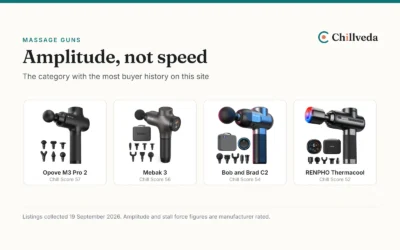
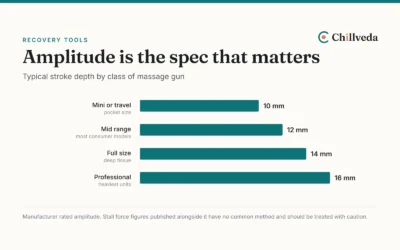
Lower amplitude devices are gentler, which for a first device is an argument in their favour rather than against. Our guide to amplitude and stall force explains which specifications matter, and our massage gun coverage applies it.
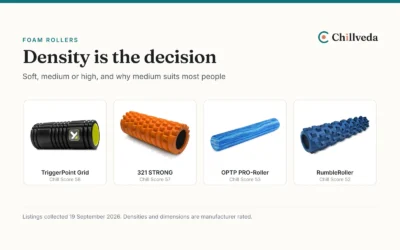
If you are at all unsure whether percussion is appropriate for your body, a foam roller does a related job with far less force and far fewer contraindications.



Write Your Review
No reviews yet. Be the first to share your experience!