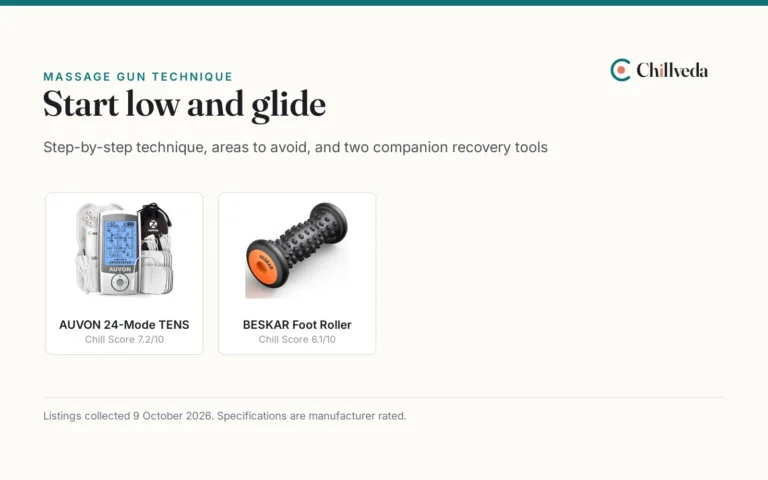
How to use a massage gun comes down to a simple routine: select a broad attachment head, turn on the device before touching your skin, start on the lowest speed setting, and glide the head slowly along the belly of the target muscle without pressing down. Let the rapid percussive pulses do the work for short intervals per muscle group as directed by your manufacturer manual, and stop immediately if you feel pain, numbness, or irritation. Never force the head into joints, bones, or sensitive areas.
This guide explains proper massage gun technique, attachment head selection, areas to avoid, and two companion recovery tools to complement your soft tissue routine. Listings were collected 9 October 2026.
This article is informational and is not medical advice. Massage guns deliver rapid mechanical force to soft tissue. Do not use a massage gun on your neck, spine, throat, head, groin, or major arteries, or over acute sprains, fractures, or open wounds. Consult a healthcare provider before use if you are pregnant, have a pacemaker, take blood thinners, or have a vascular condition. See our Medical Disclaimer.
Chillveda earns a commission when you buy through links on this page, at no extra cost to you. As an Amazon Associate I earn from qualifying purchases. Affiliate disclosure.
Quick picks
-
1
 AUVON 24 Modes TENS Unit Muscle Stimulator Chill Score 9.5/10Check price on Amazon
A rechargeable dual-channel TENS unit with 24 pre-programmed modes, 8 electrode pads, and a stated 12-month warranty.
-
2
 BESKAR Foot Massager Roller for Plantar Fasciitis Chill Score 9.3/10Check price on Amazon
A 4-ounce contoured thermoplastic elastomer foot roller designed for manual arch and heel acupressure massage.

A rechargeable dual-channel TENS unit with 24 pre-programmed modes, 8 electrode pads, and a stated 12-month warranty.
Pros & ConsViewHide
Pros
- 24 pre-programmed modes across 6 massage patterns
- Rechargeable lithium battery with up to 10 hours continuous use
- Includes 8 reusable electrode pads and pad holder
- 12-month warranty stated by the manufacturer
Cons
- Not for individuals with pacemakers, pregnancy, or epilepsy
- Solid gel pads require replacement after about 45 uses
- No independent electrical safety listing stated
- Requires consulting a physician before use for existing medical conditions

A 4-ounce contoured thermoplastic elastomer foot roller designed for manual arch and heel acupressure massage.
Pros & ConsViewHide
Pros
- Compact footprint measuring 6 by 2.59 by 2.59 inches
- Lightweight design at 4 ounces
- Thermoplastic elastomer construction contoured for foot arch
- Manual rolling requires no charging or batteries
Cons
- No warranty term is stated
- No safety certifications stated
- Designed only for foot use rather than full body muscles
- Listing title model number contradicts the FR-300 part number
More to compare
 TOLOCO Massage GunCheck price on Amazon
 RENPHO Power+ Thermacool Massage Gun with Heat and Cold 12mmCheck price on Amazon
 RENPHO Active Thermacool 2 Red Massage Gun with InfraredCheck price on Amazon
 OLsky Massage Gun Deep Tissue 30 Speeds 9 Attachments HandheldCheck price on Amazon
 Lifepro Sonic Massage Gun Percussion Muscle MassagerCheck price on Amazon
 Opove M3 Mini Massage Gun for Back Pain Relief with FacialCheck price on Amazon
How to use a massage gun: attachment heads and target areas
| Attachment head | Target muscle group | Technique guideline |
|---|---|---|
| Round ball head | Quads, glutes, hamstrings, calves | Glide across large muscle bellies without pressing downward |
| Flat head | Chest, shoulders, dense tissue | Maintain flat contact across broad surface areas |
| Bullet head | Targeted knots, trigger points | Apply briefly to localized tight spots; avoid pressing into bone |
| Fork head | Calves, forearms, Achilles tendon | Position prongs to straddle elongated tissue while avoiding bone |
| Cushion head | Sensitive areas, near joints | Gentle percussion for tender spots and light recovery |
Matching the head to the tissue ensures even pressure without jarring bone. Start any session with a softer round or cushion head before progressing to targeted shapes.
Massage gun technique: glide, do not press
A percussion massager is engineered to deliver rapid pulses against soft tissue. Pressing the device hard into your muscle stalls the motor and strains the tissue rather than promoting relaxation. Rest the attachment head lightly against your skin and let the percussive strokes do the work. Move the head along the length of the muscle belly at a steady, unhurried pace rather than holding it motionless in one spot.
Start every session on the lowest speed setting to let your muscles adjust to the percussive rhythm. Higher speeds do not necessarily provide deeper relief and can cause discomfort on tight or fatigued muscles. Keep the device perpendicular to the muscle surface so the head strikes evenly rather than bouncing sideways.
Where not to use a massage gun
Knowing where to avoid placing a percussion massager is just as important as knowing how to use it. Never use a massage gun directly on bone, joints, the front or sides of the neck, the throat, or the spine. The rapid mechanical hammering can compress superficial nerves, irritate cervical vertebrae, or damage delicate blood vessels in the carotid area.
Avoid the groin, armpits, abdomen, and any area with varicose veins or visible swelling. Do not apply percussive therapy to acute injuries, pulled muscles, sprains, bursitis, or broken skin. For an in-depth breakdown of high-risk anatomical zones and contraindications, read our guide on where not to use a massage gun.
Recovery tools to pair with your massage gun
These are scored on the Chill Score, which weighs performance 35, build 25, value 25, safety certifications 10 where it applies and warranty 5. None of these four listings state an independent safety certification, so all four score 0 for safety.
| Product | Chill Score | Perf. /35 | Build /25 | Value /25 | Safety /10 | Warranty /5 |
|---|---|---|---|---|---|---|
| AUVON 24-Mode TENS | 9.5 | 29 | 20 | 21 | 0 | 1 |
| BESKAR Foot Roller | 9.3 | 24 | 18 | 19 | 0 | 0 |
Scores run from 9.2 to 9.8: each product’s point total is placed on that range, so more points always means a higher score.
For dedicated percussion massager options across power and stall force tiers, explore our best massage guns guide.
Setting up your session in practice
- Start on the lowest speed. Begin on the lowest speed setting before increasing intensity. Higher speeds are not necessarily more effective and should only be used if lower speeds feel comfortable.
- Follow your manual on session length. Percussion manuals typically specify short intervals per muscle group. Follow the duration in your device manual rather than guessing.
- Turn the device on first. Power on the massager before placing the attachment head against your skin to avoid sudden jarring impact.
- Breathe and stay relaxed. Keep the muscle you are treating slack and supported. Tensing against the percussive pulse works against the massage.
- Stop at pain. Percussion should feel like firm relief, not sharp pain. If you experience stinging, numbness, or bruising, power off the unit immediately.
Common mistakes
- Pushing down forcefully into muscle tissue until the motor stalls.
- Running the attachment head over bony landmarks, joints, or the spine.
- Starting on the highest speed setting before muscle tissue has adapted.
- Using percussion over acute muscle strains, open wounds, or inflamed joints.
- Ignoring device manufacturer safety warnings regarding pacemakers or vascular conditions.
Common questions
How to use a massage gun for the first time?
Turn on the device on its lowest speed before touching your skin. Rest the round head lightly against a large muscle group like your quad or calf and glide it gently along the muscle belly. Follow your manufacturer manual for session duration and stop if you feel discomfort.
Where should you avoid using a massage gun?
Do not use a massage gun on your neck, throat, spine, armpits, groin, or directly over bones and joints. Avoid acute sprains, bruises, fractures, and areas with varicose veins. If you have a medical implant or circulatory condition, consult your physician before use.
Should you press down hard with a massage gun?
No. Let the weight of the device and the mechanical percussion do the work. Pressing down hard can stall the motor, cause bruising, and irritate deeper nerves or periosteum.
Which attachment head should you use first?
Start with a large round ball head or a soft cushion head. These distribute percussive force broadly and are the gentlest options for warming up large muscle groups before moving to targeted shapes.
How often can you use a massage gun?
Check your manufacturer manual for session frequency recommendations. Allow muscles to recover fully between sessions, and avoid treating areas that still feel tender or sore.
Sources: Amazon product listings for the recovery tools named above, collected 9 October 2026. Related: our massage gun specs explained guide and best massage gun attachments roundup.
Back to all massage gun reviews.