Setting aside ten minutes on a living room carpet or yoga mat after a long workday at a desk can relieve lumbar stiffness before evening sets in. Finding the best back stretcher device comes down to whether you need passive arched extension, targeted thoracic release, or mechanical traction levers to decompress spinal discs at home.
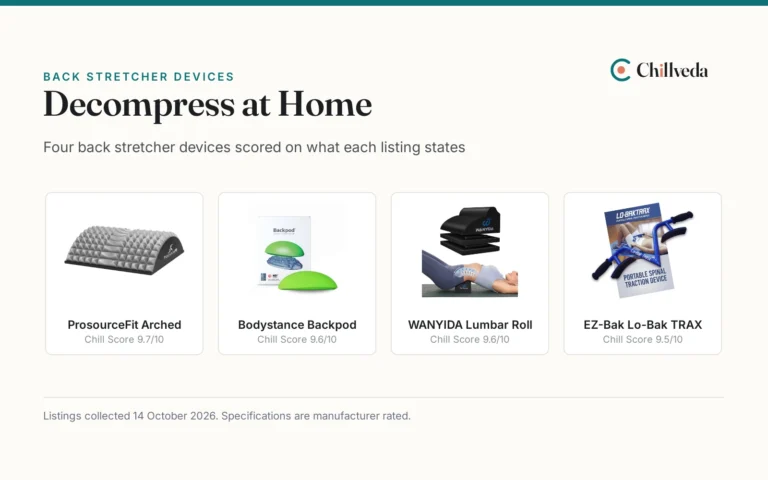
This roundup scores four back stretcher devices on Amazon based on what each manufacturer listing states. Listings were collected 14 October 2026.
This article is informational and is not medical advice. Back stretching tools place direct pressure on vertebrae and connective tissues. Avoid aggressive force on the cervical neck, acute disc herniations, spinal fractures, or major blood vessels, and stop immediately if you feel numbness or sharp pain. Speak to a physician or physical therapist before starting spinal traction. See our Medical Disclaimer.
Chillveda earns a commission when you buy through links on this page, at no extra cost to you. As an Amazon Associate I earn from qualifying purchases. Affiliate disclosure.
Quick picks
-
1
 ProsourceFit Arched Back Stretching Spike Chill Score 9.7/10Check price on Amazon
An arched EVA foam stretching device with firm massage bumps and a stated limited lifetime warranty for home lumbar support.
-
2
 Bodystance Backpod - Premium Device Chill Score 9.6/10Check price on Amazon
A New Zealand-made contoured thoracic stretching device designed by physiotherapists to target costochondritis, hunching, and upper spine stiffness.
-
3
 WANYIDA Lumbar Orthotic Traction Roll Device Chill Score 9.6/10Check price on Amazon
A height-adjustable EVA foam lumbar roll featuring three cushion placement settings and a 300-pound load rating for home back support.
-
4
 EZ-Bak Lo-Bak TRAX Lumbar Spine Stretcher Chill Score 9.5/10Check price on Amazon
A portable metal spinal traction frame with dual hand levers that delivers non-powered decompression while lying flat on your back.
What we picked for home recovery

An arched EVA foam stretching device with firm massage bumps and a stated limited lifetime warranty for home lumbar support.
Pros & ConsViewHide
Pros
- Limited lifetime warranty stated on the listing
- Solid foam-filled interior provides a sturdy base
- Firm yet flexible EVA foam bumps for acupressure massage
- Lightweight design weighing 8 ounces
Cons
- Fixed 4-inch arch height without adjustments
- Foam material not rated for water resistance
- No safety certification listed
- Manual design lacks heat or motorized massage
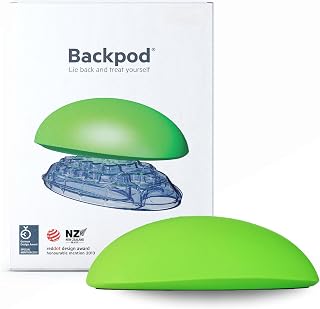
A New Zealand-made contoured thoracic stretching device designed by physiotherapists to target costochondritis, hunching, and upper spine stiffness.
Pros & ConsViewHide
Pros
- Physiotherapist designed and manufactured in New Zealand
- Specialized contour targeting thoracic spine and costochondritis
- Includes detailed user guide with step-by-step instructions
- Compact dimensions of 2.76 x 5.12 x 7.87 inches
Cons
- No warranty term is stated
- Weight is not stated on the listing
- No safety certification listed
- Fixed dome contour offers no height adjustments

A height-adjustable EVA foam lumbar roll featuring three cushion placement settings and a 300-pound load rating for home back support.
Pros & ConsViewHide
Pros
- Three height-adjustable placement settings
- Rated to support up to 300 lbs
- Lightweight at 6.4 ounces for easy portability
- Ergonomic fulcrum point targets lower, middle, and upper lumbar regions
Cons
- Only one size is offered
- Requires hand wash care only
- No safety certification listed
- Non-powered design without mechanical traction handles

A portable metal spinal traction frame with dual hand levers that delivers non-powered decompression while lying flat on your back.
Pros & ConsViewHide
Pros
- Sturdy metal frame construction weighing 2.5 pounds
- Dual hand levers allow user-controlled traction force
- Includes instructional manual, instructional DVD, and bonus stretch DVD
- Non-powered operation requires no cords or batteries
Cons
- Spec table lists massager form as roller despite title describing a traction frame
- No warranty term is stated
- No safety certification listed
- Larger footprint at 23 x 9 x 5 inches than foam arches
More to compare
 ChiFit Multi-Level Back Stretching DeviceCheck price on Amazon
 Multi-Level Back Stretcher DeviceCheck price on Amazon
 Electric Lumbar Traction Device for Decompression & SciaticaCheck price on Amazon
 Electric Lumbar Traction Device for Lower Back DecompressionCheck price on Amazon
 Cervical Neck Traction DeviceCheck price on Amazon
 4-in-1 Electric Lumbar Traction Device for Lower Back PainCheck price on Amazon
What to look for in the best back stretcher device
Back stretchers differ in how they apply force along the spine. Passive arch supports rely on your body weight over a curved surface, while mechanical frames let you apply push force through hand levers:
| Design Type | Primary Mechanism | Typical Height | Best Suited For |
|---|---|---|---|
| Acupressure arch | Passive body-weight curve with raised nodules | 4 inches | General lumbar extension and muscle knots |
| Adjustable roll | Variable foam cushions with fulcrum point | Up to 4.9 inches | Targeted lower back curve realignment |
| Thoracic pivot | Dense contoured dome for rib and upper spine joints | 5 centimeters | Upper back slouching and costochondritis |
| Traction frame | Dual-lever hand pushing for axial decompression | 5 inches | Lower spine decompression without inversion |
Choosing between these styles depends on whether your stiffness centers in the lumbar spine, between the shoulder blades, or requires active traction control rather than passive lying down.
Materials, dimensions and warranty
| Device | Material | Dimensions | Weight | Warranty |
|---|---|---|---|---|
| ProsourceFit Arched | EVA foam | 12 x 11 x 4 in | 8 oz | Limited Lifetime Warranty |
| Bodystance Backpod | Not stated | 2.76 x 5.12 x 7.87 in | Not stated | Not stated |
| WANYIDA Lumbar Roll | EVA foam | 9.8 x 6.3 x 4.9 in | 6.4 oz | One year warranty |
| EZ-Bak Lo-Bak TRAX | Metal | 23 x 9 x 5 in | 2.5 lb | Not stated |
Two listings state a concrete warranty term: ProsourceFit with a limited lifetime warranty and WANYIDA with a one year warranty. Bodystance and EZ-Bak do not state a warranty term. Weights range from 6.4 ounces for the WANYIDA roll to 2.5 pounds for the metal EZ-Bak traction frame.
Who should not buy these
Anyone experiencing acute spinal trauma, active disc herniations with radiating numbness, spinal instability, spondylolisthesis, or severe osteoporosis should avoid unguided spinal traction and consult a physician first. Passive arches and traction devices place firm, localized pressure on spinal joints that can aggravate acute inflammation if used improperly.
These manual devices also lack powered heat or massage rollers. If you want active percussion or automated kneading rather than manual stretching, a dedicated back massager or massage gun is a better fit. For alternatives, see our guides to back massagers, foam rollers, inversion tables, and massage guns.
Score notes
The Chill Score weighs performance 30, build 20, value 20, safety certifications 15, and warranty 15. For these manual back stretchers, performance reflects stated traction support, ergonomic adjustability, and functional design. Because none of these non-powered devices carry independent electrical or safety certifications, safety is zero for all four. Warranty points require a concrete term stated on the listing.
| Product | Chill Score | Perf. /35 | Build /25 | Value /25 | Safety /10 | Warranty /5 |
|---|---|---|---|---|---|---|
| ProsourceFit Arched | 9.7 | 29 | 21 | 22 | n/a | 3 |
| Bodystance Backpod | 9.6 | 30 | 21 | 20 | n/a | 0 |
| WANYIDA Lumbar Roll | 9.6 | 28 | 20 | 21 | n/a | 0 |
| EZ-Bak Lo-Bak TRAX | 9.5 | 27 | 20 | 19 | n/a | 0 |
Scores run from 9.2 to 9.8: each product’s point total is placed on that range, so more points always means a higher score. Safety counts only for powered gear or where the listing states safety features; where it does not apply, the score is taken over the remaining 90 points.
ProsourceFit leads the group with solid EVA foam construction and a stated limited lifetime warranty. Bodystance provides specialized thoracic targeting developed by physiotherapists for upper back tension. WANYIDA offers useful three-level height adjustments, while EZ-Bak provides portable metal lever traction despite an internal listing contradiction regarding its form factor.
Check Your Space First
- The longest device here is the EZ-Bak Lo-Bak TRAX at 23 inches long by 9 inches wide and 5 inches high, which requires enough clear floor area to lie flat with bent knees while extending the metal levers.
- The ProsourceFit arched stretcher measures 12 by 11 inches with a 4-inch arch height, while the WANYIDA roll measures 9.8 by 6.3 inches with a 4.9-inch height across its three cushion settings.
- The Bodystance Backpod measures 7.87 by 5.12 by 2.76 inches (with a 5-centimeter thickness), making it compact enough for a standard drawer or tote bag.
- Weights range from 6.4 ounces for the WANYIDA roll and 8 ounces for the ProsourceFit arch up to 2.5 pounds for the metal EZ-Bak frame, with no electrical outlets or cords required across any of the four models.
- The WANYIDA roll states a rated user weight capacity of up to 300 lbs and compresses between 10% and 30% under body weight.
Common questions
How does a back stretcher work?
A back stretcher works by supporting the spine in an extended arch or by exerting mild traction along vertebrae. Passive arches use body weight over contoured foam to stretch tight chest and abdominal muscles while opening compressed intervertebral spaces. Levered traction frames allow users to push with their arms to gently elongate the lumbar spine.
Are back stretchers safe to use at home?
When used according to manufacturer instructions on a firm, flat surface, manual back stretchers are generally safe for healthy adults. However, individuals with acute disc herniations, severe osteoporosis, spinal fractures, or persistent numbness should avoid spinal traction without consulting a doctor. Always discontinue use immediately if you experience sharp or radiating pain.
How often should you use a back stretcher?
Most manufacturers recommend starting with short sessions of two to five minutes once or twice per day on a gentle setting. As your muscles adapt to the passive extension, you can gradually increase frequency to daily use during your warm-up or evening wind-down routine. Consistency is more beneficial than prolonged, aggressive stretching sessions.
How long should you stay on a back stretcher?
Beginners should limit initial sessions to one or two minutes to gauge comfort and spinal tolerance. Over time, sessions can extend to five or ten minutes per session depending on the rigidity of the device and your personal mobility level. Lying on an arched stretcher for too long can cause muscle spasm or lower back tenderness.
Are back stretchers good for upper back stiffness?
Certain contoured devices, such as the Bodystance Backpod, are specifically shaped to mobilize the thoracic spine and rib joints between the shoulder blades. Standard arched lumbar stretchers can also be positioned higher along the mid-back to open the chest, provided you keep your knees bent to support the lower spine. Always ease onto the device gradually to prevent strain.
Back to all recovery tools reviews.