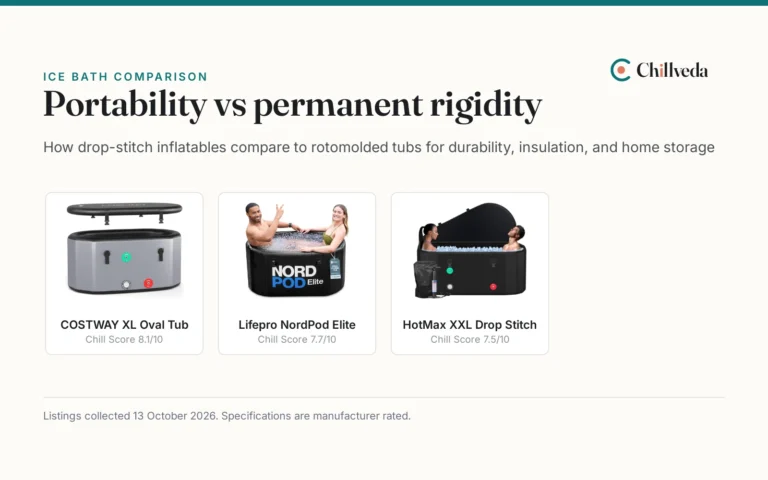
Stepping onto a cold patio or into a garage after a morning workout to plunge comes down to whether your tub needs to stay put or pack away. When deciding between a drop stitch ice bath vs rotomolded ice bath, the core trade-off is portable convenience against permanent rigidity: drop-stitch tubs inflate board-stiff with high-pressure air and pack down into a carry bag, whereas rotomolded tubs use a seamless, heavy polyethylene shell built for permanent outdoor placement.
This guide compares how drop-stitch inflatable tubs and rotomolded tubs perform across durability, thermal insulation, chiller hookups, and home storage, followed by the drop-stitch cold plunge tubs compared from maker listings. Listings were collected 13 October 2026.
This article is informational and is not medical advice. Cold water immersion triggers cold shock, rapid breathing, and afterdrop. Never plunge alone or use an ice bath with cardiovascular or heart conditions without medical clearance. Exit immediately if you feel lightheaded, numb, or disoriented. See our Medical Disclaimer.
Chillveda earns a commission when you buy through links on this page, at no extra cost to you. As an Amazon Associate I earn from qualifying purchases. Affiliate disclosure.
Quick picks
-
1
 COSTWAY XL 129 Gal Oval Ice Bath Tub with Cover Chill Score 9.6/10Check price on Amazon
A 129 gallon drop-stitch oval ice bath tub with 7-layer construction, dedicated 0.5 inch chiller ports, and an included backpack.
-
2
 Lifepro NordPod Ice Bath Tub Portable Cold Plunge Chill Score 9.6/10Check price on Amazon
A 57 gallon drop-stitch oval plunge tub with rigid walls inflated to 6 to 8 PSI, chiller valves, and a 20 minute hose drain.
-
3
 HotMax XXL Drop Stitch Ice Bath Tub for Recovery Chill Score 9.5/10Check price on Amazon
A 216 gallon rectangular drop-stitch ice bath tub featuring 5-layer construction, chiller ports, and a stated weight of 15.88 kg.

A 129 gallon drop-stitch oval ice bath tub with 7-layer construction, dedicated 0.5 inch chiller ports, and an included backpack.
Pros & ConsViewHide
Pros
- Generous 129 gallon capacity for full body immersion
- Stated 7-layer build including EPE foam insulation
- Dedicated 0.5 inch female inlet and 0.5 inch water outlet for a chiller
- Includes floor mat, lid with buckle, pump, repair kit, and backpack
Cons
- No warranty term is stated
- Item weight is not stated in the listing
- No safety certifications are stated
- Requires inflation with the supplied pump

A 57 gallon drop-stitch oval plunge tub with rigid walls inflated to 6 to 8 PSI, chiller valves, and a 20 minute hose drain.
Pros & ConsViewHide
Pros
- Rigid drop-stitch walls inflated to 6 to 8 PSI
- Dual water input and output valves for chiller and hose connections
- Dedicated drain empties in about 20 minutes via hose connect
- Folds down to 19.7 x 11.8 x 28.0 inches for storage
Cons
- Listing states lifetime customer support rather than a concrete warranty term
- Listing contradicts dimensions between bullets and spec table
- Title mentions 8 legs despite being an inflatable drop-stitch tub
- Compact 57 gallon capacity is tight for two people

A 216 gallon rectangular drop-stitch ice bath tub featuring 5-layer construction, chiller ports, and a stated weight of 15.88 kg.
Pros & ConsViewHide
Pros
- Largest volume here at 216 gallons capacity
- Stated 5-layer reinforced construction with tear-resistant polyester
- Spacious rectangular design accommodates taller adults
- Supplied air pump inflates the tub in 5 minutes
Cons
- No warranty term is stated
- Listing contradicts length across title, bullets, and spec table
- Inlet and outlet port diameters are not stated
- Heavier dry weight at 15.88 kg compared to smaller inflatables
More to compare
 Inflatable Ice Bath Tub for AthletesCheck price on Amazon
 HotMax XXL Drop Stitch Ice Bath Tub for Recovery 217 GalCheck price on Amazon
 139‑Gallon Oval Ice Bath TubCheck price on Amazon
 Face Ice Bath Bowl with Built-In Ice TrayCheck price on Amazon
 Portable BathtubCheck price on Amazon
 WAVYEASE® Portable Bath Tub for Adults -Check price on Amazon
Drop stitch ice bath vs rotomolded ice bath: construction compared
| Design feature | Drop-stitch inflatable | Rotomolded rigid tub |
|---|---|---|
| Wall structure | High-pressure PVC with internal drop-stitch fibers | Seamless rotational-molded polyethylene plastic |
| Inflation requirement | Requires air inflation to reach structural rigidity | No inflation required |
| Storage and transport | Deflates to fit inside a storage bag or backpack | Permanent footprint, non-collapsible |
| Chiller compatibility | Integrated inlet and outlet ports on sidewalls | Plumbed bulkhead fittings through the tub wall |
| Puncture resistance | Multi-layer reinforced PVC, requires puncture care | Solid thick resin wall, highly resistant to punctures |
| Thermal insulation | Air core with PVC layers and optional foam | Thick plastic shell, often with foam-filled walls |
| Cover design | Inflatable or buckle cover matched to rim | Rigid or insulated cover |
Drop-stitch construction borrows its engineering from stand-up paddleboards. Dense polyester threads connect the inner and outer PVC wall faces, allowing the chamber to hold high air pressure without ballooning outward. The result is a flat, board-like surface that stays firm under body weight. In contrast, rotomolded tubs are formed by pouring polyethylene resin powder into a heated, rotating mold. The plastic melts and coats the interior uniformly, cooling into a single, stress-free piece with no seams or glued joints.
Thermal insulation and outdoor durability
Thermal performance determines how hard your ice bath works to maintain chilled water. Rotomolded tubs feature thick plastic walls and often incorporate hollow or closed-cell foam cores that resist ambient heat transfer in hot weather. Drop-stitch tubs rely on sealed air volume and specialized multi-layer construction, such as the 7-layer design with EPE foam seen in some models, combined with an insulated cover to block ambient heat and keep water cold. Our insulated cold plunge tub vs uninsulated tub guide explains how wall insulation influences chilling efficiency.
Durability reflects how each material handles outdoor elements over time. A rotomolded tub resists heavy impact, scratches, and rough ground because its thick solid shell cannot puncture. It can sit on concrete, gravel, or dirt without puncture risk. A drop-stitch tub is tough and tear-resistant, but sharp rocks, gravel, or thorns can puncture flexible PVC. Using a dedicated ground mat and maintaining clean surroundings prevents accidental damage.
Portability, storage, and chiller hookups
Storage flexibility is the sharpest dividing line between these two styles. A rotomolded tub is permanent outdoor furniture. Because it cannot fold or collapse, it occupies a fixed space year-round and requires substantial effort to relocate. An inflatable drop-stitch tub deflates in minutes and folds into a carry bag or backpack. This allows you to store the tub in a closet between seasons, move it indoors during freezing spells, or transport it for events.
Connecting an external cooling unit requires compatible plumbing connections. Drop-stitch tubs built for chilling include water inlet and outlet ports on the sidewalls (COSTWAY, for example, lists 0.5 inch female fittings, while other models do not specify the port size). Rotomolded tubs typically use rigid bulkhead fittings through the tub wall. Our cold plunge chiller vs aquarium chiller comparison covers water flow and pump considerations for external units.
Drop-stitch ice bath tubs worth considering
These are scored on the Chill Score, which weighs performance 35, build 25, value 25, safety certifications 10 where it applies and warranty 5. Non-powered plunge tubs carry no third-party safety certification, so all three score 0 for safety.
| Product | Chill Score | Perf. /35 | Build /25 | Value /25 | Safety /10 | Warranty /5 |
|---|---|---|---|---|---|---|
| COSTWAY XL Oval Tub | 9.6 | 30 | 21 | 21 | n/a | 0 |
| Lifepro NordPod Elite | 9.6 | 28 | 20 | 20 | n/a | 1 |
| HotMax XXL Drop Stitch | 9.5 | 29 | 19 | 20 | n/a | 0 |
Scores run from 9.2 to 9.8: each product’s point total is placed on that range, so more points always means a higher score. Safety counts only for powered gear or where the listing states safety features; where it does not apply, the score is taken over the remaining 90 points.
For more choices across portable and rigid styles, see our best inflatable ice baths and best cold plunge tubs roundups.
Choosing the right tub for your home setup
- Match the footprint to your available floor area. A rotomolded tub demands a dedicated permanent spot in a backyard or garage. If your recovery area must double as a parking stall or patio space, a drop-stitch model deflates when company arrives.
- Calculate total floor load before filling. Water weight adds substantial load once filled, whether using a 57 gallon basin or an expansive 216 gallon tub. Confirm that elevated decks or interior subfloors can support the combined weight of the water, tub, and occupant.
- Check the ground surface before setup. Rotomolded polyethylene tolerates rough flagstone or gravel. Inflatable drop-stitch tubs require a smooth, swept surface, preferably protected by a dense foam mat or ground tarp.
- Evaluate how you plan to chill water. If you intend to cool with bags of ice rather than a mechanical chiller, smaller capacity tubs require far fewer ice bags to reach target temperatures than a 216 gallon tub.
- Fasten the insulated cover between sessions. Both styles depend on a tight-fitting cover to block debris, limit ambient warming, and keep water clean between sessions.
Common mistakes
- Setting an inflatable drop-stitch tub directly on sharp rocks or rough gravel without a protective floor mat.
- Exceeding the maker’s recommended inflation pressure on drop-stitch walls.
- Assuming a heavy rotomolded tub can be repositioned easily by one person once delivered.
- Neglecting water sanitation and filter care between cold immersion sessions.
Common questions
Is a drop-stitch ice bath as rigid as a rotomolded tub?
A drop-stitch tub inflated to its maker-rated pressure creates rigid walls that support an adult sitting on the rim without buckling. While rotomolded polyethylene is solid plastic, high-pressure drop-stitch construction provides comparable structural stability during a plunge.
Can you leave a drop-stitch ice bath outside year-round?
A drop-stitch tub can be used outdoors, but it needs more protection than rotomolded plastic. Direct sun exposure can degrade PVC over time, and sharp ground debris risks punctures. In severe winter climates with hard freezes, draining and storing an inflatable tub indoors avoids ice expansion damage, whereas a rotomolded shell is more weather-resilient.
Do drop-stitch ice baths connect to standard water chillers?
Many drop-stitch models feature built-in water inlet and outlet ports to connect an external chiller. Some listings specify fittings like 0.5 inch female ports, while others provide ports without listing the thread size. Check that your chiller hoses and couplers match the tub ports before setup.
Which ice bath style is better for small spaces?
A drop-stitch tub is significantly better for limited spaces like apartments or shared patios. When empty, it deflates and folds into a compact bag, whereas a rotomolded tub occupies a fixed footprint permanently.
How long does it take to inflate a drop-stitch plunge tub?
Inflation times depend on tub size and pump speed. Listings with stated inflation times cite 2.5 minutes for a 129 gallon oval tub and 5 minutes for a 216 gallon tub with the supplied pump.
Sources: Amazon product listings for the cold plunge tubs named above, collected 13 October 2026. Related: our cold plunge safety guide and cold plunge water care advice.
Back to all cold plunge reviews.