Short answer
What is the difference between massage gun amplitude and stall force?
Amplitude is the distance the massage head travels back and forth in millimeters, which determines the depth of each strike. Stall force is the amount of pressure in pounds you can apply before the motor bogs down and stops. Amplitude dictates reach, while stall force dictates how firmly you can press into the muscle.
Sitting on the living room rug after an evening workout with a power strip nearby, deciding between a high amplitude vs high stall force massage gun comes down to whether you want deep mechanical punch or firm pressure resistance. High amplitude means the massage head travels a greater distance on each stroke, delivering a punchy percussive impact, while high stall force measures how many pounds of manual pressure the motor withstands before stopping. If you want deep reach without pressing hard, prioritize amplitude; if you lean heavily into tight knots and do not want the motor to stall, stall force matters more.
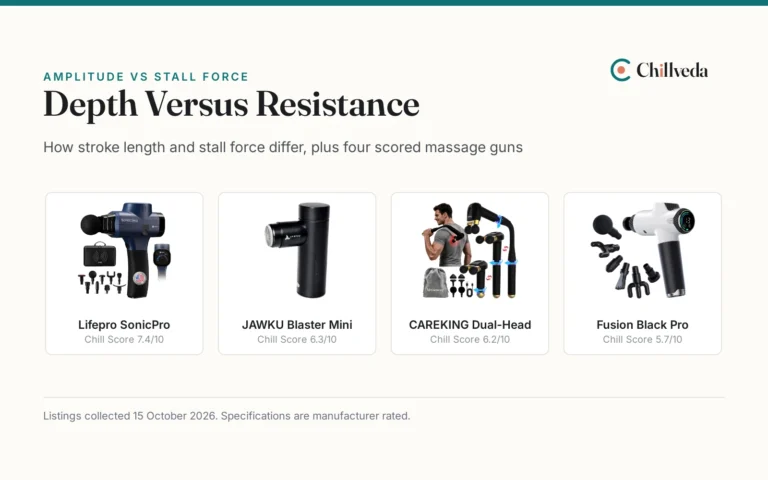
This guide compares the stated stroke lengths and motor forces published on current Amazon listings, explains why the two specs create different recovery sensations, and scores four models to show what makers actually disclose. Listings were collected 15 October 2026.
This article is informational and is not medical advice. Percussion massagers deliver repetitive mechanical force to soft tissue. Avoid using a massage gun directly on the neck, spine, throat, major arteries, or acute injuries without consulting a medical professional. Stop immediately if you experience sharp pain or numbness. See our Medical Disclaimer.
Chillveda earns a commission when you buy through links on this page, at no extra cost to you. As an Amazon Associate I earn from qualifying purchases. Affiliate disclosure.
Quick picks
-
1
 Lifepro SonicPro Massage Gun Percussion Muscle Chill Score 9.5/10Check price on Amazon
A 12 mm amplitude percussion massage gun delivering 75 lbs of stated stall force with 9 attachment heads, 10 speeds, and heated massage modes.
-
2
 JAWKU Muscle Blaster Mini Cordless Percussion Chill Score 9.3/10Check price on Amazon
A compact 1 lb percussion massager offering 40 lbs of stated stall force across 3 speed settings with up to 6 hours of continuous battery life.
-
3
 3-in-1 Massage Gun with Detachable Long Handle Chill Score 9.3/10Check price on Amazon
An 8 mm amplitude massager featuring dual percussion heads, a detachable 20-inch extension handle, and 5 speeds up to 2800 RPM.
-
4
 Deep Tissue Massage Gun for Athletes Chill Score 9.2/10Check price on Amazon
A 1.8 lb handheld massager with 20 intensity levels up to 3300 ppm, 6 swappable heads, and a Japanese brushless motor rated under 45 dB.

A 12 mm amplitude percussion massage gun delivering 75 lbs of stated stall force with 9 attachment heads, 10 speeds, and heated massage modes.
Pros & ConsViewHide
Pros
- Stated 75 lbs stall force resists heavy pressure
- 12 mm amplitude delivers deep muscle reach
- 9 swappable heads and 10 speed levels
- Stated 6 hour battery life with 2.5 hour charging
Cons
- Weight contradiction: 2.5 lbs in bullets versus 3.9 lbs in spec table
- Dimension discrepancy between product description and spec table
- Warranty lists lifetime support rather than a clear repair term
- No independent safety certification stated

A compact 1 lb percussion massager offering 40 lbs of stated stall force across 3 speed settings with up to 6 hours of continuous battery life.
Pros & ConsViewHide
Pros
- Stated 40 lbs stall force in a mini chassis
- Lightweight 1 lb build for portable use
- Quiet operation rated under 40 decibels
- Up to 6 hours of continuous battery run time
Cons
- Exact stroke amplitude in millimeters is not stated
- Listing spec table is completely blank
- No warranty term is stated
- Limited to 3 speed settings (1600, 2200, 2800 ppm)

An 8 mm amplitude massager featuring dual percussion heads, a detachable 20-inch extension handle, and 5 speeds up to 2800 RPM.
Pros & ConsViewHide
Pros
- Detachable 20-inch extension handle for solo back reach
- Dual alternating heads cover wider surface area
- Stated 8 mm stroke depth with 5 speed levels
- Up to 4 hours of battery life with USB-C charging
Cons
- Stall force is not stated anywhere in the listing
- Shallow 8 mm stroke functions closer to vibration than percussion
- No warranty term is stated
- Title calls it 3-in-1 while bullet points state 2-in-1

A 1.8 lb handheld massager with 20 intensity levels up to 3300 ppm, 6 swappable heads, and a Japanese brushless motor rated under 45 dB.
Pros & ConsViewHide
Pros
- Quiet operation rated under 45 decibels
- 20 speed levels reaching up to 3300 ppm
- 6 swappable attachment heads included
- Lightweight 1.8 lb build with a 12-degree angled handle
Cons
- Neither amplitude nor stall force is stated in the listing
- Spec table lists erroneous 1x1x1 inch dimensions
- Spec table lists material type as tissue
- No warranty term is stated
More to compare
 Mebak 3 Massage Gun Deep TissueCheck price on Amazon
 BOB AND BRAD C2 Pro Massage Gun with Heat and Cold TherapyCheck price on Amazon
 Medcursor Massage GunCheck price on Amazon
 TheraGun Therabody Relief Massage GunCheck price on Amazon
 BOB AND BRAD D6 Ultra Max Massage Gun 8-16mm AdjustableCheck price on Amazon
 AERLANG Massage Gun with Heat and ColdCheck price on Amazon
Stated amplitude and stall force across maker listings
| Massage gun | Stated amplitude | Stated stall force | Stated speeds and heads |
|---|---|---|---|
| Lifepro SonicPro | 12 mm | 75 lbs | 10 speeds, 9 heads |
| JAWKU Blaster Mini | Not stated | 40 lbs | 3 speeds, heads not stated |
| CAREKING Dual-Head | 8 mm | Not stated | 5 speeds, 6 heads |
| Fusion Black Pro | Not stated | Not stated | 20 speeds, 6 heads |
Examining these listings reveals a common challenge: few makers publish both specifications. Lifepro lists both a 12 mm amplitude and a 75 lb stall force, providing clear data on both stroke depth and motor resistance. In contrast, JAWKU specifies a 40 lb stall force for its compact 1 lb frame but omits stroke length in millimeters, while CAREKING publishes an 8 mm stroke depth but omits stall force entirely. Fusion Black Pro advertises 20 speed levels up to 3300 percussions per minute, yet leaves both amplitude and stall force unstated.
Why stroke amplitude determines percussion depth
Amplitude refers to the physical distance the massage head travels forward and backward during each cycle, measured in millimeters. A larger stroke length creates a distinct, hammering impact that penetrates deeper into thick muscle layers before retracting. In our comparison, Lifepro lists a 12 mm amplitude, which provides noticeable mechanical travel suitable for dense areas like the hamstrings and glutes.
Conversely, a shorter stroke length produces a sensation closer to surface vibration. CAREKING publishes an 8 mm amplitude, which creates shallow percussive pulses. While a shorter stroke can feel gentler over sensitive muscle groups, it cannot deliver the physical displacement of a longer stroke, regardless of how firmly the device is held.
How stall force prevents the motor from bogging down
Stall force measures the amount of pressure, in pounds, you can apply against the massage head before the motor bogs down and ceases moving. When you press a massage gun into a tight knot, resistance builds against the motor drive. If a device has a low stall force, even moderate hand pressure causes the percussion mechanism to stutter and stall, reducing the tool to passive contact.
A high stall force rating ensures the motor continues cycling under load. Lifepro rates its SonicPro at 75 lbs of stall force, allowing heavy manual pressure during targeted sessions. Motor resistance can be substantial even in smaller designs: JAWKU rates its 1 lb Blaster Mini at 40 lbs of stall force, designed to resist stalling despite its lightweight chassis. When a listing omits stall force altogether, as seen with CAREKING and Fusion Black Pro, there is no way to verify whether the motor will sustain pressure against dense muscle tissue.
Understanding high amplitude vs high stall force massage gun specs
Comparing a high amplitude vs high stall force massage gun requires understanding how the two metrics interact during use. A tool with high amplitude but weak stall force will deliver a deep stroke when held lightly, but will stall the moment you push down for deeper relief. Conversely, a device with high stall force but low amplitude can take heavy pressure without stopping, yet its shallow stroke depth behaves more like high-frequency vibration than true percussion.
For true deep-tissue percussion, you need both adequate stroke depth and sufficient motor resistance. When choosing a device, consider which sensation your body tolerates:
- High amplitude preference: Prioritize longer stroke length if you want a distinct percussive strike that reaches into muscle without needing to lean heavy body weight into the tool.
- High stall force preference: Prioritize higher motor stall force if you prefer actively pressing into stubborn knots and need the motor to keep cycling under firm resistance.
- Balanced approach: Look for models that publish verified figures for both stroke length and stall force, rather than relying on unmeasured marketing terms.
Percussion massage guns compared by stated specs
These are scored on the Chill Score, which weighs performance 35, build 25, value 25, safety certifications 10 where it applies and warranty 5. Handheld massage tools in this group carry no stated independent safety certification, so all four score 0 for safety.
| Product | Chill Score | Perf. /35 | Build /25 | Value /25 | Safety /10 | Warranty /5 |
|---|---|---|---|---|---|---|
| Lifepro SonicPro | 9.5 | 32 | 20 | 21 | 0 | 1 |
| JAWKU Blaster Mini | 9.3 | 26 | 18 | 20 | 0 | 0 |
| CAREKING Dual-Head | 9.3 | 24 | 18 | 20 | 0 | 0 |
| Fusion Black Pro | 9.2 | 22 | 16 | 19 | 0 | 0 |
Scores run from 9.2 to 9.8: each product’s point total is placed on that range, so more points always means a higher score.
For more options across various shapes and sizes, see our best massage guns roundup.
How to choose the right balance for your routine
- Assess your target muscle density. Larger, denser muscle groups like quadriceps and glutes generally benefit from longer stroke displacement, while calves, arms, and shoulders often respond better to gentler, shallower percussion.
- Check motor specifications before attachments. A listing offering 9 heads or 20 speed levels cannot compensate for missing amplitude and stall force figures. Prioritize verified motor data over accessory counts.
- Account for device weight during solo use. A heavier massager provides downward mass through gravity but can tire your arm during extended back sessions. A 1 lb mini massager like the JAWKU offers easier handling and portable storage, though compact listings often omit full dimension or stroke details.
- Inspect the technical spec table for listing errors. Sellers occasionally populate technical tables with placeholder text, such as the 1 by 1 by 1 inch dimensions and tissue material noted in the Fusion Black Pro listing. Always verify that spec table entries align with the main description.
- Respect soft tissue boundaries. Never press a high stall force massager into bone or joints, and keep percussion sessions to short intervals as recommended by your device manual.
Common mistakes
- Assuming high speed settings or high RPM figures compensate for shallow stroke amplitude.
- Buying a massage gun with unstated stall force and expecting it to withstand deep manual pressure.
- Equating a high number of attachment heads or speed increments with superior motor performance.
- Pushing hard with a low stall force motor and causing repeated internal motor stalling.
- Using percussion tools on sensitive areas like the neck, spine, or joints rather than fleshy muscle tissue.
Common questions
What is the difference between massage gun amplitude and stall force?
Amplitude is the distance the massage head travels back and forth in millimeters, which determines the depth of each strike. Stall force is the amount of pressure in pounds you can apply before the motor bogs down and stops. Amplitude dictates reach, while stall force dictates how firmly you can press into the muscle.
Is higher amplitude always better for muscle recovery?
Not necessarily. Higher amplitude delivers a punchier, deeper strike that suits dense muscle groups like the quadriceps and glutes, but it can feel jarring on smaller muscles or sensitive areas. A shorter stroke delivers a milder percussive tap that many users find more comfortable for everyday relaxation.
What happens if a massage gun has low stall force?
When a massage gun has low stall force, pressing down firmly against a tight knot will cause the motor to slow down or stall completely. You are then limited to the weight of the device and light surface pressure. Higher stall force lets you work through stubborn knots without halting the percussion.
Can a mini massage gun have high stall force?
Yes, certain compact units list substantial motor resistance despite their small frame. For instance, the JAWKU Blaster Mini in our comparison states 40 pounds of stall force while weighing only 1 pound. However, mini models often provide fewer speed increments or omit stroke depth specifications entirely.
Which specification matters more for deep tissue massage?
Both play a role, but stall force is critical if you prefer applying firm manual pressure without stopping the motor. High amplitude provides the physical stroke depth, but without adequate stall force, the device stalls as soon as you press into dense tissue. A balance of both delivers the most effective deep tissue percussion.
Sources: Amazon product listings for the percussion massage guns named above, collected 15 October 2026. Related: see our massage gun specs explained and where not to use a massage gun.
Back to all massage gun reviews.