Short answer
Do ice blocks keep a plunge cold longer than ice cubes?
Yes. Solid ice blocks have far less surface area exposed to water than an equal weight of ice cubes, which slows the rate of heat exchange. While cubes dissolve rapidly and deliver a fast initial chill, blocks dissolve more gradually in the tub, maintaining a lower water temperature over a longer period.
Stepping out to your patio or garage tub for an early morning session means deciding how to chill the water, and choosing ice blocks vs ice cubes for plunge setups comes down to melt duration versus cooling speed. Large ice blocks melt slowly due to their low surface area, keeping tub water cold across longer sessions, while small ice cubes expose more surface area to drop water temperature rapidly but dissolve within minutes. For most home plungers looking to sustain cold water without constantly adding ice, freezing solid blocks in reusable silicone molds is the more practical approach.
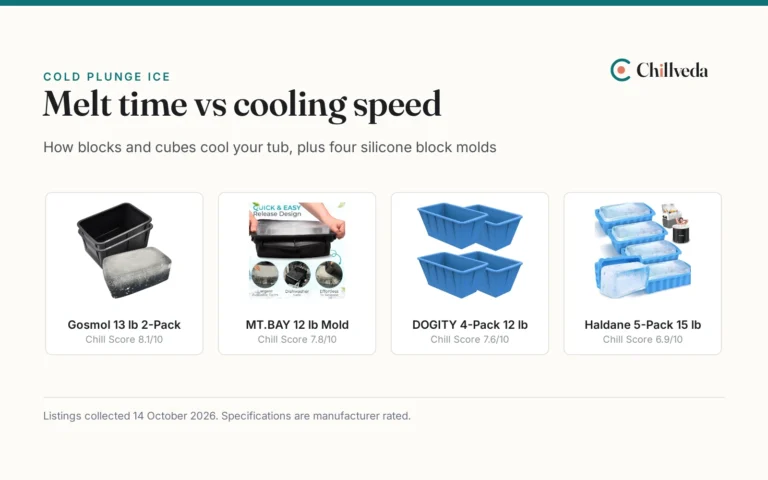
This guide explains how surface area affects melt rates, compares freezer demands and handling, and reviews four silicone block molds to make large ice bricks at home. Listings were collected 14 October 2026.
This article is informational and is not medical advice. Sudden immersion in cold water causes cold shock, rapid breathing, and afterdrop. Never plunge alone or with a heart condition, high blood pressure, or while pregnant without medical clearance. Step out immediately if you feel lightheaded, numb, or unwell. See our Medical Disclaimer.
Chillveda earns a commission when you buy through links on this page, at no extra cost to you. As an Amazon Associate I earn from qualifying purchases. Affiliate disclosure.
Quick picks
-
1
 Gosmol Extra Large Ice Block Mold Chill Score 9.6/10Check price on Amazon
A two-pack of silicone molds with steel-reinforced rims designed to freeze 13-pound block ice for cold plunge tubs.
-
2
 Ice Block Form Makes 12 Lb. Ice Cube 11" x 7" x 5" Chill Score 9.6/10Check price on Amazon
A single food-grade silicone mold with a metal reinforced rim that freezes a 12-pound block for cold plunge water chilling.
-
3
 Extra Large Ice Block Molds 4 Pack 48LB for Cold Chill Score 9.6/10Check price on Amazon
A four-pack of 12-pound silicone ice block molds providing 48 pounds of total ice capacity for home plunge tubs.
-
4
 Haldane 5PC Extra Large Ice Block Mold 15LB Ice Chill Score 9.4/10Check price on Amazon
A five-piece silicone mold set producing ice bricks totaling 15 pounds, with reinforced corners.

A two-pack of silicone molds with steel-reinforced rims designed to freeze 13-pound block ice for cold plunge tubs.
Pros & ConsViewHide
Pros
- Steel reinforced rim prevents spills during transport
- Two-pack provides two 13-pound block molds
- Dishwasher safe silicone construction
- Stated block size of 11.9 by 7.9 by 5.1 inches
Cons
- No warranty term is stated
- Dimensions conflict between bullets and spec table
- Spec table lists total weight as only 408 grams
- Takes substantial freezer shelf space

A single food-grade silicone mold with a metal reinforced rim that freezes a 12-pound block for cold plunge water chilling.
Pros & ConsViewHide
Pros
- Metal reinforced rim adds rigidity when carrying
- Food-grade silicone is dishwasher safe
- Clear instructions on expansion space before freezing
- Single mold fits smaller freezer shelves
Cons
- No warranty term is stated
- Only one mold included per pack
- Title states 11 by 7 inches while table states 12 by 8 inches
- Requires a full 24-hour freeze cycle

A four-pack of 12-pound silicone ice block molds providing 48 pounds of total ice capacity for home plunge tubs.
Pros & ConsViewHide
Pros
- Largest total batch capacity here at 48 pounds
- BPA-free food safe grade silicone
- Freeze time listed as 12 to 24 hours
- Four separate molds allow staggered freezing
Cons
- No warranty term is stated
- Spec table lists nonsensical dimensions of 0.1 inch
- Lacks a metal or steel reinforced rim
- Requires significant freezer volume for all four molds
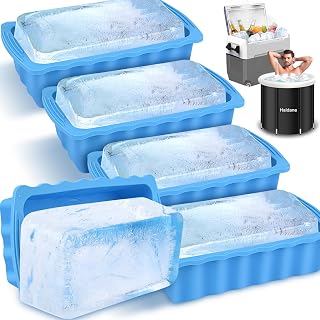
A five-piece silicone mold set producing ice bricks totaling 15 pounds, with reinforced corners.
Pros & ConsViewHide
Pros
- Five separate molds freeze in 12 hours
- Stated melt time of 7 to 9 hours at 71.6 F
- Reinforced 4-corner design reduces bulging
- BPA-free and dishwasher safe
Cons
- No warranty term is stated
- Multiple listing contradictions in quantity and volume
- Spec table mislabels item as water chiller
- Divides the 15-pound total across five separate molds
More to compare
 6pcs Extra Large Silicone Ice Block Molds for Cold Plunge orCheck price on Amazon
 Extra Large Ice Block MoldCheck price on Amazon
 12-Pack Ice BrickCheck price on Amazon
 3-Pack Ice BrickCheck price on Amazon
 Trevix Ice Block Mold for Ice BathCheck price on Amazon
 Extra Large Ice Block Molds 4 Pack 32LB for Cold Plunge TubCheck price on Amazon
Ice blocks vs ice cubes for plunge: how they compare
| Factor | Ice blocks | Ice cubes |
|---|---|---|
| Melt duration | Slow and steady; lower exposed surface area slows dissolution in water | Fast; high surface contact causes rapid melting |
| Water chilling speed | Gradual temperature drop as outer surface dissolves | Fast initial temperature drop due to large surface area |
| Preparation | Frozen at home in molds over 12 to 24 hours | Bought in bags or frozen in standard trays |
| Freezer space needed | Requires flat shelf clearance for molds up to 5 inches deep | Can be tucked into smaller gaps in freezer bags |
| Tub handling | Heavy single units; must be lowered gently into water | Lightweight; easy to pour directly from bags |
The physical differences between these two chilling methods come down to geometry. A solid block exposes minimal surface area relative to its total mass, slowing heat transfer from the surrounding water. In contrast, an equivalent weight of standard ice cubes exposes far greater surface area, absorbing heat quickly. This means cubes cool warm water faster initially, but they disappear quickly, whereas blocks provide prolonged cooling that keeps your plunge tub cold over a full session.
Why surface area dictates melt speed and cooling time
When you place ice into a cold plunge tub, heat transfers from the water into the ice across its exterior surface. Because ice cubes consist of dozens of small pieces, the total surface area in contact with the water is extensive. That high contact area produces a rapid drop in water temperature, which can be useful if your tap water runs warm and you need immediate chilling. However, that rapid heat transfer also causes cubes to melt away quickly.
Large blocks behave differently. With a single compact mass, only the outer boundary touches the water, which slows the rate of melting compared to fractured ice. While one maker listing notes that a block takes 7 to 9 hours to melt in open air at 71.6 F, immersion in water accelerates melting considerably. Even so, because less surface area is exposed to the water at any given moment, solid blocks provide a more gradual, sustained cooling effect than cubes.
Freezer space, freezing cycles, and tub handling
Using block ice requires planning around your freezer space and routine. Silicone block molds range from smaller multi-packs totaling 15 pounds up to large individual molds holding 12 to 13 pounds, with four-packs providing up to 48 pounds of total capacity across 4 molds. Freezing these large volumes of water requires patience: makers list freezing cycles between 12 and 24 hours. If you plunge daily, maintaining a rotating cycle with multiple molds ensures a fresh block is ready when you need it.
Handling also differs between methods. Dropping a solid 12-pound ice block into an inflatable plunge tub can stress seams or damage the floor liner. Blocks should be lowered into water that is already in the tub so the water cushions the weight and protects the bottom liner. In addition, carrying a flexible silicone mold filled with water to the freezer can lead to spills unless the mold includes a reinforced metal rim or you support it with a rigid baking sheet.
Silicone ice block molds worth freezing
These are scored on the Chill Score, which weighs performance 35, build 25, value 25, safety certifications 10 where it applies and warranty 5. Ice block molds carry no electrical safety certification and list no formal warranty terms, so all four score 0 for safety and warranty.
| Product | Chill Score | Perf. /35 | Build /25 | Value /25 | Safety /10 | Warranty /5 |
|---|---|---|---|---|---|---|
| Gosmol 13 lb 2-Pack | 9.6 | 30 | 21 | 21 | n/a | 0 |
| MT.BAY 12 lb Mold | 9.6 | 29 | 21 | 20 | n/a | 0 |
| DOGITY 4-Pack 12 lb | 9.6 | 28 | 19 | 21 | n/a | 0 |
| Haldane 5-Pack 15 lb | 9.4 | 26 | 18 | 19 | n/a | 0 |
Scores run from 9.2 to 9.8: each product’s point total is placed on that range, so more points always means a higher score. Safety counts only for powered gear or where the listing states safety features; where it does not apply, the score is taken over the remaining 90 points.
For more cold plunge equipment, see our best cold plunge tubs and ice block mold for cold plunge reviews.
Making and using block ice in practice
- Allow room for expansion. Water expands as it freezes into ice. Leave space below the mold rim, as noted by MT.BAY, to prevent overflowing inside your freezer.
- Give molds a full freezing cycle. Large blocks need 12 to 24 hours in the freezer to freeze solid to the core. Pulling them out too early leaves a liquid center that collapses quickly in the tub.
- Support flexible silicone during transport. Molds without steel rims flex under the weight of water. Place a flat tray beneath the mold before filling so you can carry it steadily from the sink to the freezer shelf.
- Ease blocks out with a short rest. Straight from the freezer, silicone can adhere to frozen ice. Waiting 30 seconds to 5 minutes at room temperature, as maker listings suggest, lets the block release cleanly without tearing the silicone.
- Lower blocks carefully into the tub. Never drop a 12-pound or 13-pound block into an empty tub or onto an unpadded liner. Lower it gently into the water by hand to protect seams and liners.
Common mistakes
- Dropping heavy ice blocks into an empty tub before water is added, risking punctures to the bottom liner.
- Filling silicone molds to the top edge without leaving space for water expansion during freezing.
- Expecting a single small ice brick to significantly chill a full tub of water on a warm day.
- Removing molds from the freezer prematurely before the 12 to 24 hour freezing cycle completes.
- Carrying unreinforced silicone molds by the corners while filled with liquid water.
Common questions
Do ice blocks keep a plunge cold longer than ice cubes?
Yes. Solid ice blocks have far less surface area exposed to water than an equal weight of ice cubes, which slows the rate of heat exchange. While cubes dissolve rapidly and deliver a fast initial chill, blocks dissolve more gradually in the tub, maintaining a lower water temperature over a longer period.
How long does it take to freeze a 12-pound ice block at home?
Maker listings for 12-pound silicone molds specify freezing times between 12 and 24 hours in a standard freezer. The exact duration depends on freezer temperature and air circulation around the mold. Leaving the mold undisturbed for a full 24 hours ensures the core is solid.
Can heavy ice blocks damage an inflatable cold plunge tub?
Yes, if dropped carelessly onto an unpadded tub floor or against the sidewalls. A 12-pound or 13-pound ice brick has hard edges that can puncture or abrade vinyl liners. Always lower blocks into the water gently by hand rather than dropping them into an empty tub.
How do you release large ice blocks from silicone molds?
Listing instructions recommend letting the mold rest at room temperature for 30 seconds to 5 minutes after removing it from the freezer. Once the outer surface loosens slightly, pulling the flexible silicone sides outward allows the solid block to slide out smoothly.
Is it better to use ice blocks or ice cubes for quick cooling?
Ice cubes cool water faster initially because their large combined surface area transfers heat rapidly into the ice. If your plunge water is warm and you need a rapid temperature drop before stepping in, cubes work faster, while blocks are better for maintaining a steady low temperature.
Sources: Amazon product listings for the ice molds and plunge gear named above, collected 14 October 2026. Related: see our cold plunge water care and cold plunge safety guides.
Back to all cold plunge reviews.