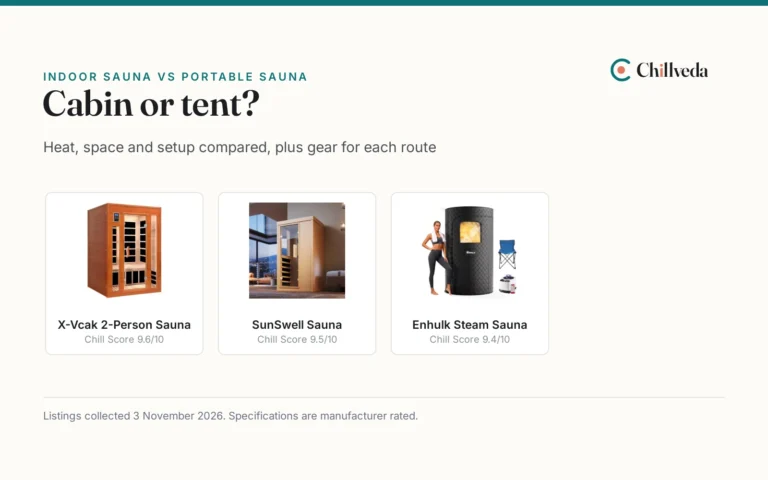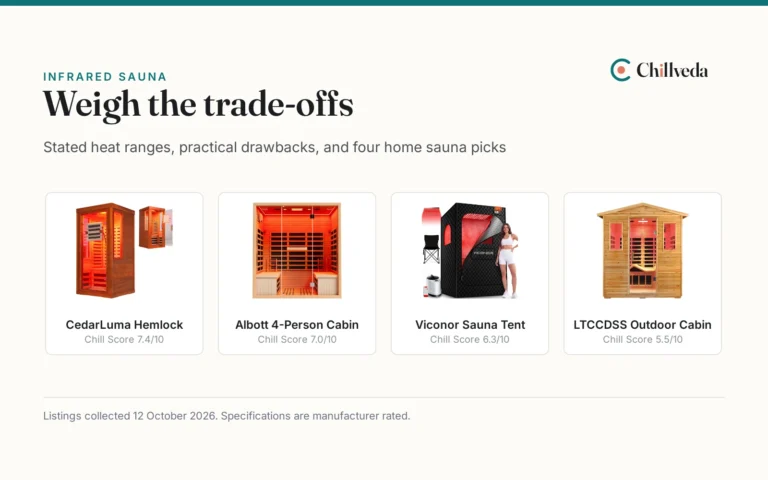
What are the infrared sauna benefits and disadvantages? The primary benefit is radiant heat that warms the body directly at lower air temperatures than traditional rock saunas, which many people find more tolerable during longer sessions. The main disadvantages are electrical limitations, high space and weight demands for solid wood cabins, and substantial warm-up times. Furthermore, many online listings make unverified wellness claims while omitting critical electrical or warranty details.
This guide examines stated maker specifications across four home recovery models, the physical differences between infrared and steam heating, and the electrical realities of running a cabin at home. Listings were collected 12 October 2026.
This article is informational and is not medical advice. Heat exposure strains the heart and causes fluid loss. Do not use a sauna after alcohol, when pregnant, when unwell, or with a heart condition or low blood pressure without asking a clinician first. Leave at once if you feel dizzy, sick or confused. See our Medical Disclaimer.
Chillveda earns a commission when you buy through links on this page, at no extra cost to you. As an Amazon Associate I earn from qualifying purchases. Affiliate disclosure.
Quick picks
-
1
 Infrared Sauna with FDA-Certified Red Light Chill Score 9.5/10Check price on Amazon
A Canadian hemlock cabin with 7 carbon fiber heaters, dual-wavelength red light therapy, and a 30-month warranty.
-
2
 Albott 4 Person Infrared Sauna with 7-Color Light Chill Score 9.5/10Check price on Amazon
A 4-person Canadian hemlock cabin powered by 10 carbon panels at 2145W, featuring tourmaline stone floor heat and Bluetooth speakers.
-
3
 Infrared Sauna Box, Portable Steam Infrared Sauna Chill Score 9.3/10Check price on Amazon
A portable 33 by 33 by 71 inch fabric sauna enclosure pairing a 1200W steam generator with a dual-wavelength light lamp.
-
4
 LTCCDSS Full Spectrum Outdoor Sauna 4 Person Chill Score 9.2/10Check price on Amazon
A 4-person outdoor sauna with a pitched gambrel roof, full-spectrum heating panels, and Bluetooth audio.

A Canadian hemlock cabin with 7 carbon fiber heaters, dual-wavelength red light therapy, and a 30-month warranty.
Pros & ConsViewHide
Pros
- Stated 30-month professional warranty
- Standard 110V operation at 1170W
- Built-in 660nm and 850nm light panel with protective goggles
- Stated low EMF range of 1.4 to 2.6 mG
Cons
- Listing title claims FDA certification while bullet specifies registration
- Stated warm-up time of 45 to 50 minutes to reach 149 F
- No electrical safety certification listed
- At 188 pounds, requires two people to move and assemble

A 4-person Canadian hemlock cabin powered by 10 carbon panels at 2145W, featuring tourmaline stone floor heat and Bluetooth speakers.
Pros & ConsViewHide
Pros
- High heat capacity from 10 carbon panels at 2145W
- Tourmaline stone foot heating element
- Canadian hemlock construction with dual-side seating
- Includes dual Bluetooth speakers and 7-color light therapy
Cons
- Requires a dedicated 20A circuit at 110V
- Heavy 400-pound cabinet requires dedicated floor support
- No warranty term is stated
- No electrical safety certification listed

A portable 33 by 33 by 71 inch fabric sauna enclosure pairing a 1200W steam generator with a dual-wavelength light lamp.
Pros & ConsViewHide
Pros
- Compact 33 by 33 by 71 inch footprint for small rooms
- Lightweight 26.7-pound package packs away between sessions
- Dual 660nm and 850nm light therapy lamp included
- Comes with folding chair, remote control, and floor mat
Cons
- Fabric tent lacks the insulation and rigidity of solid wood
- Hybrid steam and light design differs from dry infrared cabins
- No warranty term is stated
- No electrical safety certification listed

A 4-person outdoor sauna with a pitched gambrel roof, full-spectrum heating panels, and Bluetooth audio.
Pros & ConsViewHide
Pros
- Large 73.09 by 48.66 by 83.5 inch exterior sized for 4 people
- Pitched gambrel roof engineered for outdoor rain and snow drainage
- Full-spectrum heating panels covering near, mid, and far infrared
- Fitted with 4 colorful lights, 2 reading lights, and 2 speakers
Cons
- Title advertises Canadian hemlock while bullets state soft fir wood
- No wattage, voltage, or amperage specifications provided
- Heavy 320-pound structure requires outdoor site preparation
- No warranty term or electrical certification stated
Infrared sauna benefits and disadvantages
| Sauna model | Design type | Stated power | Key benefits | Practical disadvantages |
|---|---|---|---|---|
| CedarLuma Hemlock | Solid wood indoor cabin | 1170W, 110V | 149 F heat, red light therapy, 30-month warranty | 45 to 50 min warm-up, 188 lb weight |
| Albott 4-Person Cabin | 4-person indoor cabin | 2145W, 110V/20A | 10 carbon panels, tourmaline stone foot heat | Requires 20A circuit, 400 lb weight, no warranty |
| Viconor Sauna Tent | Portable steam and light tent | 1200W steamer | 33 x 33 in footprint, 26.7 lb packable frame | Fabric walls, hybrid steam rather than dry wood |
| LTCCDSS Outdoor Cabin | 4-person outdoor cabin | Not stated | Pitched gambrel roof, 4-person capacity | Wood contradiction, unstated electrical specs |
The trade-offs depend on construction. Solid wood cabins provide stable radiant heat and low EMF carbon panels, but require significant space, high weight, and dedicated electrical planning. Portable fabric enclosures offer easy storage and lower entry costs, but lack the structural heat retention of solid hemlock. Outdoor models feature pitched roofs for weather runoff, yet listings can omit vital power data.
Why radiant warmth differs from heated air
In a traditional sauna, an electric stove heats stones, which in turn heat the ambient room air to high temperatures. In an infrared cabin, carbon or ceramic heating elements emit infrared waves that warm the occupant directly. Because radiant warmth heats tissue directly rather than relying purely on ambient air, an infrared cabin can promote deep sweating at lower room temperatures. In this lineup, CedarLuma lists a maximum setting of 149 F. Our infrared vs traditional sauna comparison examines these thermal dynamics in detail.
Humidity also influences the session. Dry infrared cabins keep humidity low, whereas portable tents with steam generators introduce dense moisture. In wooden cabins, low electromagnetic field emissions help ensure peace of mind during prolonged exposure, as detailed in our guide on what is EMF in an infrared sauna.
Electrical draw and installation realities in practice
Operating a home sauna introduces specific electrical requirements that buyers must evaluate before delivery. Power draw determines whether a cabin can share an existing household outlet or requires dedicated wiring from an electrician:
- Current draw requirements: Current draw follows the standard electrical formula where amperage equals wattage divided by voltage (Amps = Watts / Volts). For Albott, dividing 2145W by 110V confirms why the listing specifies a 20A connection: the current demand exceeds ordinary household lines, requiring a dedicated 20A branch circuit and matching receptacle. CedarLuma lists 1170W at 110V, drawing well within standard household limits without requiring upgraded wiring. Viconor lists a 1200W steamer, which operates on standard household lines. LTCCDSS omits power specifications entirely, leaving buyers unable to calculate circuit load before purchase.
- Physical footprint and freight: Albott arrives with a total weight of 400 pounds, requiring substantial floor support and permanent room allocation. LTCCDSS measures 73.09 by 48.66 by 83.5 inches and weighs 320 pounds, demanding a prepared outdoor foundation. CedarLuma weighs 188 pounds for a more manageable indoor footprint. At the opposite end, Viconor weighs 26.7 pounds and occupies 33 by 33 by 71 inches, allowing it to pack away between uses.
- Energy consumption: Operating costs depend directly on stated wattage. Units with lower wattage like the 1170W CedarLuma and 1200W Viconor consume less electricity per hour than large 2145W multi-person cabins. To evaluate utility expenses, see our guide on home sauna running cost.
Home saunas to consider
These models are scored using the Chill Score, which evaluates performance across 35 points, build 25, value 25, safety certifications 10 where it applies, and warranty 5. None of these listings publish a verified UL or ETL electrical safety listing, so safety scores remain at 0. Only CedarLuma provides a concrete warranty period.
| Product | Chill Score | Perf. /35 | Build /25 | Value /25 | Safety /10 | Warranty /5 |
|---|---|---|---|---|---|---|
| CedarLuma Hemlock | 9.5 | 29 | 21 | 21 | 0 | 3 |
| Albott 4-Person Cabin | 9.5 | 30 | 21 | 19 | 0 | 0 |
| Viconor Sauna Tent | 9.3 | 26 | 18 | 20 | 0 | 0 |
| LTCCDSS Outdoor Cabin | 9.2 | 21 | 18 | 16 | 0 | 0 |
Scores run from 9.2 to 9.8: each product’s point total is placed on that range, so more points always means a higher score.
For more configurations, see our guide to the best outdoor sauna cabins and our best 2 person home saunas roundup.
Practical considerations before you buy
- Check circuit capacity. Confirm whether your designated outlet supports high-draw equipment. Albott specifies a 110V/20A connection and 2145W, requiring a dedicated 20A circuit, whereas the 1170W CedarLuma operates on standard household lines.
- Verify floor support. A 400-pound cabin like Albott or a 320-pound unit like LTCCDSS requires firm, level flooring capable of handling structural weight plus multiple seated adults.
- Account for warm-up periods. Solid wood cabins do not warm up instantly. CedarLuma specifies a 45 to 50 minute warm-up period to reach its 149 F ceiling.
- Examine listing consistency. Look closely for omitted electrical data or contradictory timber specifications before completing an order.
- Maintain hydration. Perspiration causes fluid loss even at lower temperatures. Drink water before and after sessions, and step out immediately if you feel faint.
Common mistakes
- Expecting an infrared cabin to reach the high air temperatures of a traditional stone stove.
- Connecting a 2145W cabin to an ordinary household line without the required 20A dedicated circuit.
- Treating FDA establishment registration as a clinical endorsement or safety clearance.
- Overlooking the logistical challenge of moving a 400-pound wooden cabin into a residence.
- Assuming an unstated warranty offers long-term coverage.
Common questions
What are the primary benefits of an infrared sauna?
Infrared cabins provide direct radiant heat that warms the body without requiring extreme air temperatures. Because radiant warmth heats tissue directly rather than superheating the room air, users can comfortably enjoy gentle sweating at lower air temperatures. Features like low-EMF carbon panels, chromotherapy lights, and built-in Bluetooth audio also create a relaxing home recovery environment.
What are the main disadvantages of an infrared sauna?
The main drawbacks include significant space requirements, high shipping weight, and electrical demands. Large 4-person cabins can weigh 400 pounds and draw 2145W, which requires a dedicated 20A circuit. In addition, solid wood cabins require dedicated warm-up periods (CedarLuma lists 45 to 50 minutes to reach 149 F), and rigid structures cannot easily be stored away.
Can you plug an infrared sauna into a regular outlet?
It depends on the wattage. Moderate units like the 1170W CedarLuma or the 1200W Viconor tent operate on standard 110V household circuits. In contrast, heavy-duty units like the 2145W Albott require a dedicated 20A branch circuit and matching receptacle to run safely.
Does an infrared sauna feel cooler than a traditional sauna?
The air temperature measures lower, but your body does not necessarily feel cool. Because radiant heaters warm you directly rather than relying solely on heated air, you can sweat profusely even when the surrounding air is cooler than a traditional rock sauna. In this lineup, CedarLuma lists a maximum setting of 149 F, delivering substantial heat to the body while keeping ambient air below traditional sauna levels.
How much electricity does a home infrared sauna use?
Power consumption is directly tied to the heating elements. A 1170W cabin uses substantially less energy than a traditional heater, while a larger multi-person cabin draws 2145W at 110V. For compact setups, a 1200W steamer tent provides an intermediate option that plugs directly into standard household outlets.
Sources: Amazon product listings for the saunas named above, collected 12 October 2026. Related: our home sauna running cost guide and what is EMF in an infrared sauna.
Back to all sauna reviews.