Short answer
Is a massage gun better than a handheld massager?
Neither tool is universally superior because each serves a distinct purpose. A massage gun uses percussive strokes to deliver deeper impacts into dense muscle groups. A handheld vibration massager produces rapid surface oscillations that focus on trigger points and superficial tissue without deep mechanical pounding.
Side by side Choose a handheld massager if Choose a massage gun if
Massage gun vs handheld massager comes down to the depth and mechanical motion of the treatment. A massage gun delivers deep percussive pulses into dense muscle tissue to relieve soreness after strenuous workouts. A handheld massager produces high-frequency surface vibration to soothe sensitive tissues, joints, and tendons without deep hammering. Choose a massage gun if you want targeted percussive recovery for dense muscle tissue, or pick a handheld massager if you want high-frequency vibration across tendons and sensitive areas without tiring your hands.
This comparison covers mechanical action, motor speed, battery run time, reach, ergonomics, and safety considerations, using concrete specifications from current listings. Listings were collected 9 October 2026.
This article is informational and is not medical advice. Percussion and vibration tools should not be used on the neck, spine, major arteries, or acute injuries. Consult a healthcare professional before use if you have circulatory issues, neuropathy, or are pregnant. See our Medical Disclaimer and our massage gun safety guide.
Chillveda earns a commission when you buy through links on this page, at no extra cost to you. As an Amazon Associate I earn from qualifying purchases. Affiliate disclosure.
Quick picks
-
1
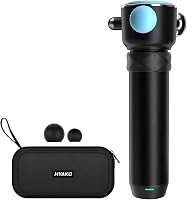 HYAKO Pro R1 Therapy Massager Chill Score 9.5/10Check price on Amazon
An aluminum handheld vibration massager listed at 5,500 to 7,500 RPM with 5 heads and a stated 2 year manufacturer warranty.
-
2
 Massage Gun, Deep Tissue Percussion Massager Chill Score 9.3/10Check price on Amazon
A battery-powered percussion massage gun listed with 30 speed levels up to 3,600 taps per minute, 10 attachments, and a 2000mAh battery.
-
3
 TheraGun Therabody PRO Plus 6-in-1 Deep Tissue Chill Score 9.3/10Check price on Amazon
A multi-therapy percussion massage gun featuring heat, vibration, LED, breathwork, and a biometric sensor, with USB-C charging.
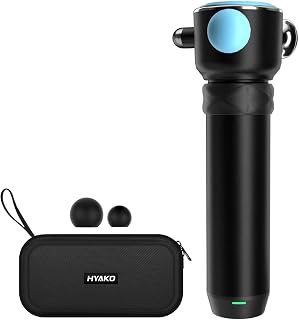
An aluminum handheld vibration massager listed at 5,500 to 7,500 RPM with 5 heads and a stated 2 year manufacturer warranty.
Pros & ConsViewHide
Pros
- Vibration frequency of 5,500 to 7,500 RPM stated
- Aluminum body construction
- 5 interchangeable massage heads included
- 2 year manufacturer warranty stated
Cons
- Spec table states 3 AAA batteries alongside 4 hour rechargeable battery life
- Weight listed as 1.7 lbs in bullets and 1.6 pounds in spec table
- Stroke amplitude is not stated
- Listing claims arthritis and sciatica relief that we do not endorse

A battery-powered percussion massage gun listed with 30 speed levels up to 3,600 taps per minute, 10 attachments, and a 2000mAh battery.
Pros & ConsViewHide
Pros
- 30 speed levels up to 3,600 taps per minute stated
- 10 attachments and carry bag included
- 2000mAh battery rated for 15 days at 20 minutes per day
- IPX5 water resistance rating stated
Cons
- Weight listed as 800g in bullets, 1.8 pounds in table, and 1.76 pounds in dimensions
- Stroke amplitude and stall force are not stated
- No warranty term is stated
- Charging time is listed as 5 without units
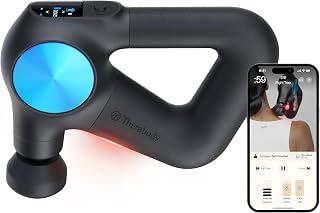
A multi-therapy percussion massage gun featuring heat, vibration, LED, breathwork, and a biometric sensor, with USB-C charging.
Pros & ConsViewHide
Pros
- Combines percussion with heat, vibration, LED, and breathwork
- Biometric sensor and LCD screen built in
- 5 massage speeds with Bluetooth connectivity stated
- USB-C charging cable included
Cons
- Power block is not included
- Cold therapy attachment is sold separately
- Battery capacity, run time, amplitude, and stall force are not stated
- No warranty term is stated
More to compare
 Mebak 3 Massage Gun Deep TissueCheck price on Amazon
 Medcursor Massage GunCheck price on Amazon
 TheraGun Therabody Relief Massage GunCheck price on Amazon
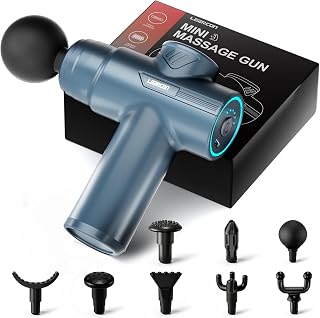 LEERCON Massage Gun Deep Tissue Handheld Muscle Massager forCheck price on Amazon
 LEERCON Massage Gun Deep Tissue Back Massager for Pain ReliefCheck price on Amazon
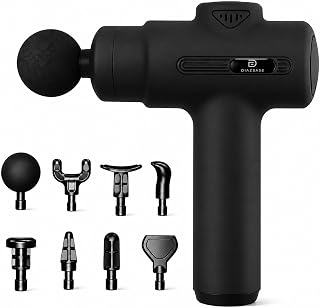 Massage Gun Deep TissueCheck price on Amazon
Massage gun vs handheld massager at a glance
| Massage gun | Handheld massager | |
|---|---|---|
| Drive mechanism | Percussive stroke driving into muscle tissue | Rapid reciprocating or oscillating vibration |
| Motion characteristics | Longer stroke depth with distinct impacts | Short stroke length with rapid cycling |
| Primary design focus | Targeted deep tissue and dense muscle groups | Multi-angle vibration and sensitive areas |
| Common form factor | Pistol grip with angled handle | Cylindrical wand or contoured body |
| Treatment feel | Direct physical punch into muscle bellies | High-frequency surface buzz with less kickback |
| Attachment variety | Interchangeable hard and soft head attachments | Specialized tip covers and surface heads |
| Weight considerations | Often heavier due to internal percussion drives | Often lighter with compact cylindrical frames |
| Power design | Rechargeable lithium-ion battery packs | Rechargeable batteries or replaceable cells |
How percussion and vibration mechanics differ
The defining technical distinction between these categories is the drive mechanism and stroke depth. A percussion massage gun uses a motorized drive mechanism to push an attachment head forward and back with measurable stroke depth. This creates distinct percussive pulses that penetrate into dense muscle tissue. In contrast, a handheld vibration massager produces short-stroke, reciprocating movements that vibrate against the skin with minimal travel depth.
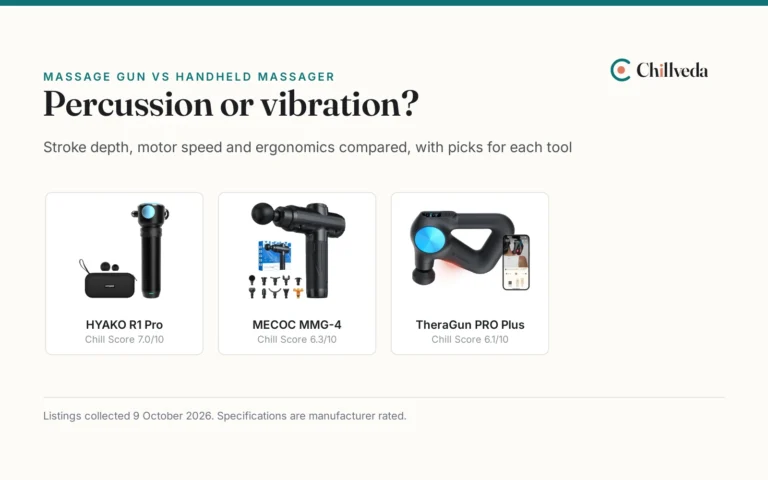
Motor speed also separates the categories, as shown in the listings examined here. The MECOC massage gun listing states a top speed of 3,600 taps per minute across 30 speed levels. Meanwhile, the HYAKO handheld massager listing states a vibration frequency of 5,500 to 7,500 RPM. The vibration tool cycles at a higher frequency, but each stroke is short and remains near the surface, whereas the percussion gun delivers distinct mechanical pulses into muscle tissue.
| Tool example | Stated speed rating | Speed settings |
|---|---|---|
| MECOC MMG-4 (massage gun) | Up to 3,600 taps per minute | 30 speed levels |
| HYAKO R1 Pro (handheld massager) | 5,500 to 7,500 RPM | Speed control stated |
| TheraGun PRO Plus (massage gun) | Not stated | 5 speeds |
Power specifications also reflect their portable design. The MECOC model lists a 12V model rating with a 2000mAh battery pack, which the maker claims provides 15 days of duration at 20 minutes per day. The HYAKO handheld massager lists a 4 hour battery average life with a 6 hour charging time, though its spec table also lists 3 AAA batteries. For rechargeable models, cordless recovery tools draw minimal power during charging, making household electricity consumption negligible during regular use.
Neither the MECOC nor the TheraGun listing publishes motor stall force or stroke amplitude in millimeters, and the HYAKO listing leaves stroke amplitude unstated. Our massage gun specs explained guide details how stroke length changes the feel of each impact.
Cost, reach and power
A massage gun is shaped like a pistol or angled drill. This layout allows you to push straight down into large muscle groups like the quadriceps, hamstrings, and glutes. However, reaching the middle or upper back can cause wrist strain due to the bulky motor housing. The MECOC example lists a product weight of 1.8 pounds (and 1.76 pounds in dimensions), while the TheraGun listing states a weight of 5.71 pounds in its product dimensions without specifying whether that figure includes retail packaging. See our roundup of the best massage guns for other designs.
Handheld massagers frequently use an elongated wand or slim cylindrical shape. The HYAKO example measures 3.5 by 3.5 by 7.8 inches and weighs 1.6 pounds in its spec table (and 1.7 lbs in bullets). The lighter aluminum cylinder is easier to maneuver along the back, shoulders, and wrists with a single hand. Power delivery differs too: while the MECOC and TheraGun models rely on internal rechargeable batteries, the HYAKO spec table confusingly lists both a 4 hour rechargeable battery life and 3 AAA batteries.
Upkeep
Both tool types require regular surface cleaning because sweat and skin oils transfer to the attachment heads during use. Silicone and plastic attachments should be wiped down with a damp cloth and mild soap after every session. Avoid submerging motorized handles in water, even if a listing claims water resistance like the MECOC model’s IPX5 rating.
Battery care also affects service life. Rechargeable lithium-ion devices should not be left in hot vehicles or completely drained for months at a time. For models that omit a wall charging block, like the TheraGun example, use a compatible low-voltage USB-C power source to prevent overheating.
Gear for each route
These are scored on the Chill Score: performance 35, build 25, value 25, safety certifications 10 where it applies and warranty 5. None of these listings states a UL or ETL safety certification, so all score 0 for safety.
| Product | Chill Score | Perf. /35 | Build /25 | Value /25 | Safety /10 | Warranty /5 |
|---|---|---|---|---|---|---|
| HYAKO R1 Pro | 9.5 | 27 | 20 | 20 | 0 | 3 |
| MECOC MMG-4 | 9.3 | 26 | 18 | 20 | 0 | 0 |
| TheraGun PRO Plus | 9.3 | 27 | 18 | 16 | 0 | 0 |
Scores run from 9.2 to 9.8: each product’s point total is placed on that range, so more points always means a higher score.
Choose a handheld massager if
- You want high-frequency vibration rather than a deep mechanical stroke.
- You prefer a tool designed for trigger points, tendons, and sensitive areas without heavy percussive impact.
- You prefer a lightweight, compact cylinder, like the 1.6-pound HYAKO model.
- You want documented warranty coverage, such as the 2-year manufacturer warranty stated on the HYAKO listing.
Choose a massage gun if
- You need deep percussive action for large muscles like the quads, calves, and glutes.
- You want multiple interchangeable heads, such as the 10 attachments included with the MECOC model.
- You want a wide range of speed settings, such as the 30 speeds reaching up to 3,600 taps per minute on the MECOC model.
- You want advanced multi-therapy features like heat and biometric tracking, as featured on the TheraGun example.
Common questions
Is a massage gun better than a handheld massager?
Neither tool is universally superior because each serves a distinct purpose. A massage gun uses percussive strokes to deliver deeper impacts into dense muscle groups. A handheld vibration massager produces rapid surface oscillations that focus on trigger points and superficial tissue without deep mechanical pounding.
Can you use a massage gun on your neck?
Neither percussion massage guns nor handheld massagers should be used directly on the neck or spine. The neck houses delicate structures, including the carotid artery, cervical vertebrae, and sensitive nerves, that can be harmed by mechanical impacts or heavy vibration. Keep both types of tools away from bony areas and arteries, and speak with a clinician for persistent neck discomfort.
How often should you use a percussion massage gun?
The MECOC listing cites 20 minutes per day of operation. Users should move the massager across muscle groups rather than lingering on a single spot. Overusing a percussive tool on one area can cause tissue irritation. Starting at lower speed settings helps gauge comfort before increasing intensity.
What is the difference between percussion and vibration?
Percussion creates an oscillating back-and-forth stroke that hammers into muscle tissue with distinct depth and force. Vibration produces rapid, shallow oscillations that stimulate surface sensory receptors without heavy penetration. For instance, the HYAKO vibration unit oscillates up to 7,500 RPM, while the MECOC percussion gun taps at up to 3,600 pulses per minute.
Are massage guns worth the extra investment?
A massage gun is worth considering if you regularly perform strenuous training and need deeper mechanical impacts into dense muscle groups. If your primary goal is targeted trigger point relief, soothing stiff tendons, or easing tension around sensitive spots without heavy impact, a handheld vibration massager is often easier to handle and less fatiguing to hold.
Back to all recovery tool reviews.