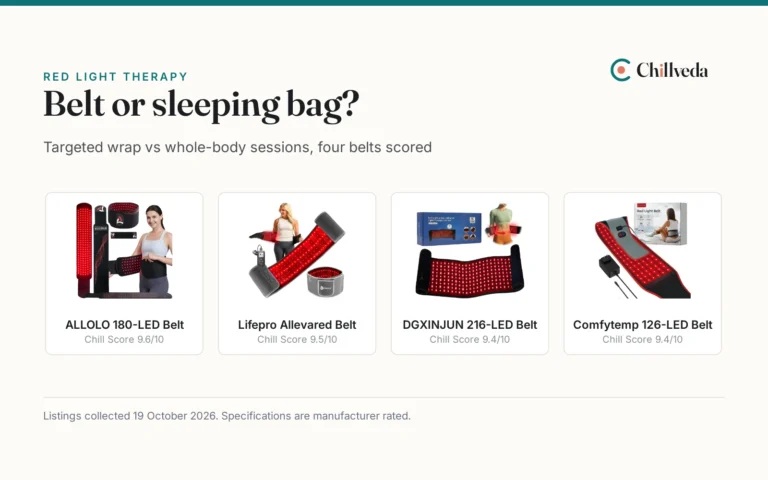
Red light therapy belt vs sleeping bag comes down to targeted sessions versus whole-body sessions. A belt wraps one area, waist, back, shoulder or knee, and runs while you sit at your desk or move around the house. A sleeping bag wraps the whole body for a full-body session while you lie down. Listings were collected 19 October 2026.
This article is informational and is not medical advice. Red light devices are bright: avoid staring into the LEDs, and consider eye protection if you use one near your face. Ask a clinician before use if you have a medical condition. See our Medical Disclaimer.
Chillveda earns a commission when you buy through links on this page, at no extra cost to you. As an Amazon Associate I earn from qualifying purchases. Affiliate disclosure.
Quick picks
-
1
 ALLOLO Red Light Therapy for Body Chill Score 9.6/10Check price on Amazon
A 180-bead triple-chip belt with 660nm and 850nm LEDs, 4 modes including pulse, and a 12-month warranty.
-
2
 Lifepro Allevared Red Light Therapy Belt -105 Chill Score 9.5/10Check price on Amazon
A USB-powered 105 triple-chip belt in neoprene with 660nm and 850nm LEDs and a 1 to 30 minute timer.
-
3
 DGXINJUN Red Light Therapy Belt for Body Chill Score 9.4/10Check price on Amazon
A 216-LED microplush belt with 880nm infrared stated, a 15 ft cord and 20-minute auto shut-off.
-
4
 Comfytemp Red Light Belt with 126 LEDs Chill Score 9.4/10Check price on Amazon
A corded 22W belt with 126 dual-chip LEDs, on-belt controls and a 20-minute timer off.

A 180-bead triple-chip belt with 660nm and 850nm LEDs, 4 modes including pulse, and a 12-month warranty.
Pros & ConsViewHide
Pros
- 180 lamp beads with 3 chips each (180x660nm, 360x850nm)
- 4 modes including a 10 Hz pulse mode
- 39 by 7.7 in coverage; 47.44 in total belt length with extension
- 12-month extended warranty stated
Cons
- No safety certification stated
- Plug-powered through a controller, no battery
- 2.73 lb package weight, the heaviest of the four
- No spare parts listed in the box

A USB-powered 105 triple-chip belt in neoprene with 660nm and 850nm LEDs and a 1 to 30 minute timer.
Pros & ConsViewHide
Pros
- 105 triple-chip LEDs at 660nm and 850nm
- 3 modes (red, NIR, both) with 1-30 min auto timer
- USB-powered and listed as rechargeable; 15.2 oz
- Neoprene wrap, 49.5 by 7.8 in
Cons
- "Lifetime Customer Support" is support, not a warranty term
- Listed as rechargeable but no battery capacity stated
- 105 LEDs is the fewest in this set
- No safety certification stated

A 216-LED microplush belt with 880nm infrared stated, a 15 ft cord and 20-minute auto shut-off.
Pros & ConsViewHide
Pros
- 216 LEDs (108 red + 108 infrared)
- 880nm near-infrared wavelength stated
- 15 ft cord for room to move
- Soft microplush wearable build
Cons
- No warranty term stated
- Red LED wavelength not stated, only the 880nm infrared
- No safety certification stated
- Fixed 20-minute auto shut-off, no custom timer settings stated

A corded 22W belt with 126 dual-chip LEDs, on-belt controls and a 20-minute timer off.
Pros & ConsViewHide
Pros
- 126 dual-chip LEDs at 660nm and 850nm
- 4 modes with 3 levels, buttons on the belt
- 22W corded: no charging needed
- 50 by 8 in belt with 22 by 8 in coverage
Cons
- No warranty term stated
- Corded to a wall outlet; cannot roam during sessions
- Dual-chip beads carry fewer chips than triple-chip belts
- No safety certification stated
More to compare
 Lifepro Allevared Red Light Therapy BeltCheck price on Amazon
 Comfytemp Cordless Red Light Therapy BeltCheck price on Amazon
 Red Light Therapy Belt for Body BackCheck price on Amazon
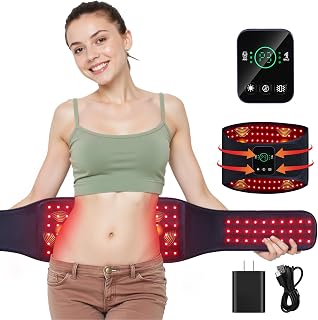 Cordless Red Light Therapy Belt for Body Back & Abdomen withCheck price on Amazon
 Red Light Therapy BeltCheck price on Amazon
 iRESTORE Sculpt LED BeltCheck price on Amazon
Red light therapy belt vs sleeping bag: the short answer
Choose the belt when you want light on one spot: the waist after a long drive, the shoulder after a workout, the knee on a rest day. All four products below are belts, and the listings score them on LEDs, modes and build. Choose the sleeping bag when you want a whole-body session in one go and you have the floor or bed space for it; no sleeping bag listings are in this guide, so the bag side below is explained from general device knowledge without listing figures.
Many people start with a belt because it is the smaller commitment: less space, less money tied up, and sessions that fit into a workday. The bag suits a dedicated recovery corner where the session is the evening routine.
How the two form factors compare
| Belt | Sleeping bag | |
|---|---|---|
| Coverage | One area at a time | Whole body at once |
| Session style | Wear while sitting or moving | Lie down inside it |
| Space needed | A chair or sofa | Floor or bed space |
| Portability | Light wrap; some run on USB power | Bulkier; stays at home |
| What the listings show | Four belts below, scored | Not listed here |
The belts, scored
These are scored on the Chill Score, which weighs performance 30, build 20, value 20, safety certifications 15 and warranty 15. No listing here states a safety certification, so all four score 0 for safety.
| Product | Chill Score | Perf. /35 | Build /25 | Value /25 | Safety /10 | Warranty /5 |
|---|---|---|---|---|---|---|
| ALLOLO 180-LED Belt | 9.6 | 32 | 21 | 21 | 0 | 3 |
| Lifepro Allevared Belt | 9.5 | 29 | 20 | 20 | 0 | 1 |
| DGXINJUN 216-LED Belt | 9.4 | 29 | 19 | 19 | 0 | 0 |
| Comfytemp 126-LED Belt | 9.4 | 28 | 19 | 19 | 0 | 0 |
Scores run from 9.2 to 9.8: each product’s point total is placed on that range, so more points always means a higher score.
What to check before you buy
LED count and chip type. More beads and more chips per bead mean denser coverage: the ALLOLO lists 180 beads with 3 chips each, the Lifepro 105 triple-chip LEDs, the DGXINJUN 216 LEDs and the Comfytemp 126 dual-chip beads. Our tri chip vs dual chip red light guide explains the difference.
Wavelengths. Three of the four list 660nm red plus 850nm near-infrared; the DGXINJUN lists 880nm infrared without stating the red wavelength. Our red vs near-infrared light therapy guide covers what the numbers mean.
Modes and timer. Timers run from a fixed 20-minute auto-off on the Comfytemp and DGXINJUN to a 1 to 30 minute auto timer on the Lifepro and a 5/10/15/20/25/30 minute controller on the ALLOLO. Pulse modes appear on the Lifepro and ALLOLO listings.
Power. The Lifepro runs on USB power and is listed as rechargeable; the Comfytemp is corded at 22W to a wall outlet; the ALLOLO and DGXINJUN run through a plug and controller or a 15 ft cord. Corded means no charging; USB means portability.
Size against your body. Check coverage area against where you will wear it: 39 by 7.7 inches on the ALLOLO, 49.5 by 7.8 inches on the Lifepro, 50 by 8 inches on the Comfytemp. Extension straps help larger waists.
Warranty. Only the ALLOLO states a warranty term, 12 months extended. The Lifepro lists lifetime customer support, which is support rather than a warranty term; the other two state nothing.
Running your first belt session
Setup is the same across all four belts: connect the pad, plug and controller (or the USB cable on the Lifepro, or the wall cable on the Comfytemp), wrap the belt around the target area and fasten it so the LEDs sit against the skin or light clothing. Pick a mode, red, infrared or both, and set the timer; the Lifepro runs 1 to 30 minutes, the ALLOLO 5 to 30, and the Comfytemp and DGXINJUN switch off by themselves at 20 minutes.
Two habits are worth building. First, keep the LEDs off your eyes: do not stare into the beads when you check that the belt is on, and keep face sessions short and shielded. Second, write down what you ran, mode and minutes, for the first week; the listings give you the controls but not a schedule, and your notes beat memory when you compare how sessions felt.
Common questions
Can a belt cover the whole body?
No. A belt covers one area per session, so whole-body coverage means moving it between sessions. For whole-body sessions in one go, a sleeping bag or a panel is the form factor; our red light therapy pad vs panel guide compares the larger formats.
What do 660nm and 850nm mean?
They are the wavelengths the listings state: 660nm red light and 850nm near-infrared, with the DGXINJUN listing 880nm infrared instead. The numbers describe the light color the LEDs emit, not a health outcome.
How long is a session?
Follow the timer on your device: the Lifepro auto timer runs 1 to 30 minutes, the ALLOLO controller offers 5 to 30 minutes in steps, and the Comfytemp and DGXINJUN switch off automatically at 20 minutes. Your device manual comes before anything you read online.
Do I need eye protection?
The devices are bright. Avoid staring into the LEDs, and consider eye protection if you use a belt near your face. Sessions on the waist, back or legs keep the light away from the eyes naturally.
Belt or sleeping bag for a small apartment?
The belt. It stores in a drawer and runs on a chair or sofa, while a sleeping bag needs dedicated floor or bed space and stays set up.
Sources: Amazon product listings for the belts named above, collected 19 October 2026. Related: our red light therapy pad vs panel, flexible red light pad vs rigid panel and red light therapy canopy vs red light bed.
Back to all red light therapy reviews.