Short answer
What is the main difference between far infrared and near infrared saunas?
A far infrared sauna uses long-wavelength radiant panels to heat the body directly and warm the cabin up to comfort settings such as 140 F or 149 F, inducing deep sweating. A near infrared sauna uses shorter wavelengths that penetrate tissue more deeply with less ambient heat, often delivered via red and near-infrared light lamps. Many home saunas combine far infrared wall panels for sweating with an overhead red light lamp for light exposure.
When setting up a home wellness space next to a bedroom or home gym outlet, choosing between a far infrared sauna vs near infrared sauna comes down to how heat and light are delivered. A far infrared sauna uses carbon or ceramic heating emitters to produce long-wavelength radiant heat that warms your body directly and brings the enclosed cabin up to comfort settings like 140 F or 149 F, promoting full-body sweating. A near infrared sauna uses shorter wavelengths that penetrate tissue more deeply while keeping ambient room temperatures lower, often delivered through focused heat lamps or targeted red and near-infrared light panels. If your priority is a heavy sweat and whole-cabin warmth, choose far infrared; if you want targeted light exposure and deeper tissue penetration without hot cabin air, choose near infrared. Many home cabins combine both, using far infrared panels for ambient warmth and an overhead red light lamp for simultaneous light therapy.
This guide compares how these two infrared technologies function in home saunas, what installation requirements they demand, and two cabin options that integrate these technologies. Listings were collected 13 October 2026.
This article is informational and is not medical advice. Heat exposure strains the heart and causes fluid loss. Do not use a sauna after alcohol, when pregnant, when unwell, or with a heart condition or low blood pressure without asking a clinician first. Leave at once if you feel dizzy, sick or confused. See our Medical Disclaimer.
Chillveda earns a commission when you buy through links on this page, at no extra cost to you. As an Amazon Associate I earn from qualifying purchases. Affiliate disclosure.
Quick picks
-
1
 Ceramic Infrared Sauna 2 Person Infrared Sauna Chill Score 9.5/10Check price on Amazon
A 2-person hemlock cabin with 6 ceramic infrared heating tubes, an infrared therapy red light, and a 2-year warranty.
-
2
 Homsido Red Light Therapy Infrared Sauna for Home Chill Score 9.4/10Check price on Amazon
A compact 1-person cedar cabin with 5 carbon crystal heating panels, an overhead red light beauty lamp, and 110V operation.

A 2-person hemlock cabin with 6 ceramic infrared heating tubes, an infrared therapy red light, and a 2-year warranty.
Pros & ConsViewHide
Pros
- 2-year limited warranty stated on structure, heating, and electronics
- 6 ceramic infrared heating tubes plus concealed foot heating panel
- Separate infrared therapy red light included
- Heats to 149 F with 10-minute warm-up
Cons
- 1840W power draw requires heavy electrical supply and dedicated wiring
- Spec table lists 62.99-inch width while bullets state 47.09 inches
- No UL or ETL electrical safety certification stated
- Large footprint not suited for tight rooms

A compact 1-person cedar cabin with 5 carbon crystal heating panels, an overhead red light beauty lamp, and 110V operation.
Pros & ConsViewHide
Pros
- 110V 1300W electrical system operates on standard household supply
- 5 carbon crystal heating panels provide even cabin warmth
- Overhead red light beauty lamp included with cabin
- Compact 32 by 34 inch footprint fits smaller rooms
Cons
- No warranty term is stated
- No UL or ETL electrical safety certification stated
- Maximum temperature stops at 140 F
- 1-person interior fits only a single seated user
More to compare
 OUTEXER Infrared Sauna Home Sauna Spa Room Chilean Pine WoodCheck price on Amazon
 Homsido Red Light Therapy Infrared Sauna for HomeCheck price on Amazon
 X-Vcak 1-2 Person Infrared SaunaCheck price on Amazon
 2-3 Person Ceramic Infrared Sauna with Red Light TherapyCheck price on Amazon
 Full Spectrum Ultra-Low EMF Outdoor Sauna 2-PersonCheck price on Amazon
 Lifepro BioRemedy Infrared Sauna Blanket for Home RelaxationCheck price on Amazon
Far infrared sauna vs near infrared sauna: key differences
| Feature | Far infrared | Near infrared |
|---|---|---|
| Wavelength range | Longer infrared wavelengths absorbed by surface skin | Shorter infrared wavelengths penetrating deeper into tissue |
| Primary emitter type | Carbon crystal panels or ceramic heating tubes | Red and near-infrared lamps or light panels |
| Heat delivery | Radiant heat warming the body and raising cabin temperature | Targeted radiant energy focused where the light shines |
| Primary user goal | Full-body sweating, relaxation, and thermal heat exposure | Targeted light exposure and localized tissue warmth |
| Typical home format | Lining the walls of 1-person or 2-person wooden cabins | Overhead cabin lamp or standalone light panel |
The distinction between far infrared and near infrared lies in how their wavelengths interact with the human body. Far infrared wavelengths are absorbed efficiently by the water in surface tissues, creating direct radiant warmth that triggers profuse sweating even at lower ambient air temperatures than traditional hot-rock rooms. Near infrared wavelengths sit closer to visible red light, penetrating deeper into subcutaneous tissue with less ambient air heating. In home setups, far infrared serves as the primary engine for cabin warmth, while near infrared provides focused light exposure.
How far infrared heat warms the body
In a traditional sauna, a stove heats rocks, the rocks heat the air, and the hot air warms your skin through convection. A far infrared sauna works differently: emitters radiate infrared waves that travel directly through the air to warm your body. As the session progresses, the emitters and warm cabin surfaces also elevate the cabin air temperature, with listings here stating thermostat settings up to 140 F or 149 F. Because your body absorbs the radiant energy directly, you experience a heavy sweat without needing the high air temperatures of a traditional room. Our infrared vs traditional sauna guide explains these trade-offs in detail.
Home cabins typically rely on two types of far infrared emitters. Broad carbon crystal panels cover larger wall areas to distribute gentle, even heat throughout the enclosure. Ceramic heating tubes provide higher radiant intensity from specific positions. For a closer comparison of these emitter styles, see our guide to carbon vs ceramic infrared heaters.
Where near infrared light fits in a home sauna
Near infrared light occupies the spectrum just past visible red light. While standalone near-infrared heat lamp setups exist, modern prefabricated wooden cabins often integrate near-infrared as a supplemental feature. In these cabins, makers include an overhead red light beauty lamp or an infrared therapy light module to deliver targeted light exposure to the face and upper body while you sit inside. Our guide on red light vs near infrared light breaks down how optical wavelengths compare.
Pairing near infrared light with far infrared panels creates a dual-action session: the far infrared emitters provide full-body warmth and sweating, while the near-infrared red light source delivers focused topical light exposure during the same seated period.
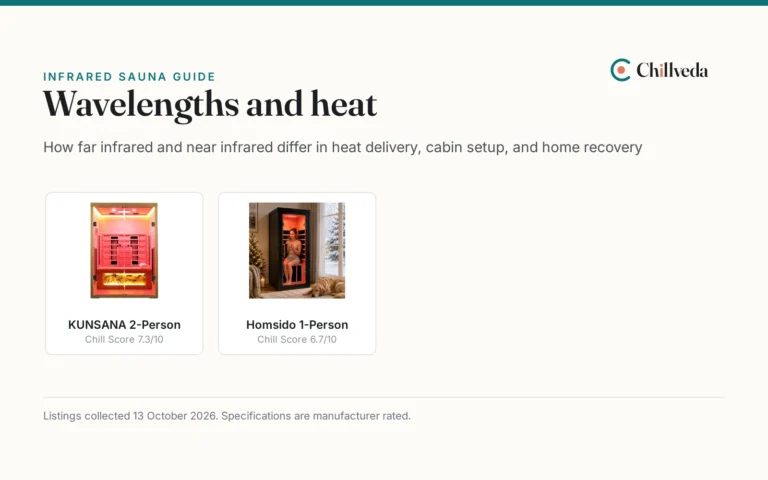
Infrared saunas combining far and near wavelengths
These are scored on the Chill Score, which weighs performance 35, build 25, value 25, safety certifications 10 where it applies and warranty 5. Neither listing states a UL or ETL safety listing, so both score 0 for safety.
| Product | Chill Score | Perf. /35 | Build /25 | Value /25 | Safety /10 | Warranty /5 |
|---|---|---|---|---|---|---|
| KUNSANA 2-Person | 9.5 | 29 | 20 | 20 | 0 | 4 |
| Homsido 1-Person | 9.4 | 27 | 20 | 20 | 0 | 0 |
Scores run from 9.2 to 9.8: each product’s point total is placed on that range, so more points always means a higher score.
For more home cabin options, see our guides to the best 1 person saunas and best 2 person home saunas.
Choosing the right sauna setup for your home
- Check electrical capacity before ordering. Verify your available circuit against the sauna’s listed power. A 1300W cabin built for 110V operation is designed to run on standard household circuits without specialized wiring, whereas an 1840W cabin draws significantly more current and typically requires a dedicated circuit to prevent tripping breakers.
- Measure doorway clearance and floor space. Measure your hallway, doors, and intended space before ordering. A compact 1-person cabin lists a 32 by 34 inch floor footprint, while a 2-person model requires at least 47.09 by 39.21 inches of clear floor area.
- Select your preferred heating elements. Carbon crystal panels provide wide, even heat coverage across cabin walls, while ceramic heating tubes deliver higher localized radiant output.
- Allow adequate preheat time. Infrared cabins need time to warm their emitters and cabin walls. Preheating time varies by room temperature and construction; for example, the ceramic listing here notes a 10-minute warm-up period, while reaching maximum settings like 140 F or 149 F takes longer.
- Stay hydrated. Drink water before and after your session, and never use a sauna after consuming alcohol or when feeling unwell.
Common mistakes
- Expecting a supplemental overhead red light lamp alone to produce cabin-wide heating and sweating.
- Plugging a high-draw 1840W sauna into a shared household outlet instead of a dedicated circuit.
- Assuming lower infrared air temperatures mean less effective sweating than a traditional sauna.
- Failing to verify exterior cabin dimensions against doorways and stairwells before delivery.
Common questions
What is the main difference between far infrared and near infrared saunas?
A far infrared sauna uses long-wavelength radiant panels to heat the body directly and warm the cabin up to comfort settings such as 140 F or 149 F, inducing deep sweating. A near infrared sauna uses shorter wavelengths that penetrate tissue more deeply with less ambient heat, often delivered via red and near-infrared light lamps. Many home saunas combine far infrared wall panels for sweating with an overhead red light lamp for light exposure.
Can a near infrared light lamp heat an entire sauna cabin?
In home cabins with wooden enclosures, overhead near-infrared or red light lamps are designed for localized light exposure rather than heating the whole room. Full-body sweating and cabin warmth rely on far infrared carbon or ceramic heaters. If your goal is a heated sweat session, far infrared heating elements are essential.
What electrical outlet does a home infrared sauna need?
It depends on the listed power and voltage. A 1300W cabin built for 110V operation plugs into standard household wall outlets without panel upgrades. A larger 1840W cabin draws substantially more power, making a dedicated circuit advisable to prevent tripping breakers during prolonged sessions.
What temperature settings do far infrared saunas offer?
Operating ranges vary across manufacturers, with the models featured here listing top settings of 140 F and 149 F. Because far infrared warms your body directly through radiant energy, users sweat heavily at these moderate temperatures without the high air heat required by traditional saunas.
Can you use far infrared and near infrared at the same time?
Yes, many home infrared cabins are designed specifically for simultaneous use. The far infrared carbon or ceramic panels warm the cabin and elevate your core temperature, while an overhead red light lamp provides topical light exposure throughout your session.
Sources: Amazon product listings for the saunas named above, collected 13 October 2026. Related: our sauna electrical requirements and home sauna running cost guides.
Back to all sauna reviews.