Short answer
Can a red light bulb replace a red light panel?
A red light bulb works well for focused treatment on small areas like a knee, elbow, or hand, but it cannot match the coverage of a mid-size or full panel. Treating a larger area like the full back with a bulb requires sitting through multiple sessions while repeatedly repositioning the lamp. A taller panel measuring 15.5 to 20.3 inches can cover broad sections of your back or torso in a single session, whereas a bulb or compact 11-inch panel focuses on smaller, localized target zones.
Setting up a recovery space in a bedroom corner or beside a home desk usually comes down to outlet access, available floor space, and how much of your body you want to cover at once. When weighing a red light panel vs red light bulb, the choice hinges on treatment area and convenience: a red light panel uses an array of diodes to deliver structured light across larger treatment zones or torso sections in a single session, while a red light bulb fits a standard lamp socket to target a localized spot such as an ankle, wrist, or cheek at a fraction of the physical footprint.
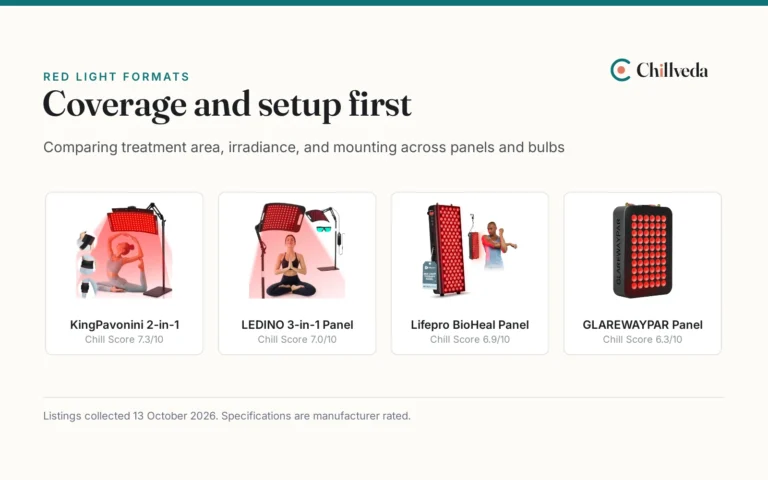
Panels offer dedicated hanging kits or floor stands with integrated timers and multi-diode arrays, while bulbs offer compact portability for focused spots. Below, we compare the physical formats, beam spread, and setup requirements of both designs, along with four home panels to illustrate how stated dimensions, irradiance, and mounting hardware shape your routine. Listings were collected 13 October 2026.
This article is informational and is not medical advice. Red light and near-infrared devices emit concentrated optical radiation. Always use appropriate eye protection during sessions, avoid staring directly into the diodes, and consult a healthcare professional before use if you are photosensitive, pregnant, or taking medications that increase light sensitivity. See our Medical Disclaimer.
Chillveda earns a commission when you buy through links on this page, at no extra cost to you. As an Amazon Associate I earn from qualifying purchases. Affiliate disclosure.
Quick picks
-
1
 KingPavonini Red Light Therapy for Body Chill Score 9.5/10Check price on Amazon
A versatile red light therapy device with 136 LEDs delivering up to 250 mW/cm² that unlatches from its floor stand to wear as a flexible body belt.
-
2
 Red Light Therapy for Body face-660nm 850nm Chill Score 9.5/10Check price on Amazon
A dual-wavelength red light therapy panel with 360 LED beads and an adjustable 40 to 60 inch floor stand, desktop bracket, and remote control.
-
3
 Lifepro Bioheal Red Light Therapy Panel 90 &120 Chill Score 9.4/10Check price on Amazon
A 20.3-inch red light therapy panel with 120 dual-chip LEDs rated at 203 mW/cm² at 3 inches, supplied with a door-hanging kit and eyewear.
-
4
 Red Light Therapy Panel for Body 660nm 850nm Chill Score 9.3/10Check price on Amazon
A compact metal red light therapy panel measuring 11 by 7 inches with 120 LEDs delivering 145 mW/cm² and backed by a 60-day replacement policy.

A versatile red light therapy device with 136 LEDs delivering up to 250 mW/cm² that unlatches from its floor stand to wear as a flexible body belt.
Pros & ConsViewHide
Pros
- Highest stated irradiance here at 250 mW/cm²
- Detaches to wear as a belt with included strap
- 136 LEDs with 408 chips and 9 operating modes
- Includes stand with 360 degree rotating head and 10ft cord
Cons
- No warranty term is stated
- No safety certifications listed
- Power bank for portable belt use not included
- Package weight is 8.84 pounds to move

A dual-wavelength red light therapy panel with 360 LED beads and an adjustable 40 to 60 inch floor stand, desktop bracket, and remote control.
Pros & ConsViewHide
Pros
- Stated irradiance of 203 to 206 mW/cm²
- Includes height-adjustable stand from 40 to 60 inches
- Separate desktop stand and remote control included
- States 43 to 45 W power consumption
Cons
- No warranty term is stated
- No safety certifications listed
- Panel listing reports heat up to 104 to 110 F
- Floor stand assembly requires checking screw tightness

A 20.3-inch red light therapy panel with 120 dual-chip LEDs rated at 203 mW/cm² at 3 inches, supplied with a door-hanging kit and eyewear.
Pros & ConsViewHide
Pros
- Stated irradiance of 203 mW/cm² at 3 inches
- Generous panel size at 20.3 by 8.3 inches
- Includes door hanging kit and eyewear
- Established brand listing with unisex rating
Cons
- No warranty term is stated
- No safety certifications listed
- Title contradicts itself stating 90 and 120 LEDs
- Heaviest unit here at 9.7 pounds with no floor stand

A compact metal red light therapy panel measuring 11 by 7 inches with 120 LEDs delivering 145 mW/cm² and backed by a 60-day replacement policy.
Pros & ConsViewHide
Pros
- Stated 60-day replacement policy
- Metal housing build at 4.89 pounds
- Compact 11 by 7 inch footprint fits small spaces
- Includes adjustable door or wall hanger
Cons
- Lowest stated irradiance here at 145 mW/cm²
- Smallest treatment area at 11 by 7 inches
- No safety certifications listed
- Even 60 red and 60 NIR split offers fewer NIR beads than rivals
More to compare
 Red Light Therapy PanelCheck price on Amazon
 Red Light Therapy Panel for Face & BodyCheck price on Amazon
 HiStrips Portable Red Light Therapy Panel with 660nm & 850nmCheck price on Amazon
 LED-Red-Light-Therapy-DeviceCheck price on Amazon
 45W Red LED Light Therapy PanelCheck price on Amazon
 BestQool Red Light Therapy PanelCheck price on Amazon
Red light panel vs red light bulb: core differences
| Feature | Red light panel | Red light bulb |
|---|---|---|
| Treatment area | Varies from targeted facial areas to broad torso coverage | Concentrated spot coverage for a single joint or area |
| Light source | Multi-diode array (120 to 136 LEDs in these picks) | Clustered diodes in a single lamp casing |
| Mounting setup | Door hanger, tabletop bracket, or floor stand | Standard household screw-in lamp fixture |
| Stated irradiance | Multi-point grid output (145 to 250 mW/cm² in these picks) | Concentrated conical beam over narrow radius |
| Typical session format | Hands-free standing, lying flat, or seated | Stationary desk lamp or clip-on fixture positioning |
| Timer and controls | Integrated digital timer (1 to 30 minutes, model dependent) | Relies on external lamp switch or wall timer |
The structural difference between a panel and a bulb defines how you use each device day to day. Panels in this class feature 120 or more light emitting diodes across a flat or curved surface, spreading 660nm red and 850nm near-infrared wavelengths evenly across a broad surface area. The panels reviewed here vary in length from compact 11-inch models suited for localized areas to taller 15.5 to 20.3 inch panels designed to cover broader sections of the back, torso, or legs without shifting position. In contrast, a red light therapy bulb concentrates its diodes into a single spotlight housing that screws into a standard lamp socket, restricting effective coverage to a small zone.
Because a bulb projects a conical beam from a single socket, moving further away widens the illuminated area but rapidly diminishes delivered energy. Panels avoid this steep drop-off across broad areas by arranging diodes in a grid, maintaining higher irradiance across the full treatment field. If your routine focuses on a specific tendon, finger joint, or small facial patch, our guide to the best red light therapy bulbs details dedicated spot lamps.
Beam angle and coverage: why format determines session time
Session efficiency is the primary practical difference between these two form factors. A user looking to cover both shoulders and the upper back with a bulb must reposition the lamp or sit through multiple successive sessions, treating one small zone at a time. With a panel measuring 15.5 to 20.3 inches, those areas receive light simultaneously during a single session.
Mounting also dictates where in your home you can comfortably complete a session. Bulbs depend on an existing gooseneck lamp, desk fixture, or clamp that can support their front-heavy heat sinks and position the beam securely without tipping. Panels arrive with purpose-built hardware: the models below feature weighted floor stands adjustable from 40 to 60 inches, over-the-door hanging straps, or desktop brackets. For details on how dual wavelengths penetrate tissue, see our guide on red light wavelengths explained.
Power draw, floor space, and setup requirements
A light source must deliver sufficient energy density across your target area while fitting your available room layout. In the listings below, makers rate panel irradiance between 145 mW/cm² and 250 mW/cm². The LEDINO panel lists a power draw of 43 to 45 W at its highest output level, which connects to a standard household outlet without specialized wiring.
Physical space and mounting requirements vary significantly across these formats. The compact GLAREWAYPAR metal panel measures 11 by 7 by 2.7 inches and weighs 4.89 pounds, making it easy to suspend from an interior door using its adjustable hanger. In comparison, the Lifepro BioHeal measures 20.3 by 8.3 by 3.4 inches and weighs 9.7 pounds, requiring a sturdy door anchor or clear tabletop. Floor-standing models like LEDINO and KingPavonini require dedicated floor clearance for their weighted bases, with LEDINO featuring a stand that adjusts from 40 to 60 inches in height and KingPavonini including a 10ft cord for flexible positioning away from wall outlets. To understand how distance affects light delivery, consult our guide on how to read a red light irradiance number.
Red light panels worth mounting
These panels are scored on the Chill Score, which weighs performance 35, build 25, value 25, safety certifications 10 where it applies, and warranty 5. None of these four listings state independent safety certifications, so all four score 0 for safety.
| Product | Chill Score | Perf. /35 | Build /25 | Value /25 | Safety /10 | Warranty /5 |
|---|---|---|---|---|---|---|
| KingPavonini 2-in-1 | 9.5 | 30 | 21 | 21 | 0 | 0 |
| LEDINO 3-in-1 Panel | 9.5 | 29 | 20 | 21 | 0 | 0 |
| Lifepro BioHeal Panel | 9.4 | 28 | 21 | 20 | 0 | 0 |
| GLAREWAYPAR Panel | 9.3 | 24 | 19 | 19 | 0 | 1 |
Scores run from 9.2 to 9.8: each product’s point total is placed on that range, so more points always means a higher score.
For larger multi-switch setups, see our best full body red light panels roundup, or check our best targeted red light devices guide.
Setting up your sessions in practice
- Start with shorter durations. Stated panel timers adjust from 1 to 30 minutes, or 5 to 30 minutes on KingPavonini. Begin with a shorter session to observe skin response before using the full duration.
- Observe distance and placement guidelines. Rigid panels with uncovered LEDs should be positioned at the manufacturer-stated distance, such as 3 inches for Lifepro, rather than pressed against the skin. In contrast, hybrid silicone panels like KingPavonini include dedicated straps designed for direct contact as a wearable pad. Read our guide on how far should you sit from a red light panel.
- Always wear eye protection. High-output 660nm red and 850nm near-infrared diodes emit intense optical radiation. Use the opaque goggles included with these panels rather than regular sunglasses. See our guide on red light therapy eye safety.
- Check stand stability and cord routing. The KingPavonini and LEDINO models include tall floor stands extending up to 60 inches. Tighten all bracket screws securely and route the 10ft power cords away from foot traffic.
- Clean surfaces gently. Unplug panels before wiping casing edges with a dry microfiber cloth. Avoid spraying liquids directly onto exposed diode lenses or internal circuitry.
Common mistakes
- Buying a single bulb and expecting full-body or torso coverage in a single sitting without repositioning.
- Ignoring thermal output on high-power panels; LEDINO lists operating temperatures between 104 and 110 F at peak output.
- Treating seller cosmetic marketing claims as medical clearance; check our report on how FDA cleared is not approval.
- Staring directly into near-infrared 850nm diodes; because 850nm light is largely invisible to human eyes, users may mistakenly assume the diodes are off while they emit active optical energy.
- Overlooking mounting requirements before purchase, such as door clearance for hanging kits or floor space for weighted bases.
Common questions
Can a red light bulb replace a red light panel?
A red light bulb works well for focused treatment on small areas like a knee, elbow, or hand, but it cannot match the coverage of a mid-size or full panel. Treating a larger area like the full back with a bulb requires sitting through multiple sessions while repeatedly repositioning the lamp. A taller panel measuring 15.5 to 20.3 inches can cover broad sections of your back or torso in a single session, whereas a bulb or compact 11-inch panel focuses on smaller, localized target zones.
How far should you sit from a red light panel?
Recommended distance varies by model and stated irradiance. The Lifepro panel specifies an irradiance of 203 mW/cm² at 3 inches, while other panels allow positioning comfortably close or further back depending on warmth. Always consult the device manual and begin at a greater distance during initial sessions.
Do red light panels use a lot of electricity?
No. Stated power consumption for panels in this class is modest. The LEDINO panel lists a draw of 43 to 45 W at full power. Running a 45 W panel uses very little energy compared to larger heating appliances or traditional saunas.
Do you need eye protection with red light panels and bulbs?
Yes. Concentrated 660nm red and 850nm near-infrared light can strain the eyes and cause glare. While 850nm light is largely invisible to human vision, it remains optically active. Always wear the opaque goggles provided by the maker and avoid looking directly into illuminated diodes.
What is the difference between pulsed and continuous red light?
Continuous light delivers a steady, unbroken stream of optical energy throughout your session. Pulsed modes, such as the 10Hz and 40Hz options on the KingPavonini panel, cycle the light on and off at fixed intervals. Our guide on pulsed vs continuous red light therapy explores how different frequencies function.
Sources: Amazon product listings for the red light therapy devices named above, collected 13 October 2026. Related: our best portable red light therapy devices and best full body red light panels.
Back to all red light therapy reviews.