


A cold plunge chiller is the rare appliance that runs twenty four hours a day, seven days a week, whether or not you use it. That changes how you should think about its cost, because the electricity bill has almost nothing to do with how often you plunge and almost everything to do with how hard the chiller has to fight to hold temperature.
Here is the arithmetic, and the four things that move it.
This article is informational and is not medical advice. Please read our Medical Disclaimer and our guide to cold plunge safety before your first session.
Why the spec sheet number misleads
Chillers are sold by horsepower, and the wattage on the specification is the draw when the compressor is running. Manufacturers rate roughly 250 to 350 watts for a quarter horsepower unit, 400 to 600 for a half, and 800 to 1100 for a full horsepower.
But the compressor does not run continuously. Once the water is at your set temperature, it cycles on and off to hold it. The fraction of the time it spends running is the duty cycle, and that single figure dominates your bill.
Monthly cost = rated watts ÷ 1000 × 24 hours × 30 days × duty cycle × your rate per kWh
We use 18.34 cents per kWh throughout, the US residential average for June 2026 published by the Energy Information Administration. Substitute the rate from your own utility bill, because residential rates range from around 11 cents in parts of the South to well over 40 cents in Hawaii.
What the numbers look like
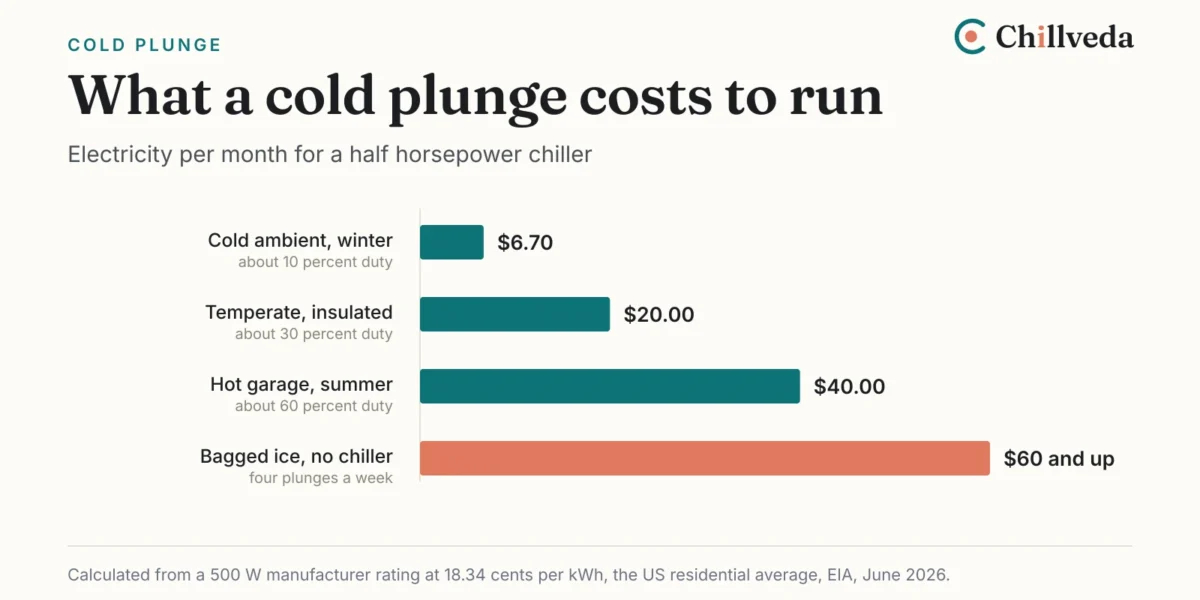
The chart above models a half horsepower chiller rated at 500 watts, at three realistic duty cycles.
In a cold garage in winter, the ambient air is doing most of the work for you and the compressor barely runs. Around ten percent duty gives roughly 3.6 kWh a day and about $6.70 a month.
In a temperate space with a well insulated tub and a cover, thirty percent duty is a reasonable planning figure. That is roughly 3.6 kWh a day and about $20 a month.
In a hot garage in summer, with an uninsulated tub, the compressor works continuously for long stretches. Sixty percent duty puts you near $40 a month.
That spread, roughly six dollars to forty for the same appliance, is the point of this article. Anyone quoting you a single figure for what a cold plunge costs to run is guessing.
The ice comparison nobody runs
The fourth bar is the one that surprises people.
Chilling with bagged ice instead of a chiller looks cheaper because there is no equipment to buy. Run the arithmetic on consumption instead. A reasonable plunge needs somewhere around thirty to forty pounds of ice to bring a tub down and hold it, which is two bags or more. At four sessions a week, that is over thirty bags a month.
Multiply by whatever a bag costs where you live and the monthly figure generally lands above the worst case chiller scenario, permanently, with the added job of hauling ice. A chiller has a purchase price, but it stops costing you more or less the same amount every month forever.
Ice makes sense for occasional use or for finding out whether you like cold exposure at all. As a long term routine for four plunges a week, it is usually the expensive option. Our inflatable ice bath coverage covers the tubs people start with.
The four things that move your bill
1. Ambient temperature
This is the biggest lever and the one you least control. The same tub in an unheated garage in Minnesota and a carport in Phoenix are two completely different appliances in operating terms. If yours lives outdoors in a hot climate, budget toward the top of the range.
2. Insulation and the cover
Every degree the water gains from the air is a degree the compressor pays to remove. An insulated shell and a fitted cover are the cheapest efficiency upgrades available, and a cover also keeps the water clean, which reduces the work in our water care guide.
3. Set temperature
Holding water at 39 degrees Fahrenheit costs meaningfully more than holding it at 50. If you are new to this, you should be starting warmer anyway for safety reasons, and your bill will thank you.
4. A clean condenser
The chiller rejects heat through a coil. When that coil is choked with dust, lint, or garage grit, the unit runs longer to achieve the same cooling. Cleaning it twice a year is free and it shows up directly in what you pay.
The costs beyond electricity
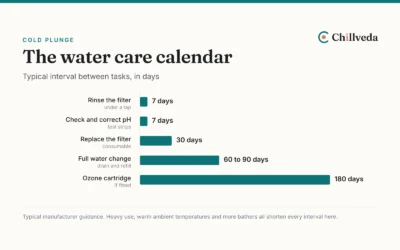
Filter cartridges are the recurring consumable, typically replaced monthly with regular use. Ozone cartridges, where fitted, come around roughly twice a year. Water itself has a cost when you drain and refill every two to three months, modest in most places but not zero.
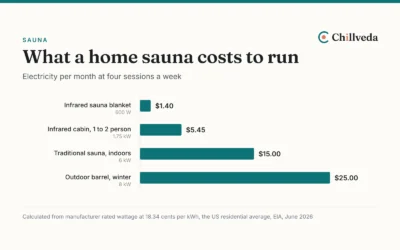
Then there is the electrician. A chiller sitting next to a tub of water needs ground fault protection, and depending on the unit and your setup it may want its own circuit. Get that quoted before you buy, the same way you would for a sauna installation.
Who should reconsider
If your electricity rate is above about 30 cents per kWh and your tub will live somewhere warm, run the formula with your own numbers before you commit. The monthly figure can approach the cost of a gym membership that includes a plunge pool.
If you plunge once or twice a week, a chiller running continuously to serve eight sessions a month is poor value. An inflatable tub you fill and drain is the honest answer at that frequency.
And if you have not established that you will keep doing this, do not buy a chiller yet. Cold showers cost nothing, and an inflatable tub with ice costs very little. Find out first.
Run it yourself
Take the rated wattage from the chiller’s specification, estimate a duty cycle from the scenarios above, and multiply through with the rate on your bill. Then add filters and the electrician’s quote. That total is the real cost, and it is the number worth deciding on.
Source: US Energy Information Administration, Electric Power Monthly, Table 5.6.A, average retail price of electricity to residential customers, June 2026: 18.34 cents per kWh. View the current table. Chiller wattage figures are manufacturer ratings.



Write Your Review
No reviews yet. Be the first to share your experience!