Side by side Choose an ozone generator if Choose chlorine for cold plunge if
Ozone generator vs chlorine for cold plunge comes down to how you sanitize your water and how much routine effort you want to invest. An ozone generator uses ozone gas to oxidize contaminants automatically while your circulation pump runs, leaving no chemical odor or residue. Chlorine relies on manual additions of tablets or granules to maintain a steady chemical residual that sanitizes standing water around the clock. An ozone generator suits plungers who want automated oxidation without handling chemicals, while chlorine suits anyone wanting a low-cost, dependable residual sanitizer that works in any tub without extra plumbing.
This comparison covers sanitation mechanics, maintenance routines, setup needs, equipment requirements, and ongoing upkeep, using concrete examples from each approach. It does not compare cold water recovery benefits, because cold water feels the same regardless of how it stays clean. Listings were collected 14 October 2026.
This article is informational and is not medical advice. Cold water triggers a gasp reflex and fast breathing, and your core temperature keeps falling after you get out (afterdrop). Never plunge alone, keep your head above water, and ask a clinician first if you have a heart condition, high blood pressure, or are pregnant. See our Medical Disclaimer and our cold plunge safety guide.
Chillveda earns a commission when you buy through links on this page, at no extra cost to you. As an Amazon Associate I earn from qualifying purchases. Affiliate disclosure.
Quick picks
-
1
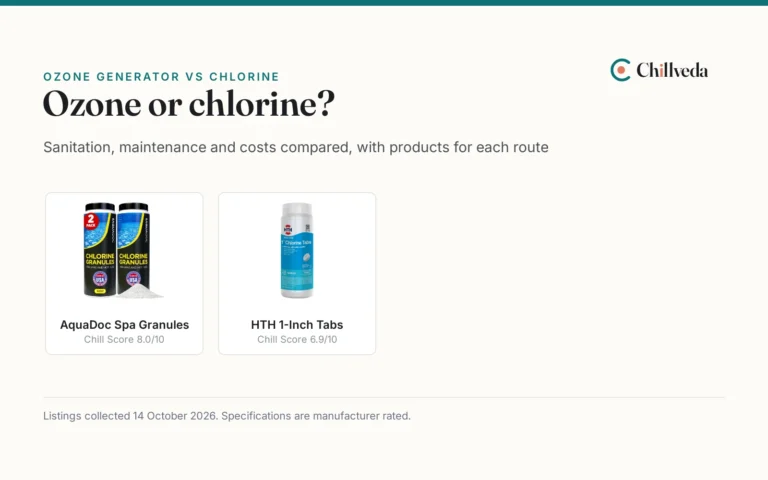
 AquaDoc Hot Tub Chlorine Granules Chill Score 9.6/10Check price on Amazon
A 2 pack of quick dissolving dichlor chlorine granules totaling 4 pounds, formulated for spa and hot tub water care.
-
2
 HTH 42049, Pool Care 1" Chlorine Tabs Chill Score 9.4/10Check price on Amazon
A 1.5-pound bottle of 1-inch slow dissolving chlorine tablets with built-in clarifier for floater or feeder use.

A 2 pack of quick dissolving dichlor chlorine granules totaling 4 pounds, formulated for spa and hot tub water care.
Pros & ConsViewHide
Pros
- Quick dissolving granular dichlor formula
- 2 pack totaling 4 pounds (64 ounces)
- Made in the USA, per the maker
- Easy to measure into circulating water
Cons
- No safety certification stated
- No warranty term is stated
- Requires manual measuring for each application
- Can cause chemical odor if overapplied

A 1.5-pound bottle of 1-inch slow dissolving chlorine tablets with built-in clarifier for floater or feeder use.
Pros & ConsViewHide
Pros
- Slow dissolving 1-inch tablets for floater use
- Built-in clarifier included in the formula
- States it lasts up to one week per application
- Targets 1 to 4 ppm chlorine residual
Cons
- Spec table mistakenly lists check strip function
- No warranty term is stated beyond a generic label
- No safety certification stated
- Needs a floating dispenser or inline feeder
More to compare
 Charmline Smart Ozone Generator for Car 12V and Home 120VCheck price on Amazon
 Ozone Generator with Timer for Cold Plunge and Hot Tubs 2-WayCheck price on Amazon
 Ambohr SPA-124 Ozone GeneratorCheck price on Amazon
 Airthereal MA5000 Ozone GeneratorCheck price on Amazon
 Ozone Generator 48Check price on Amazon
 Hadlook Ozone GeneratorCheck price on Amazon
Ozone generator vs chlorine for cold plunge at a glance
| Feature | Ozone generator | Chlorine for cold plunge |
|---|---|---|
| Sanitizing action | Oxidizes contaminants via ozone gas | Destroys bacteria and algae chemically |
| Residual protection | None; active only during circulation | Maintains residual in standing water |
| Application method | Automatic via inline venturi injector | Manual dosing of granules or floater tabs |
| Water feel and odor | No chemical residue or chlorine odor | Can leave chemical scent if overapplied |
| Equipment required | Ozone unit, power outlet, water loop | Floating dispenser or direct dosing |
| Ongoing supplies | Periodic generator maintenance | Replenishment of tabs or granules |
| Water checks needed | Periodic balance checks | Regular checks to maintain sanitizer level |
| Best suited for | Automated, chemical-free daily oxidation | Dependable residual sanitation on any tub |
How ozone and chlorine sanitize cold water
The main functional difference between an ozone generator and chlorine is how long the sanitizer remains active in your tub. Ozone (O3) is a powerful oxidizer produced on site by an electrical corona discharge or UV lamp. When injected into the circulating water line, ozone rapidly breaks down organic matter, body oils, and bacteria. Once the reaction completes, ozone converts back into standard oxygen, leaving no chemical residue, no dissolved solids, and no chemical aroma. However, ozone is transient: it dissipates quickly and leaves no residual sanitizer once the circulation pump shuts off.
Chlorine provides what ozone cannot: a persistent, measurable sanitizer residual that protects standing water between sessions. When chlorine dissolves, it forms hypochlorous acid, which remains present in the water and neutralizes bacteria even when the pump is idle. Maintaining a residual between 1 and 4 ppm, as recommended on the HTH listing, ensures that ambient organisms and bacteria introduced during a plunge session are addressed promptly. The trade-off is chemical management: chlorine introduces dissolved solids into your water over time and requires regular checks to avoid chloramine odors or skin irritation.
Formulation also matters within chlorine options. The AquaDoc example features a quick-dissolving sodium dichlor granular formula in a 2 pack totaling 4 pounds (64 ounces), designed to dissolve rapidly during active water circulation. In contrast, the HTH example features 1-inch slow-dissolving tablets in a 1.5-pound bottle, meant to sit in a floating dispenser and erode steadily over up to one week.
Upkeep and water care routines
An ozone system makes routine water care straightforward because the generator oxidizes water automatically whenever the circulation pump runs. Because ozone is active only while the pump circulates water past the injector, water care with ozone focuses on maintaining consistent daily pump run times and keeping mechanical filters clean. The generator hardware requires periodic inspection to ensure electrical indicators operate and airflow is clear, while the water itself eventually requires draining and refilling once dissolved bather solids accumulate.
A chlorine routine requires regular attention. You must monitor sanitizer levels regularly using water check strips to keep free chlorine within balanced levels. Granular chlorine like the AquaDoc example is measured and added directly to circulating water after plunging sessions. Tablet options like the HTH example require checking the floating dispenser to confirm the 1-inch tabs have not completely dissolved, with the maker suggesting twice-weekly checks to hold 1 to 4 ppm. Letting chlorine levels drop too low allows algae or biofilm to form, while adding too much causes harsh fumes and skin discomfort. Our cold plunge water care guide outlines the full weekly maintenance schedule, and our cold plunge water treatments roundup reviews balancing supplies.
Equipment, setup and ongoing upkeep
Setup complexity separates these two approaches. An inline ozone generator is a dedicated piece of equipment requiring an electrical supply, plumbing connections into your water loop, and a venturi injector. It must be mounted securely where water cannot splash onto electrical components. While initial hardware involves more planning, day-to-day operating supplies are minimal once installed. See our cold plunge ozone generators guide for compatible hardware options.
Chlorine requires virtually zero upfront installation. You need only the chemical container and, if using tablets, a floating dispenser. There are no power cords, no plumbing connections, and no electrical equipment near water. The ongoing requirement is replenishing chemicals as containers empty. The AquaDoc example provides two 2-pound bottles (4 pounds total), while the HTH bottle supplies 1.5 pounds of tablets. The total lifespan of a bottle depends on bather frequency and plunge tub volume.
Gear for each route
These are scored on the Chill Score: performance 35, build 25, value 25, safety certifications 10 where it applies and warranty 5. Neither states a UL or ETL listing, so both score 0 for safety.
| Product | Chill Score | Perf. /35 | Build /25 | Value /25 | Safety /10 | Warranty /5 |
|---|---|---|---|---|---|---|
| AquaDoc Spa Granules | 9.6 | 29 | 21 | 21 | n/a | 0 |
| HTH 1-Inch Tabs | 9.4 | 26 | 18 | 19 | n/a | 0 |
Scores run from 9.2 to 9.8: each product’s point total is placed on that range, so more points always means a higher score. Safety counts only for powered gear or where the listing states safety features; where it does not apply, the score is taken over the remaining 90 points.
Choose an ozone generator if
- You want an automated sanitizer that runs alongside your circulation pump.
- You want to avoid the chemical smell and skin feel of chlorinated water.
- Your cold plunge tub has dedicated ports or an inline venturi injector.
- You prefer an oxidizer that leaves no chemical byproducts in the water.
Choose chlorine for cold plunge if
- You want a proven residual sanitizer that protects water even when the pump is off.
- You want a low-cost start using simple granules or a floating tablet dispenser.
- Your tub does not have plumbing fittings or power connections for an ozone unit.
- You are comfortable checking water levels regularly with check strips to maintain balance.
Check Your Space First
- Chemical storage: The AquaDoc example weighs 4 pounds across two bottles, while the HTH bottle weighs 1.5 pounds. Keep chlorine containers tightly sealed on a dedicated shelf away from direct heat and moisture.
- Ventilation for supplies: Chlorine tablets and granules give off strong vapors when opened. Choose a well-ventilated storage spot rather than an airtight, unvented utility cabinet.
- Dispenser room: The HTH listing specifies 1-inch tablets for floater or feeder use. Confirm your plunge tub has adequate surface room for a floating chlorinator without interfering with your immersion space.
- Plumbing and power for ozone: An inline ozone generator requires an electrical outlet and connection to your water circulation loop. Verify your space has accessible power and room around the tub plumbing before choosing ozone hardware.
Common questions
Can you use an ozone generator and chlorine together in a cold plunge?
Yes, some plunge owners choose to combine an ozone generator with chlorine. In a combined setup, ozone handles heavy oxidation while the pump runs, reducing the amount of chemical sanitizer required to maintain water clarity. A chlorine residual, such as the 1 to 4 ppm range targeted by the HTH example, then maintains protection in standing water when the pump is off.
Does an ozone generator eliminate the need for water changes?
No water sanitation method eliminates water changes completely. An ozone generator oxidizes contaminants, but dissolved minerals, body oils, and fine debris still accumulate over time. Periodic draining and refilling with fresh water remains necessary to keep the plunge sanitary and clear.
Is chlorine safe for cold plunge tubs and chillers?
Chlorine is safe when kept within recommended levels, but overdosing can degrade tub liners, seals, and chiller heat exchangers. Granular dichlor, such as the AquaDoc example, dissolves rapidly to prevent granules from settling against the tub floor. Slow-dissolving tablets should always stay inside a dedicated dispenser rather than resting loose in the basin.
How often do you need to check water in a cold plunge?
With chlorine, sanitizer levels require routine monitoring; the HTH listing recommends checking water twice weekly to maintain levels between 1 and 4 ppm. With an ozone generator, water still requires periodic checks for pH and clarity, but daily sanitizer measuring is not required while the unit operates. For either system, heavy bather use or warmer ambient conditions call for more frequent water checks.
Which is easier to maintain, ozone or chlorine?
An ozone generator operates automatically on a daily basis whenever water circulates. Chlorine requires active management, including measuring granules or refilling floating tablet dispensers and routine water checks. However, chlorine does not require specialized plumbing, electrical connections, or ozone generator hardware.
Back to all cold plunge reviews.