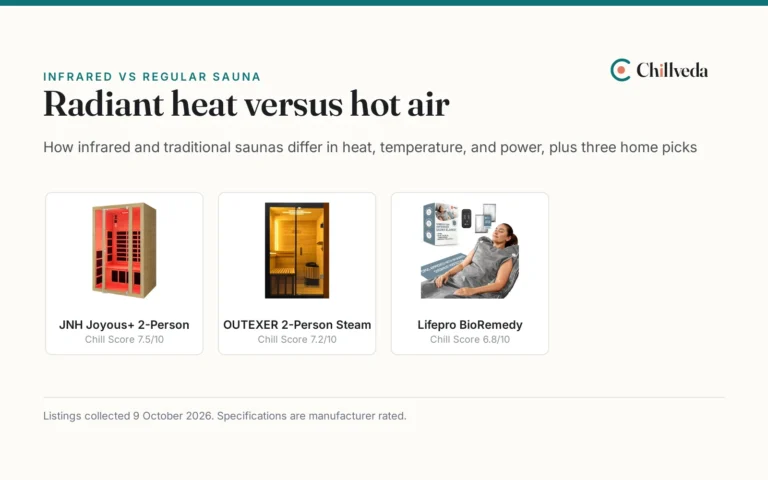
Short answer
Is an infrared sauna better than a regular sauna?
Neither format is universally superior; each excels at different priorities. An infrared sauna is better for individuals who prefer lower air temperatures, dry radiant warmth, and simpler electrical requirements. A regular traditional sauna is better for those who want intense convective heat, traditional Finnish steam from pouring water over rocks, and higher ambient temperatures.
An infrared sauna heats your body directly using radiant light waves, while a regular sauna heats the surrounding air using a stove and heated stones. Because of this fundamental difference in heat transfer, an infrared sauna operates at lower air temperatures while still inducing heavy sweating, whereas a regular traditional sauna relies on high ambient air heat. Choosing between them comes down to whether you prefer dry, gentle radiant warmth that is easy on the lungs or intense ambient heat accompanied by traditional steam over hot rocks.
This guide compares how infrared and regular saunas work, their temperature ranges, electrical and installation requirements, and three home sauna options across different formats. Listings were collected 9 October 2026.
This article is informational and is not medical advice. Heat exposure strains the heart and causes fluid loss. Do not use a sauna after alcohol, when pregnant, when unwell, or with a heart condition or low blood pressure without asking a clinician first. Leave at once if you feel dizzy, sick or confused. See our Medical Disclaimer.
Chillveda earns a commission when you buy through links on this page, at no extra cost to you. As an Amazon Associate I earn from qualifying purchases. Affiliate disclosure.
Quick picks
-
1
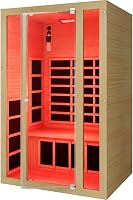 JNH Lifestyles Joyous+ 170°F 2-Person Infrared Chill Score 9.5/10Check price on Amazon
A 2-person Canadian Hemlock infrared cabin with 8 carbon fiber heaters rated up to 170 F and chromotherapy lighting.
-
2
 OUTEXER 2 Person Sauna Steam Traditional Saunas Chill Score 9.5/10Check price on Amazon
A 2-person traditional indoor steam sauna cabin made of Okume wood with a 3 kW 240V heater reaching up to 194 F.
-
3
 LifePro BioRemedy Infrared Sauna Blanket for Home Chill Score 9.4/10Check price on Amazon
A 71 by 31 inch far infrared sauna blanket with dual-layer carbon fiber heating, adjustable from 86 to 158 F across 4 zones.
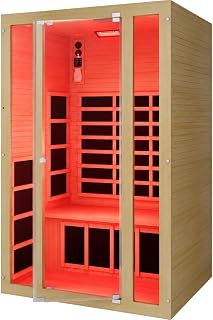
A 2-person Canadian Hemlock infrared cabin with 8 carbon fiber heaters rated up to 170 F and chromotherapy lighting.
Pros & ConsViewHide
Pros
- Heats up to 170 F with 8 carbon heaters
- Canadian Hemlock wood cabin construction
- Built-in chromotherapy and Bluetooth audio
- Dimensions 47.3 x 39.5 x 75 inches
Cons
- No warranty term is stated
- Heavy cabin at 303 pounds requires assembly
- No safety certification standard listed
- Spec table omits electrical wattage and amperage

A 2-person traditional indoor steam sauna cabin made of Okume wood with a 3 kW 240V heater reaching up to 194 F.
Pros & ConsViewHide
Pros
- Reaches up to 194 F (90 C) in 30 to 40 minutes
- Powerful 3 kW traditional heater on 240V
- Includes stones, bucket, ladle, and hourglass
- Natural Okume wood and tempered glass cabin
Cons
- Height contradiction: bullets state 75.6 in, spec table states 76.8 in
- Requires dedicated 240V electrical connection
- No formal warranty term stated, only after sales service
- No independent safety certification listed

A 71 by 31 inch far infrared sauna blanket with dual-layer carbon fiber heating, adjustable from 86 to 158 F across 4 zones.
Pros & ConsViewHide
Pros
- Adjustable heat from 86 to 158 F across 4 zones
- Compact 7.7 lb blanket with storage bag included
- Dual-layer carbon fiber heating wires
- Timer adjustable from 20 to 60 minutes
Cons
- Contradiction: bullets say 5 wraps, spec table lists 3
- Spec table lists customer support rather than a parts warranty
- No safety listing like UL or ETL stated
- Accommodates max 60 in interior circumference
More to compare
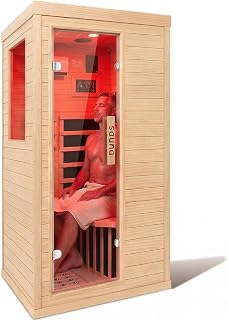 1350W Far Infrared Sauna Room for HomeCheck price on Amazon
 Infrared Sauna Blanket for Relaxation & Self-CareCheck price on Amazon
 Ceramic Infrared Sauna 2 PersonCheck price on Amazon
 Portable Far Infrared Sauna in SilverCheck price on Amazon
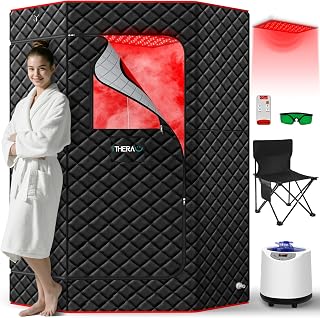 I-THERA-U XL Infrared Sauna Box with True 660 & 850nm RedCheck price on Amazon
 MIXC Upgraded Low EMF Infrared Sauna BoxCheck price on Amazon
Comparing infrared sauna vs regular sauna: key differences
| Format | Example from listings | Stated heating and temperature |
|---|---|---|
| Traditional cabin | OUTEXER 2-person, 3 kW heater (240V) | Above 140 F in 10 min; max 194 F (90 C) in 30 to 40 min |
| Infrared cabin | JNH Joyous+ 2-person, 8 carbon heaters | Up to 170 F selected temperature, low EMF |
| Infrared blanket | Lifepro BioRemedy, 4 heat zones | Adjustable 86 to 158 F, 20 to 60 min timer |
The primary contrast between these two recovery tools lies in heat transfer. In a regular traditional sauna, an electric heater warms dense stones, which heat the surrounding air in an enclosed room. When water is ladled over the rocks, it produces steam that temporarily elevates humidity and creates an intense burst of sensation. An infrared sauna bypasses the air, using carbon fiber heating elements that emit far infrared wavelengths absorbed directly by the body. As detailed in our infrared vs traditional sauna overview, this allows an infrared room to induce sweating at lower, more manageable air temperatures.
Why infrared saunas operate at lower temperatures
Because infrared radiant heat directly warms tissue rather than relying on convection through hot air, an infrared cabin does not need to heat the surrounding air to extreme temperatures to induce sweating. Radiant warmth penetrates the body directly, allowing users to experience a thorough sweat session without inhaling scorching air. For many individuals, this makes longer sessions substantially more comfortable and easier on the respiratory system.
Regular saunas, by contrast, rely on thermal air mass and convection. The elevated ambient air temperature heats the skin from the outside, creating a rapid, intense cardiovascular flush. Adding water to the heated stones creates bursts of steam that temporarily increase humidity, making the room feel substantially hotter without altering the air temperature. Those who appreciate the ritual of ladling water and the sensation of intense heat spikes generally favor a traditional design.
Electrical requirements and installation needs
Installation requirements differ between the two formats. Portable sauna blankets and compact infrared units are designed for convenience, requiring no specialized wiring. By contrast, a permanent traditional sauna cabin requires substantial electrical capacity. The OUTEXER traditional sauna includes a 3 kW heater that operates on 240V. Running a 3 kW heater at 240V requires dedicated wiring and an appropriate double-pole breaker installed by a licensed electrician. For detailed wiring considerations, see our guide to sauna electrical requirements.
Operating expenses depend on the power rating of the heater and how often the cabin is used. A high-draw 3 kW traditional heater consumes more electricity per session than a compact infrared blanket. Readers planning regular weekly sessions should factor heater wattage into their utility expectations. For an overview of residential expenses across different models, see our analysis of home sauna running cost.
Home saunas compared: three format picks
Every model is evaluated using our Chill Score methodology, which evaluates performance, build quality, value, safety certifications, and warranty terms. Because none of the manufacturer listings publish independent third-party electrical safety certifications, all three options receive zero points for safety.
| Product | Chill Score | Perf. /35 | Build /25 | Value /25 | Safety /10 | Warranty /5 |
|---|---|---|---|---|---|---|
| JNH Joyous+ 2-Person | 9.5 | 32 | 22 | 21 | 0 | 0 |
| OUTEXER 2-Person Steam | 9.5 | 30 | 21 | 20 | 0 | 0 |
| Lifepro BioRemedy | 9.4 | 27 | 19 | 21 | 0 | 1 |
Scores run from 9.2 to 9.8: each product’s point total is placed on that range, so more points always means a higher score.
For more multi-user options, browse our roundup of the best 2 person home saunas, or explore our curated list of the best infrared saunas with red light.
How to choose between infrared and regular saunas
- Assess your electrical setup: If you do not have access to a dedicated 240V line, a standard plug-in infrared cabin or portable blanket is far simpler to install than a 240V traditional unit.
- Consider heat preference: If you find breathing high-temperature air uncomfortable, an infrared unit operating at lower temperatures provides a gentler session.
- Decide if steam matters to you: If pouring water over hot rocks and experiencing steam bursts is central to your routine, only a traditional regular sauna can deliver that experience.
- Evaluate available space: Permanent wooden cabins require dedicated floor space. If space is limited, a foldable blanket like the Lifepro BioRemedy can be packed away in its included storage bag. See our comparison of sauna vs sauna blanket for portable options.
Common mistakes
- Expecting an infrared cabin to match traditional air heat: Infrared saunas warm the body directly rather than superheating the ambient air; attempting to force an infrared cabin to reach traditional room temperatures misunderstands how radiant technology functions.
- Overlooking electrical circuit requirements: Installing a high-draw traditional sauna cabin without verifying 240V circuit capacity can lead to tripped breakers or electrical issues.
- Confusing passive sweat suits with powered saunas: Garments like sweat suits merely trap perspiration during exercise and do not provide radiant heating or genuine sauna therapy.
- Relying on unverified marketing claims: Many product listings claim metabolic acceleration or body sculpting benefits that lack scientific support; focus instead on verified build specs and stated temperatures.
- Ignoring hydration and session duration: Both heating styles cause fluid loss through sweating; always drink water before and after sessions and keep initial exposure within comfortable limits.
Common questions
Is an infrared sauna better than a regular sauna?
Neither format is universally superior; each excels at different priorities. An infrared sauna is better for individuals who prefer lower air temperatures, dry radiant warmth, and simpler electrical requirements. A regular traditional sauna is better for those who want intense convective heat, traditional Finnish steam from pouring water over rocks, and higher ambient temperatures.
Is an infrared sauna the same as red light therapy?
No, far infrared saunas and red light therapy utilize different wavelengths of the light spectrum. Far infrared wavelengths produce thermal heat to elevate tissue temperature and induce sweating. Red light therapy uses visible red and near-infrared light waves for cellular stimulation without generating substantial thermal heat. Some models, such as the JNH Joyous+, incorporate both far infrared heating panels and auxiliary chromotherapy lighting.
Are infrared sauna blankets safe to use at home?
Infrared sauna blankets are practical for home use when operated according to the manufacturer manual and safety guidelines. Look for units with integrated timers, overheat protection, and carbon fiber heating elements. Always use them on a flat, heat-resistant surface, keep sessions within the 20 to 60 minute range, and consult a physician if you have cardiovascular conditions.
What is a full spectrum infrared sauna?
A full spectrum infrared sauna combines near, mid, and far infrared wavelengths within a single cabin. Far infrared provides warmth for sweating, while mid and near wavelengths deliver different light penetration characteristics. Most standard home models, including the JNH Joyous+ and Lifepro blanket featured here, focus primarily on far infrared carbon heating.
How often should you use an infrared sauna?
Beginners should start with one or two short sessions per week, keeping duration between 10 and 20 minutes at modest temperatures. Regular users often progress to sessions of 20 to 30 minutes, provided they tolerate heat exposure well. Always listen to your body, replenish fluids, and follow the schedule outlined in your equipment manual.
Sources: Amazon product listings for the saunas named above, collected 9 October 2026. Related: our infrared vs traditional sauna guide and sauna electrical requirements.
Back to all sauna reviews.