Short answer
Does a barrel sauna heat up faster than a cabin sauna?
When comparing rooms with similar heater power and floor area, a barrel sauna typically reaches operating temperature faster because its curved walls enclose less total air volume. The cylindrical profile eliminates the upper corners found in a square room, leaving less air for the stove to warm. However, actual warm-up time also depends on ambient outdoor temperatures, wall insulation, and the heater’s kilowatt rating.
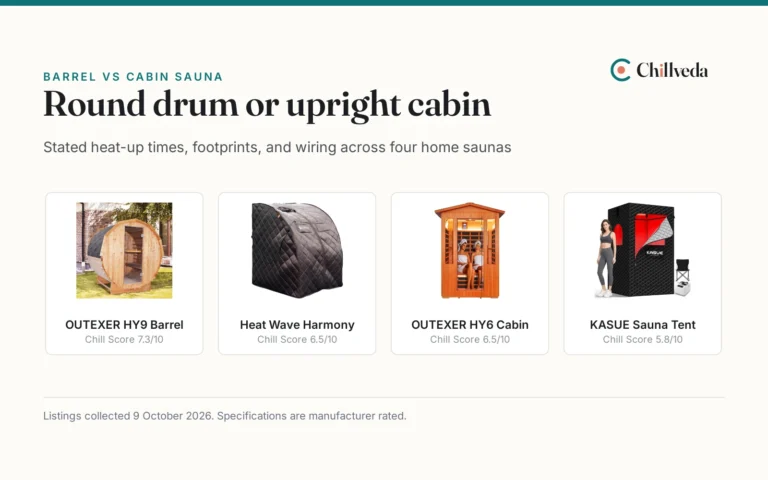
In the choice between a barrel sauna vs cabin sauna, the barrel heats faster and costs less to run because its cylindrical shape eliminates unused ceiling corners, while a cabin sauna offers tiered bench seating and more usable headroom. A barrel sauna encloses less air volume than a rectangular room with the same floor footprint, allowing a standard heater to warm the space quickly. For example, the OUTEXER barrel listing states its 4.5 kW heater reaches operating temperature in 25 to 35 minutes. An upright cabin encloses greater volume, but it allows bathers to sit higher on upper benches where the hottest air gathers.
This guide compares stated heating times, footprints, freight delivery requirements, and electrical needs across both designs, including four outdoor and portable saunas from manufacturer listings. Listings were collected 9 October 2026.
This article is informational and is not medical advice. Heat exposure strains the heart and causes fluid loss. Do not use a sauna after alcohol, when pregnant, when unwell, or with a heart condition or low blood pressure without asking a clinician first. Verify that electrical installations comply with local building codes and use certified components. Leave at once if you feel dizzy, sick or confused. See our Medical Disclaimer.
Chillveda earns a commission when you buy through links on this page, at no extra cost to you. As an Amazon Associate I earn from qualifying purchases. Affiliate disclosure.
Quick picks
-
1
 OUTEXER Outdoor Traditional Sauna 4-5 Person 240V Chill Score 9.5/10Check price on Amazon
A 4 to 5 person outdoor round barrel sauna built from Finnish carbonized spruce, equipped with a 4.5 kW electric heater running on 240V.
-
2
 Heat Wave Radiant Saunas BSA6315 Harmony Deluxe Chill Score 9.4/10Check price on Amazon
A portable folding cabin sauna measuring 32 by 33 by 41 inches, including a folding chair and backed by a stated 1 year warranty.
-
3
 OUTEXER Outdoor Sauna 2 Person Sauna Infrared Chill Score 9.4/10Check price on Amazon
A 2 person outdoor upright cabin sauna built from Canadian fir and red cedar, featuring 2080W infrared heating panels and red light therapy.
-
4
 KASUE Infrared Sauna Tent with 3L Steamer Chill Score 9.3/10Check price on Amazon
A portable home sauna tent made from 5-layer waterproof insulated fabric, paired with a 3L steam generator and an included folding chair.

A 4 to 5 person outdoor round barrel sauna built from Finnish carbonized spruce, equipped with a 4.5 kW electric heater running on 240V.
Pros & ConsViewHide
Pros
- 4.5 kW heater reaches stated temperature in 25 to 35 minutes
- Finnish carbonized spruce wood drum construction
- Includes volcanic stones, bucket, ladle, and hourglass
- Stated 7 year after sales service
Cons
- Heavy 800 lb weight requires a prepared outdoor base
- Requires dedicated 240V electrical wiring
- No UL or ETL safety certification stated
- Dimensions list 59.06 by 70.87 inches despite 6'x6' title claim
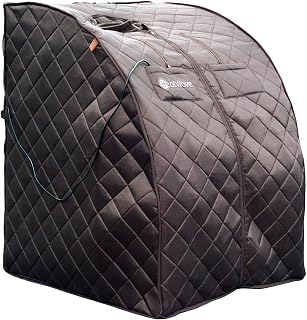
A portable folding cabin sauna measuring 32 by 33 by 41 inches, including a folding chair and backed by a stated 1 year warranty.
Pros & ConsViewHide
Pros
- Stated 1 year manufacturer warranty
- Lightweight 24 lb collapsible design for easy storage
- Accommodates individuals up to 6'5" tall
- Includes padded foldable chair with powder-coated frame
Cons
- Fabric cabin does not match solid wood insulation
- No safety certifications like UL or ETL stated
- Compact interior dimensions of 31.5 by 32.5 by 39 inches
- Single person capacity only

A 2 person outdoor upright cabin sauna built from Canadian fir and red cedar, featuring 2080W infrared heating panels and red light therapy.
Pros & ConsViewHide
Pros
- Crafted from Canadian fir and red cedar wood
- 2080W infrared heating with red light therapy
- Adjustable temperature range from 68°F to 149°F
- Separate heating plate for the soles of the feet
Cons
- No warranty term is stated
- No UL or ETL safety certification stated
- Requires freight curbside delivery coordination by phone
- Lower 149°F maximum temperature compared to traditional saunas

A portable home sauna tent made from 5-layer waterproof insulated fabric, paired with a 3L steam generator and an included folding chair.
Pros & ConsViewHide
Pros
- Includes 3L steam generator with 9 heat levels
- 5-layer waterproof insulated fabric construction
- 99-minute timer with handheld remote control
- Lightweight 15 lb total weight with folding chair
Cons
- Title claims infrared while listing describes a steam generator
- No warranty term is stated
- No wattage or electrical specifications stated
- No safety certifications like UL or ETL stated
More to compare
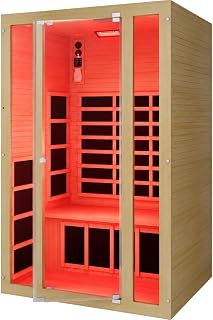 JNH Lifestyles Joyous+ 170°F 2-Person Infrared Sauna with RedCheck price on Amazon
 Vindar Sauna Room Air Vent 3.74" Round Red Cedar Wooden SaunaCheck price on Amazon
 Vindar Sauna Room Air Vent 3.58" Round Aspen Wooden SaunaCheck price on Amazon
 Vindar Sauna Room Air Vent 3.74" Round Aspen Wooden SaunaCheck price on Amazon
 THE POD COMPANY The Sauna Pod 2.0 Dry Sauna for Recovery &Check price on Amazon
Barrel sauna vs cabin sauna differences by design
| Design feature | Barrel sauna | Cabin sauna |
|---|---|---|
| Interior air volume | Less total air volume to warm due to curved walls | Larger air volume with full-height corners |
| Thermal layering | Heat gathers at the curved ceiling above single-level benches | Hot air collects at the ceiling; tiered benches let bathers sit in upper heat |
| Heating time | Heats smaller air volume faster under equal heater power | Requires heating larger room volume before target heat is reached |
| Seating layout | Opposing single-level benches along curved sides | Multi-tier benches allowing bathers to choose temperature zones |
| Footprint and base | Supported on cradle feet; requires a level, firm base | Supported on full perimeter; requires level pad or timber frame |
| Electrical connection | 240V connection stated for 4.5 kW heater | Dedicated electrical connection sized to heater wattage |
Room geometry directly affects heat distribution and bench placement. In an upright cabin, vertical walls allow manufacturers to install tiered benches. Bathers can sit on an upper bench directly in the warmest air stratum near the ceiling, or rest on a lower bench where temperatures are milder. In a barrel sauna, the curved profile eliminates the high corner volume present in a square room, reducing the cubic feet of air the stove must heat. However, because the barrel’s curved staves slope inward directly over the seating area, benches must be installed along the lower half of the cylinder. As heat rises to the top curve, bathers remain seated at a single lower level where air temperatures are lower than at the ceiling peak.
Heat-up speed, thermal volume, and electrical needs
Heating efficiency comes down to air volume, insulation, and electric draw. Because a barrel eliminates the upper dead air space present in a square room of equal width, the heater has less total cubic footage to warm. For example, the OUTEXER 4-5 person barrel sauna uses a 4.5 kW electric heater on a 240V line, which the manufacturer states reaches target temperature in 25 to 35 minutes. Operating a 4.5 kW heater on a 240V supply requires dedicated wiring and an appropriate two-pole circuit breaker to handle the load safely.
By comparison, a square outdoor cabin with equal bench length contains more total cubic space to warm. When equipped with a traditional stove, preheating typically takes longer because of the extra air volume near the ceiling. Some cabins use infrared heating panels instead, such as the OUTEXER 2 person cabin with 2080W of carbon panels running from 68°F to 149°F. For buyers considering infrared technology over stone heaters, our infrared vs traditional sauna guide breaks down the heating differences. More details on branch circuits appear in our sauna electrical requirements guide.
Footprint, exterior foundation, and freight delivery
Footprint and site preparation differ substantially between these structures. Barrel saunas rest on curved cradle supports, typically molded polymer or wood feet. Because the barrel structure is self-supporting once the stainless steel tension bands are tightened, it requires only a stable, level surface such as a compacted gravel bed, paving stones, or a reinforced deck. In contrast, an outdoor cabin sauna is an upright rectangular building that places its full perimeter weight on the ground, requiring a level concrete slab or timber subframe to prevent settling and door binding.
Freight delivery is another practical hurdle stated on manufacturer listings. Large saunas arrive by less-than-truckload (LTL) motor freight on pallets. The OUTEXER barrel lists an item weight of 800 pounds, while the two-person cabin lists an item weight of 400 pounds. Listings state that sellers require curbside delivery coordination, including phone confirmation before scheduling shipment. The carrier drops the shipment at the curb; buyers must unpack individual staves or prefabricated wall panels and carry them to the assembly site.
Barrel and cabin saunas compared
These are scored on the Chill Score, which weighs performance 35, build 25, value 25, safety certifications 10 where it applies and warranty 5. Because none of these listings publish verified UL or ETL electrical certifications, all four score 0 for safety.
| Product | Chill Score | Perf. /35 | Build /25 | Value /25 | Safety /10 | Warranty /5 |
|---|---|---|---|---|---|---|
| OUTEXER HY9 Barrel | 9.5 | 30 | 21 | 20 | 0 | 1 |
| Heat Wave Harmony | 9.4 | 26 | 18 | 20 | 0 | 2 |
| OUTEXER HY6 Cabin | 9.4 | 28 | 20 | 20 | 0 | 0 |
| KASUE Sauna Tent | 9.3 | 23 | 16 | 19 | 0 | 0 |
Scores run from 9.2 to 9.8: each product’s point total is placed on that range, so more points always means a higher score.
For dedicated barrel designs, see our best barrel saunas guide. If you prefer rectangular structures, browse our best outdoor sauna cabins roundup or explore the broader outdoor sauna cabins category.
Choosing between barrel and cabin in practice
- Assess your climate and snow load. A barrel sauna’s curved staves shed rain and snow naturally off the sides, though an exterior roof kit is recommended in regions with frequent rain to prevent moisture penetration between staves. A flat or shallow cabin roof requires regular snow clearing or an added pitched roof in heavy winter climates.
- Count your regular bathers. Barrels provide seating along two opposing benches, making the OUTEXER 4-5 person model practical for groups sitting face to face. However, if bathers want multi-tier seating so some can sit in higher heat, a rectangular cabin offers more adaptable interior height.
- Check your electrical panel before ordering. A 4.5 kW traditional heater requires a dedicated 240V circuit. If your home subpanel cannot support a 240V breaker, a portable unit or lower-wattage infrared cabin may be the only option without a service upgrade.
- Plan for maintenance and stave tightening. Barrel saunas expand in wet weather and shrink in dry conditions. You must periodically adjust the exterior stainless steel tension bands to keep the staves tight and watertight. Cabins with tongue-and-groove panel walls do not use tension bands.
- Prepare the delivery pathway. With shipping weights reaching 400 to 800 pounds on these listings, ensure you have clear access to move individual wood staves, glass doors, and heater components from the curb to your backyard.
Common mistakes
- Assuming a barrel sauna has standing height throughout. The curved ceiling means maximum standing headroom exists only along the exact center line; the ceiling slopes downward directly over the benches.
- Placing a heavy wooden sauna on raw soil. Ground moisture degrades bottom staves or floor plates over time. Always set cradle feet or cabin skids on pavers, crushed gravel, or concrete.
- Expecting an 800-pound freight shipment to be carried to your backyard. Freight carriers provide curbside delivery only. Moving components requires two people or unpacking piece by piece at the curb.
- Overlooking electrical rough-in costs. Running an outdoor 240V line from your main breaker to a sauna location requires dedicated conduit, wiring, and labor that should be budgeted alongside the kit purchase.
Common questions
Does a barrel sauna heat up faster than a cabin sauna?
When comparing rooms with similar heater power and floor area, a barrel sauna typically reaches operating temperature faster because its curved walls enclose less total air volume. The cylindrical profile eliminates the upper corners found in a square room, leaving less air for the stove to warm. However, actual warm-up time also depends on ambient outdoor temperatures, wall insulation, and the heater’s kilowatt rating.
Which sauna handles outdoor weather better?
Both designs can endure outdoor conditions when properly constructed and maintained. A barrel sauna’s rounded profile naturally sheds rain and snow off its sides, but its exterior staves expand and contract with seasonal humidity, requiring periodic band adjustments and an added roof cover in wet climates. A rectangular cabin requires a sloped roof or weatherproofing membrane to prevent standing water, but its panel walls remain rigid without tension bands.
Can you lie down inside a barrel sauna?
You can recline along the bench if the barrel’s interior length exceeds your height, though doing so takes up the entire side bench. Rectangular cabins generally offer wider bench platforms or multi-tier layouts that allow one bather to lie down while others remain comfortably seated.
Do you need a concrete slab for a barrel sauna?
A poured concrete slab is not mandatory for a barrel sauna. The structure rests on molded cradle support feet that can be placed on a level, compacted gravel base, patio pavers, or a reinforced deck. In contrast, an outdoor cabin distributes weight across its perimeter walls and benefits from a continuous concrete slab or treated timber subframe to keep the door square.
Is a barrel sauna cheaper to run than a cabin sauna?
During preheating, a barrel sauna can cost less because its smaller air volume allows a heater to reach target temperatures sooner under comparable conditions. Once the sauna is fully heated, running costs depend on the heater’s kilowatt rating, outdoor ambient temperatures, and wall insulation rather than the room’s shape alone.
Sources: Amazon product listings for the saunas named above, collected 9 October 2026. Related: our sauna electrical requirements guide and home sauna running cost analysis.
Back to all outdoor sauna cabin reviews.