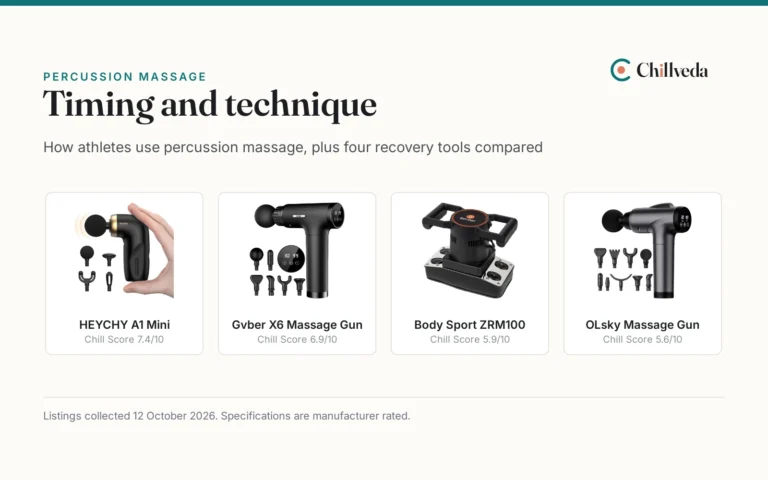
Sitting on a gym mat after a hard training session or unpacking a gear bag before a morning workout, athletes use percussion massagers to prepare muscles for movement and soothe post-exercise tightness. The primary use of percussion massage for athletes is delivering rapid mechanical pulses to large muscle groups, promoting muscle relaxation, increasing local blood flow, and easing stiffness without requiring manual massage work. Applied in brief, light sweeps during warmups or slower passes during post-workout recovery, percussive tools help athletes maintain daily mobility between training sessions.
This guide explains how percussion massage fits into warmup and cooldown routines, how motor speed and stroke depth interact, and four recovery tools compared from published manufacturer listings. Listings were collected 12 October 2026.
This article is informational and is not medical advice. Percussion massagers produce rapid mechanical pulses and are not suitable for every body area. Avoid using massage devices over the front of the neck, carotid arteries, spine, bony prominences, or acute muscle tears, and consult a clinician before use if you have circulatory conditions, blood clots, neuropathy, or an active injury. See our Medical Disclaimer.
Chillveda earns a commission when you buy through links on this page, at no extra cost to you. As an Amazon Associate I earn from qualifying purchases. Affiliate disclosure.
Quick picks
-
1
 HEYCHY A1 Mini Massage Gun Chill Score 9.5/10Check price on Amazon
A 0.6 pound pocket-sized massage gun with a brushless motor delivering up to 3,000 RPM and a 7 mm amplitude.
-
2
 Gvber Massage Gun, Deep Tissue Muscle Massager Chill Score 9.4/10Check price on Amazon
A 1.1 pound handheld percussion massager featuring 30 speed levels, 6 interchangeable heads, and an LED touch screen.
-
3
 Body Sport Therapeutic Dual Speed Chill Score 9.3/10Check price on Amazon
A 3 pound corded professional massager with dual speeds of 2,800 and 3,700 RPM, backed by a 1-year warranty.
-
4
 OLsky Massage Gun Deep Tissue 30 Speeds 9 Chill Score 9.2/10Check price on Amazon
A 1.48 pound handheld massage gun featuring 30 speed levels, 9 interchangeable heads, and an LCD battery display.

A 0.6 pound pocket-sized massage gun with a brushless motor delivering up to 3,000 RPM and a 7 mm amplitude.
Pros & ConsViewHide
Pros
- Lightweight pocket design at 0.6 pounds (9.6 ounces)
- Brushless motor delivers up to 3,000 RPM and 7 mm amplitude
- 800mAh battery rated for 5 to 7 hours of use
- Includes 4 silicone heads and USB-C charging
Cons
- No warranty term is stated
- Compact 7 mm stroke is shallower than full-size units
- Small 800mAh battery capacity
- No wall charger plug included

A 1.1 pound handheld percussion massager featuring 30 speed levels, 6 interchangeable heads, and an LED touch screen.
Pros & ConsViewHide
Pros
- 30 selectable speed levels
- 6 interchangeable massage heads included
- LED touch screen shows speed level and battery percentage
- Lightweight handheld body at 1.1 pounds
Cons
- No warranty term is stated
- Stroke amplitude and motor RPM are not stated
- Shuts off under excessive pressure due to battery protection
- Cannot be used while charging, and wall adapter is not included

A 3 pound corded professional massager with dual speeds of 2,800 and 3,700 RPM, backed by a 1-year warranty.
Pros & ConsViewHide
Pros
- 1-year warranty stated by maker
- High motor speeds of 2,800 and 3,700 RPM
- Continuous runtime from corded electric power
- Stated for personal, sports fitness, and clinic use
Cons
- Heavy 3-pound body requires two hands for long sessions
- Must be plugged into an electrical wall outlet
- Spec table contains inaccurate dimensions and feature claims
- Vibration mechanism rather than dedicated percussive stroke

A 1.48 pound handheld massage gun featuring 30 speed levels, 9 interchangeable heads, and an LCD battery display.
Pros & ConsViewHide
Pros
- 9 interchangeable massage attachments included
- 30 adjustable speed levels
- Built-in display shows speed and battery percentage
- 2-hour stated charging time
Cons
- No warranty term is stated
- Spec table incorrectly lists AA battery requirement
- Stroke amplitude and motor RPM are not stated
- Plastic housing with no stated safety certification
More to compare
 Muscle Roller & Massage Roller Stick for AthletesCheck price on Amazon
 Massage Balls for Deep Tissue Myofascial Release & TriggerCheck price on Amazon
 ZanLLW Muscle Roller StickCheck price on Amazon
 KITWILD Muscle Roller Stick Massage Roller Stick for AthletesCheck price on Amazon
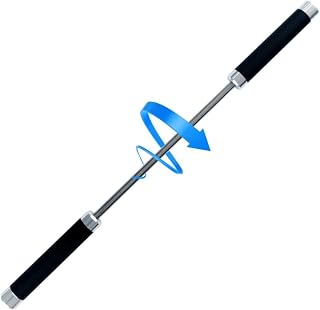 The OriginalCheck price on Amazon
 Massage Roller StickCheck price on Amazon
Percussion massage tool types, from maker listings
| Tool type | Example listing | Stated motor speed and power | Stated weight |
|---|---|---|---|
| Compact mini gun | HEYCHY A1 Mini | Up to 3,000 RPM, 800mAh battery | 0.6 lb (9.6 oz) |
| Standard cordless gun | Gvber X6 | 30 speeds, USB-C rechargeable | 1.1 lb |
| Corded dual-speed wand | Body Sport ZRM100 | 2 speeds (2,800 and 3,700 RPM), corded electric | 3 lb |
| High-speed cordless gun | OLsky M68-7 | 30 speeds, rechargeable | 1.48 lb (670 g) |
These four devices illustrate the range of designs available for athlete recovery routines. Cordless handheld guns dominate the category, offering between 4 and 9 interchangeable head attachments and multi-speed motors. Compact options weigh 0.6 pounds, making them easy to pack into a gym bag, while larger cordless units weigh between 1.1 and 1.48 pounds. Corded wands like the Body Sport reach 3 pounds and rely on constant electrical power rather than battery cells, trading portability for continuous run time.
How percussion frequency and stroke amplitude work together
Percussion massagers rely on two main physical specifications: stroke amplitude and motor frequency. Amplitude describes the depth of each strike into the tissue. The HEYCHY A1 Mini publishes a true 7 mm amplitude, which provides light to moderate depth suited for surface muscle relief and portability. Many full-size listings, including Gvber and OLsky, do not state an amplitude measurement in their specifications, leaving buyers to evaluate them primarily by motor speed settings. Our massage gun specs explained guide details how stroke depth influences percussion force.
Frequency refers to how fast the massage head oscillates, typically measured in revolutions per minute. HEYCHY states a top speed of 3,000 RPM, while Body Sport features two discrete settings at 2,800 and 3,700 RPM. Models with 30 adjustable speed levels, such as Gvber and OLsky, allow athletes to step up speed gradually. For comparisons between compact and full-sized frames, see our mini massage gun vs full size breakdown.
Matching attachments to muscle groups
Interchangeable massage heads let athletes adapt the percussion strike to different areas of the body. Across these listings, attachment sets range from 4 heads on HEYCHY to 6 heads on Gvber and 9 heads on OLsky. Review our massage gun attachments explained guide for head maintenance and compatibility.
Round ball heads and flat heads work best on large muscular regions such as the quadriceps, hamstrings, and glutes. Narrower attachments, including bullet and thumb shapes, are designed for pinpoint trigger spots in dense tissue. Fork or U-shaped heads straddle Achilles tendons and the upper trapezius. Athletes should avoid applying pointed heads directly over bony areas or along the spine, as highlighted in our where not to use a massage gun reference.
Percussion massagers worth comparing
These are scored on the Chill Score, which weighs performance 35, build 25, value 25, safety certifications 10 where it applies and warranty 5. Because none of these four listings publish a recognized electrical safety certification, each earns 0 points for safety. Body Sport earns 6 points for its stated 1-year warranty, while the other three listings publish no warranty term.
| Product | Chill Score | Perf. /35 | Build /25 | Value /25 | Safety /10 | Warranty /5 |
|---|---|---|---|---|---|---|
| HEYCHY A1 Mini | 9.5 | 30 | 21 | 22 | 0 | 0 |
| Gvber X6 Massage Gun | 9.4 | 28 | 20 | 21 | 0 | 0 |
| Body Sport ZRM100 | 9.3 | 23 | 16 | 18 | 0 | 2 |
| OLsky Massage Gun | 9.2 | 23 | 15 | 18 | 0 | 0 |
Scores run from 9.2 to 9.8: each product’s point total is placed on that range, so more points always means a higher score.
For more options across sizes and price tiers, see our best handheld percussion massagers and best mini massage guns roundups.
The use of percussion massage for athletes by workout phase
- Pre-workout muscle preparation: Athletes apply rapid, floating passes over prime movers at moderate speeds. The goal is stimulating tissue and increasing local blood flow without inducing deep muscle fatigue before lifting or sprinting.
- Post-workout cooldown: After training, athletes slow down their passes along tired muscle bellies. Rather than forcing the device down, letting the tool rest under its own weight helps ease post-exercise tightness.
- Respecting automatic shutoff timers: Devices like Gvber incorporate an automatic 10-minute shutoff timer. This built-in pause prevents motor overheating and reminds athletes not to overwork a single muscle group.
- Managing pressure limits: Excessive downward force can stall motors or trigger protective shutoffs, as noted on the Gvber listing. Light to moderate pressure delivers the intended percussive oscillation.
- Accounting for device weight: Weight ranges from 0.6 pounds on compact tools up to 3 pounds on corded units. Heavier massagers can cause shoulder or grip strain during solo back or neck sessions.
Common mistakes
- Applying excessive force until the motor stalls or shuts down under battery protection.
- Massaging directly over the front of the neck, carotid pulse points, or spinal vertebrae.
- Using percussive heads directly over acute muscle tears, sprains, or bruised tissue.
- Confusing vibration massagers like Body Sport with deep percussive stroke mechanisms.
- Attempting to operate rechargeable devices while connected to a charging cable.
Common questions
What is a percussion massage gun?
A percussion massage gun is a handheld recovery tool powered by an electric motor that rapidly pulses an attachment head against muscle tissue. Unlike surface vibration pads, percussive tools deliver repetitive linear strokes designed to penetrate muscle layers, ease muscular tightness, and support mobility routines.
How do athletes use percussion massage before a workout?
Before training, athletes use brief, sweeping passes across major muscle groups at low to moderate speeds. Keeping the device moving quickly over muscle bellies helps wake up the tissue and promote blood flow without creating soreness or blunting muscle power.
How do athletes use percussion massage after training?
Following a session, athletes apply slower glides over tight areas, spending time on major muscle groups like calves, quads, and glutes. Letting the tool glide smoothly without pressing hard helps relieve exercise-induced stiffness and assists the general cooldown routine.
Can a percussion massage gun replace a foam roller?
Percussion guns and foam rollers serve complementary recovery roles. A massage gun provides targeted mechanical pulses to specific trigger spots and hard-to-reach areas, whereas a foam roller uses body weight for broad myofascial compression across entire muscle groups.
Where should athletes avoid using a percussion massager?
Athletes should avoid using percussion devices on the front of the neck, over the throat, directly on the spine, over joints, or on visible veins. They should never be applied to acute muscle tears, bone fractures, or inflamed skin.
Sources: Amazon product listings for the percussion massage devices named above, collected 12 October 2026. Related: our how to use a massage gun guide and recovery tools overview.
Back to all massage guns reviews.