Massage gun attachments explained: each interchangeable head changes the surface area, firmness, and impact depth of percussive force on muscle tissue. The round ball head acts as a general-purpose attachment for large muscle groups like quadriceps and glutes, the flat head delivers dense, broad percussion across firm areas like hamstrings and calves, the bullet head concentrates force on pinpoint trigger points, and the fork head straddles narrow muscle bands while avoiding direct impact on bone. Deciding which massage gun head to use depends on the size of the muscle and its proximity to bony structures.
This guide explains what each percussion attachment does, how head density alters force transfer, where to avoid percussive pressure entirely, and one practical mobility tools to complement your recovery routine. Listings were collected 9 October 2026.
This article is informational and is not medical advice. Percussive therapy applies rapid mechanical pressure to muscle tissue. Never apply a massage gun to the neck, spine, throat, chest, groin, or directly over bones, joints, major arteries, or acute injuries. Discontinue use immediately if you experience sharp pain, bruising, or numbness. See our Medical Disclaimer.
Chillveda earns a commission when you buy through links on this page, at no extra cost to you. As an Amazon Associate I earn from qualifying purchases. Affiliate disclosure.

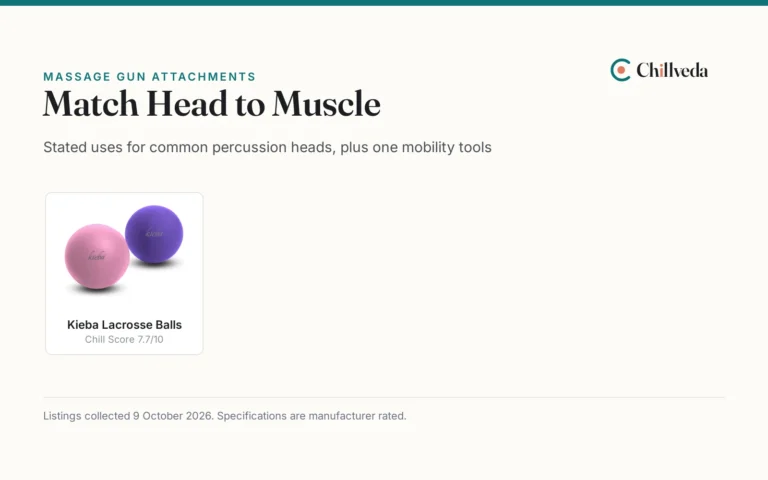
A 2-pack of solid rubber lacrosse balls measuring 2.5 inches across for manual trigger point rolling and myofascial release.
Pros & ConsViewHide
Pros
- 100% solid rubber construction
- Official 2.5 inch lacrosse ball dimensions
- Pair weighs 0.28 kg for dense pressure
- Includes two balls in pink and purple
Cons
- No warranty term stated
- Spec table lists an impossible 0.01 second charging time
- Spec table lists height adjustable for a fixed sphere
- Firm rubber density may feel too aggressive for sensitive areas
More to compare
 Massage Gun HeadsCheck price on Amazon
 Hyperice Normatec Arm Attachment Only Compression SleevesCheck price on Amazon
Massage gun attachments explained: common head types
| Attachment head | Firmness and shape | Target muscle groups | Primary application |
|---|---|---|---|
| Standard ball | Dense foam or rubber sphere | Quads, glutes, hamstrings, calves | General warm-up and broad recovery |
| Flat head | Rigid flat surface, circular face | Hamstrings, pectorals, dense tissue | Broad percussion without deep penetration |
| Bullet head | Narrow pointed tip, rigid plastic | Feet, palms, localized knots | Pinpoint trigger point release |
| Fork head | Dual prongs with center gap | Achilles tendon, calves, trapezius | Straddling tendons and muscle bands |
| Cushion head | Soft air-filled or flexible silicone | Shoulders, sensitive tissue, near joints | Gentle percussion for tender areas |
The relationship between surface area and impact depth dictates how each attachment feels. Broad heads spread the motor’s percussive force across a wider surface area, reducing localized sting and keeping tissue penetration shallow. Narrow heads concentrate that same mechanical energy into a tiny point, increasing depth and local intensity. Swapping heads allows you to adjust the sensation without altering the gun’s motor speed.
Which massage gun head to use for target muscles
Selecting the appropriate head depends on tissue thickness and sensitivity. Large muscle bellies, such as the quadriceps, glutes, and calves, respond best to the standard ball or flat head. These broader shapes allow you to glide the device across dense tissue without digging into sensitive pockets. For deeper tension in thick muscle tissue, a flat head provides a firm tap that does not sink excessively into soft tissue.
Smaller areas and tight muscle bands require more precision. The bullet head concentrates energy into stubborn trigger points, such as the plantar fascia on the soles of the feet or knots in the gluteus medius. The fork head straddles elongated structures, targeting muscles along the sides of the calves or the upper trapezius while preventing the device from hammering the bone directly. For a detailed comparison of specialized aftermarket accessories, visit our best massage gun attachments guide.
Where not to use percussion: neck and spine precautions
Percussion tools deliver rapid mechanical impacts that are dangerous when applied to delicate structures. You must never place a massage gun directly on the neck or cervical spine. The neck houses the carotid arteries, the jugular veins, cervical vertebrae, and sensitive nerve branches, none of which can tolerate percussive force. Similarly, percussion should never be applied directly over the thoracic or lumbar spine, the front of the throat, the armpits, the groin, or bony landmarks like the knee cap or elbow.
If you have tight muscles along the neck or lower back, passive positioning or manual trigger tools offer a safer alternative. Contoured cervical traction cushions, positioning wedges, or manual rubber balls allow you to release tension through gentle gravity and body weight rather than high-frequency percussion. Our detailed massage gun safety guide outlines anatomical boundaries and contraindications in full.
Mobility tools to pair with percussive therapy
These products are scored on the Chill Score, which evaluates performance 35, build 25, value 25, safety certifications 10 where it applies, and warranty 5. Because these supportive mobility and recovery devices are manual and unpowered, none carry electrical safety listings or stated warranty terms in their listings, resulting in zero points for safety and warranty.
| Product | Chill Score | Perf. /35 | Build /25 | Value /25 | Safety /10 | Warranty /5 |
|---|---|---|---|---|---|---|
| Kieba Lacrosse Balls | 9.6 | 28 | 20 | 21 | n/a | 0 |
Scores run from 9.2 to 9.8: each product’s point total is placed on that range, so more points always means a higher score. Safety counts only for powered gear or where the listing states safety features; where it does not apply, the score is taken over the remaining 90 points.
For dedicated handheld percussive devices, browse our massage guns hub.
Using attachments in practice
- Match head firmness to tissue density. Use soft foam or wide plastic heads on broader muscles, reserving narrow heads for dense muscle bellies.
- Turn the unit off before swapping heads. Power down the motor completely before inserting or removing an attachment to protect the drive shaft and locking ring.
- Float the head across the muscle. Let the percussive amplitude do the work. Do not push aggressively into tissue, which can stall the motor or cause bruising.
- Keep movement continuous. Glide along the muscle belly rather than holding the attachment on one spot.
- Maintain clearance from bone. Stay on the soft muscle belly and steer clear of joints, tendons, and bony ridges.
Common mistakes
- Applying a narrow bullet head directly over bony ridges or joint capsules.
- Attempting to use a fork head directly over the cervical spine or neck vertebrae.
- Pressing down hard with the body of the gun instead of allowing the percussive head to stroke the surface.
- Swapping attachment heads while the motor is actively running.
- Lingering on an acute muscle strain or inflamed joint.
Common questions
Which massage gun head is best for sore shoulders?
The standard round ball head or a soft cushion head works best for sore shoulders. The shoulder girdle contains several bony landmarks, including the clavicle and acromion process, so a softer, wider head delivers gentle percussion across the deltoids and trapezius without painful accidental contact with bone.
Can you use a massage gun attachment on your neck or spine?
No. You should never use a massage gun on the neck or directly over the spine. The cervical spine contains vulnerable vertebrae, blood vessels, and nerves that are easily injured by rapid percussive strokes. Use gentle passive stretching, elevation wedges, or manual bodyweight traction instead.
What is the fork attachment on a massage gun used for?
The fork attachment features parallel prongs designed to straddle narrow muscular areas, such as the Achilles tendon or the thick muscle bands of the calves. The center gap allows you to target tissue on either side while keeping the vibrating heads away from the central bone or tendon.
How do you know which massage gun head to use?
Select your head based on muscle surface area and proximity to bone. Use broad ball or flat heads for large muscle groups like the thighs and glutes, and reserve pointed bullet or fork heads for dense, localized areas that are free from immediate bone contact.
Why do some attachments use foam while others use hard plastic?
Material density controls impact absorption. High-density foam heads absorb a portion of the percussive shock, creating a softer impact suited for sensitive areas or beginners. Rigid plastic and metal heads absorb no impact, transferring the full mechanical force directly into thick, dense muscle bellies.
Sources: Amazon product listings for the mobility and recovery tools named above, collected 9 October 2026. Related: our how to use a massage gun guide and massage gun specs explained.
Back to all recovery tools reviews.