


Every red light panel on the market quotes an irradiance figure in milliwatts per square centimetre. It is the number brands compete on, the number buyers compare, and the number with the least agreement behind it of any specification in home recovery equipment.
This guide explains what the figure describes, why two panels quoting the same number can deliver very different output, and the four questions that separate a useful specification from a marketing one.
This article is informational and is not medical advice. Please read our Medical Disclaimer, and use the eye protection your device’s manufacturer supplies.
What irradiance describes
Irradiance is optical power arriving on a surface, per unit of area. Milliwatts per square centimetre tells you how much light energy lands on one square centimetre of whatever you point the panel at.
It is not a measure of how good a panel is. It is one input, and it is meaningless without the conditions under which it was obtained. That is where the trouble starts.
The four questions
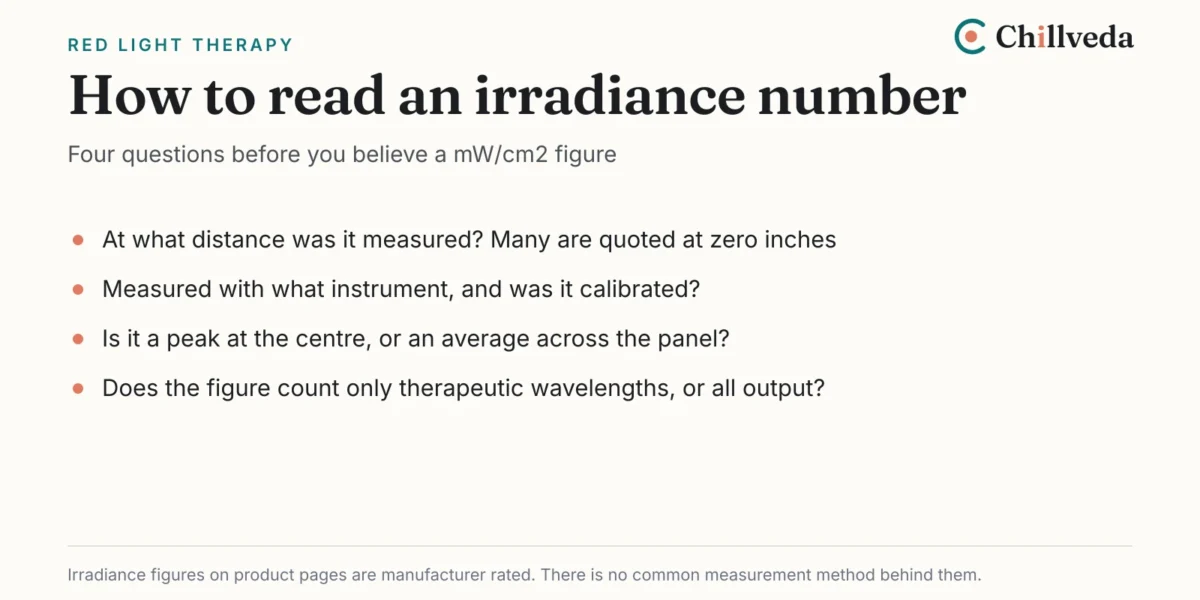
1. At what distance?
This is the big one. Light spreads out as it travels, so irradiance falls as you move away from the panel. A figure quoted at zero inches, with a sensor pressed against the face of the device, will be dramatically higher than the same panel measured at the six or twelve inches where a person would actually stand.
A specification without a distance is not a specification. If the brand publishes a number and no distance, assume it was taken at the most flattering one available.
2. Measured how?
There is no common, mandated method for these measurements in consumer marketing. Different meters, different calibration, different ambient conditions, and different interpretations of what counts all produce different results from the same hardware.
Some brands publish third party measurement reports. That is a genuinely good sign, not because the number is necessarily higher, but because somebody outside the company recorded it.
3. Peak or average?
Panels are arrays of individual emitters, so output is not uniform across the surface. It is highest directly in front of a dense cluster of diodes and lower toward the edges.
A peak figure taken at the hottest point of the array will exceed an average across the whole surface. Both are legitimate to report. Quoting the peak and describing it as the panel’s output is less so.
4. What is being counted?
Some figures include the panel’s entire measurable output. Others count only the therapeutic wavelengths the device is sold for. A panel that also emits outside those bands can report a larger total that does not reflect more of the light people are buying it for.
Why you cannot simply compare two numbers
Because of the four variables above, two panels advertising the same irradiance can differ substantially in what they actually deliver to your skin at a usable distance. Comparing the printed numbers across brands is close to meaningless unless every brand states the same conditions, and they do not.
This is why Chillveda labels every one of these figures as manufacturer rated, every time. We do not have a laboratory and we do not take measurements, and our How We Review page is explicit about that.
What to do instead
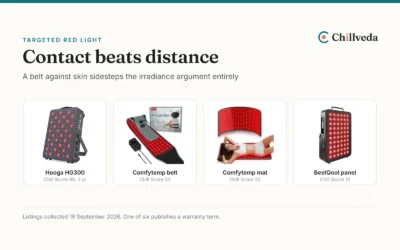
Ask the brand for the distance and the method. A company confident in its product will tell you; a company that will not is telling you something else.
Prefer a lower figure quoted at a realistic distance over a spectacular one quoted at zero. The first is information, the second is a headline.
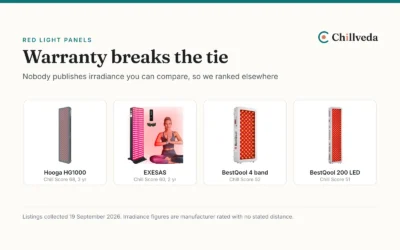
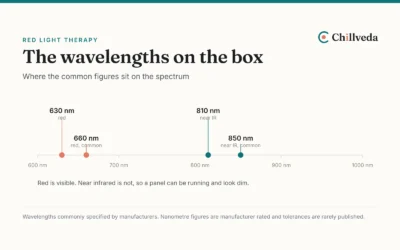
Look at what the brand publishes beyond the single number: coverage area, wavelengths and their tolerance, whether there is a third party report, and what the warranty covers. Our red light therapy coverage weighs all of these rather than ranking on irradiance alone, and the wavelengths on the box explains the other half of the specification.
And weigh the practical things that decide whether you use a device: how long a session takes, whether the panel covers the area you care about, how it mounts, and whether the fan noise is tolerable in the room you will put it in.
On the health side
Marketing frequently ties a high irradiance figure to an implied outcome. We do not repeat those claims. Research on photobiomodulation exists and is interesting, but it does not translate into a promise about a specific consumer panel, and a bigger number on a box is not evidence of a better result for you.
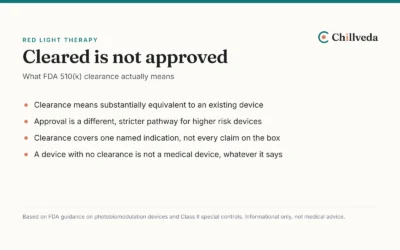
If a device makes a medical claim, check whether it actually holds FDA clearance for that indication. We explain what clearance does and does not mean in cleared is not approved.
Who should skip the specification chase
If you are buying your first device, the irradiance arms race is not where your attention belongs. Coverage area, session length, eye protection, and whether the thing fits your room and your routine will decide whether you use it at all.
And if a brand’s entire pitch is one very large number with no distance attached, that tells you what kind of company you are dealing with before you have read anything else.



Write Your Review
No reviews yet. Be the first to share your experience!