


Red light panels are sold by their wavelengths. You will see 660 and 850 on almost every box, sometimes 630 and 810 alongside them, and occasionally a list of five or six numbers presented as though more is obviously better.
This guide explains what those numbers are, why manufacturers picked them, and how to read a wavelength specification without reading more into it than is there.
This article is informational and is not medical advice. Please read our Medical Disclaimer, and use the eye protection your device’s manufacturer supplies.
What a nanometre figure tells you
A nanometre is a unit of wavelength, and wavelength determines the colour of light and how it behaves when it meets tissue. It is a physical property, not a performance rating.
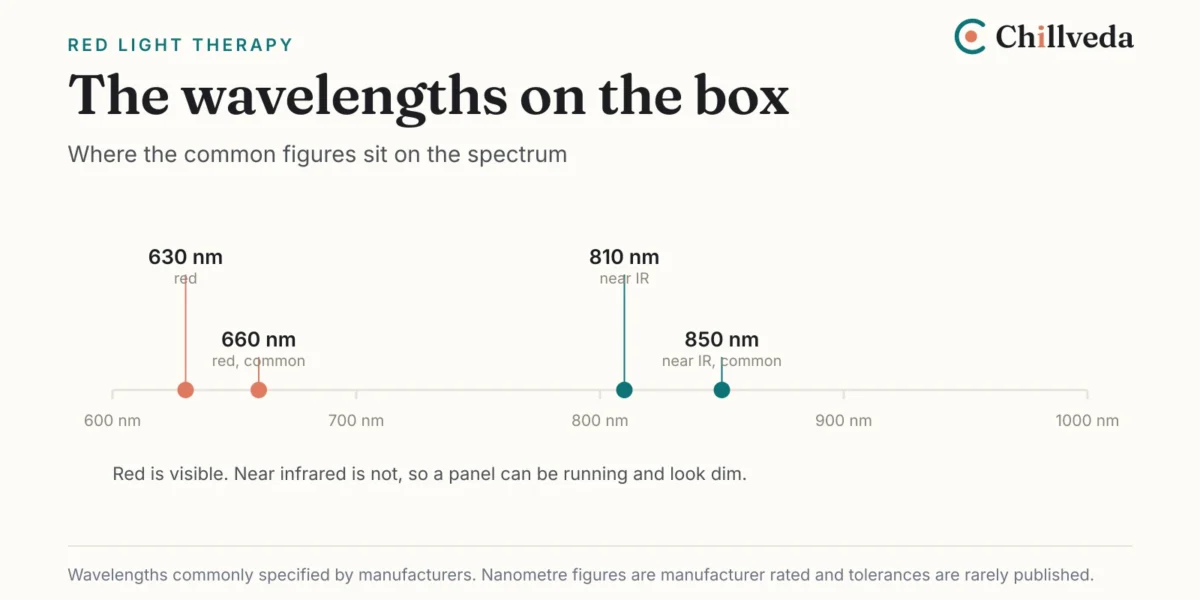
The chart above shows where the common figures sit. Everything up to roughly 700 nm is visible red. Above that is near infrared, which your eye cannot see at all. That single fact causes a lot of confusion: a panel running only near infrared emitters can look dim or almost off while drawing full power.
Why 660 and 850
These two dominate consumer devices, and the reason is largely historical. Much of the published research on photobiomodulation used sources in these regions, so device makers followed the literature, and diodes at these wavelengths became cheap and widely available because everyone was buying them.
That is a reasonable basis for a product decision. It is not the same as evidence that a specific panel at 660 nm will do something specific for you, and we are careful not to blur the two.
Red and near infrared differ in how deeply they travel into tissue, which is why devices often combine them. How much deeper, and what that means in practice, is less settled than the marketing suggests.
The specification games to watch for
More wavelengths is not automatically better
A panel advertising six wavelengths has divided its emitter count across six bands. If two of those bands are the ones you care about, you may be getting less output in them than from a simpler panel that commits its diodes to two. Count the emitters per band, not the number of bands on the box.
Tolerance is almost never published
A diode specified at 660 nm is manufactured to a tolerance, commonly plus or minus ten nanometres or more, and cheaper components have wider spread. Brands rarely publish the tolerance. Treat every nanometre figure as manufacturer rated, the same way you should treat the irradiance number.
The peak is not the whole output
A diode does not emit one single wavelength. It emits across a small band with a peak, and the quoted figure is the peak. Two panels quoting 850 nm can have differently shaped output curves.
What actually matters when choosing
Coverage area first. A panel that does not cover the part of you that you bought it for is the wrong panel, whatever its spectrum.
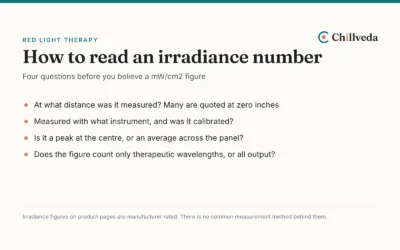
Then the honesty of the specification sheet. A brand that publishes wavelengths with tolerances, irradiance with a stated distance, and a third party measurement report is telling you something about how it operates. Our guide to reading an irradiance number covers the other half of this.
Then the practical things: mounting, fan noise, session length, eye protection, and warranty. Our red light therapy coverage weighs these together rather than ranking on spectrum alone.
What we are not going to tell you
You will find pages that assign specific outcomes to specific wavelengths with great confidence. We do not, because the research does not support that level of precision for consumer devices, and because claiming otherwise would be exactly the kind of statement the Federal Trade Commission takes an interest in.
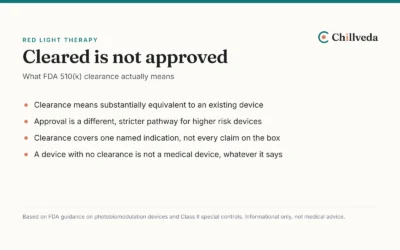
Chillveda does not claim that any wavelength treats, prevents, or cures anything. Where we refer to research we say what it found and what its limits were. Our Editorial Policy sets out the rule we work to, and cleared is not approved explains what regulatory status actually means for these devices.
Eye safety
Near infrared is invisible, so the usual blink and aversion response that protects your eyes from bright light does not happen. Do not look into an illuminated array, use the eye protection supplied with the device, and be more careful with near infrared than instinct suggests, precisely because it does not look bright.
Take extra care if you have a photosensitive condition or take medication that increases light sensitivity, and speak to a clinician first.
The short version
660 nm is red and visible. 850 nm is near infrared and is not. Most consumer panels use one or both because that is what the research used and what the supply chain makes cheaply. Every number on the box is a manufacturer rated peak with an unpublished tolerance, and the count of wavelengths on a spec sheet tells you almost nothing on its own.







Write Your Review
No reviews yet. Be the first to share your experience!